


Developers need a hosting environment that gives them control over software, server settings, and resources. This is one reason many developers prefer Linux VPS for development and production workloads. A Linux VPS provides the flexibility of a private server while keeping infrastructure costs lower than a dedicated server. Developers can install the tools they need, configure the operating system, manage applications, and adjust resources as projects grow. Linux also supports a wide range of programming languages, frameworks, databases, and open-source tools, making it a practical choice for modern development and deployment.
What Is Linux VPS Hosting?
A Linux VPS is a virtual private server that runs on a Linux operating system. If you're new to the platform, it helps to start with a primer on what Linux is before diving into server administration. A VPS operates in an isolated environment with allocated CPU, RAM, storage, and network resources. Unlike shared hosting, a VPS gives developers greater control over the server. They can access it through SSH, install software, configure services, and adjust the environment for their applications. Linux also supports several distributions, such as Ubuntu, Debian, and AlmaLinux. Developers can choose one based on their project requirements, software compatibility, and Linux experience.
Why Developers Choose Linux VPS Hosting?
Developers prefer Linux VPS because it provides control, flexibility, predictable resources, and access to a large open-source ecosystem. These benefits are useful throughout development and deployment. A VPS can also provide a practical middle ground between shared hosting and dedicated servers. Developers get more control without taking on the full cost of physical hardware.
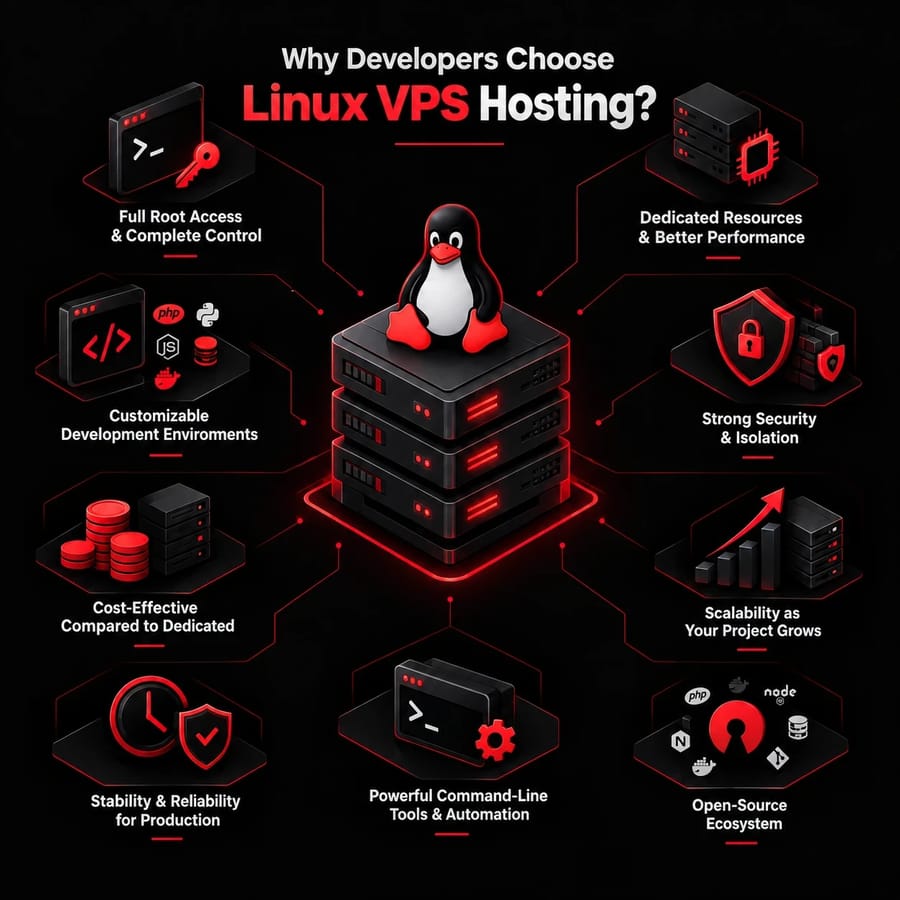
Full Root Access and Complete Control
Root access allows developers to manage the VPS at the server level. They can install required software, modify configurations, create users, and manage services. Understanding sudo privileges is essential for anyone working with root-level access, since it defines how administrative rights are delegated without sharing the root account itself. This is particularly useful when an application needs specific packages, programming language versions, databases, or server configurations that shared hosting does not support. Developers can also configure security rules, manage file permissions, and control which services run on the server. However, root access comes with responsibility. Poor configurations, weak passwords, or outdated software can create security and performance problems.
Dedicated Resources and Improved Performance
A Linux VPS provides allocated resources such as CPU, RAM, and storage. This gives developers more predictable performance than a typical shared hosting environment. Resource requirements vary between applications. A small API may need limited resources, while databases, containers, and large applications can require considerably more CPU and memory.
A VPS is useful when developers need a consistent environment for:
- Application testing
- Database workloads
- Web applications
- APIs
- Build processes
- Staging environments
The actual performance still depends on the VPS configuration, virtualization technology, storage type, and underlying infrastructure.
Highly Customizable Development Environments
Developers often work with different programming languages, frameworks, databases, and deployment tools. A Linux VPS lets them configure the environment around those specific requirements. For example, developers can install PHP, Python, Node.js, PostgreSQL, MySQL, Docker, Nginx, or other software needed by their application. If you're new to the process, our guide on how to install packages in Linux covers the different methods available. This flexibility also makes it easier to maintain separate development, testing, staging, and production environments. Instead of adapting an application to a fixed hosting setup, developers can configure the server to match the application's technical requirements.
Strong Security and Isolation
A VPS provides an isolated environment, giving developers greater control over server-level security. They can manage access, permissions, firewall rules, and installed software. Linux also provides a mature permission system that helps control access to files, directories, processes, and system resources. For a broader look at the topic, our Linux server security guide covers the fundamentals that apply to any VPS.
Developers can improve server security by using measures such as:
- SSH key authentication
- Firewall rules
- Regular security updates
- Strong user permissions
- Malware and intrusion monitoring
- Regular backups
A VPS is not automatically secure, though. Developers must properly configure and maintain the server, especially when using an unmanaged plan.
Cost-Effective Hosting Compared With Dedicated Servers
Dedicated servers provide access to an entire physical machine, but many development projects do not require that much infrastructure from the beginning. A Linux VPS provides many of the controls developers need while using virtualized resources. This can make it more affordable than renting dedicated hardware. Linux distributions are also generally open source, which can reduce operating system licensing costs. This makes VPS hosting practical for developers and smaller teams. That said, if a project eventually outgrows a VPS, a Linux dedicated server is the natural next step when full hardware control matters.
Scalability as Your Project Grows
Application requirements can change as traffic, users, databases, and workloads increase. A VPS makes it possible to move to a larger resource configuration when the project needs more capacity. For example, a development project might begin with a small amount of RAM and CPU. As the application grows, additional resources can be added depending on the provider's upgrade options. This allows developers to scale infrastructure without immediately moving to a dedicated physical server.
Stability and Reliability for Production Workloads
Linux is widely used for server workloads because it provides a stable environment for applications and services that need to run continuously. Developers can configure a Linux VPS for web applications, APIs, databases, background jobs, and other production services. However, reliability depends on more than the operating system. Hardware quality, network infrastructure, backups, monitoring, application configuration, and the hosting provider also matter.
Powerful Command-Line Tools and Automation
Linux provides powerful command-line tools that developers can use to manage servers remotely. SSH makes it possible to connect to a VPS and perform administrative tasks without requiring a graphical interface. Developers can use commands and scripts to install packages, manage files, inspect logs, monitor processes, and restart services. If you're new to the shell, our roundup of basic Linux commands is a good starting point. Command-line management also fits well with automated development workflows. Tasks such as deployments, backups, testing, and server configuration can be integrated into scripts and CI/CD pipelines.
Ideal Platform for Modern Open-Source Stacks
Linux has a large open-source ecosystem that supports many popular programming languages, frameworks, databases, and development tools. Common technologies used with Linux include PHP, Python, Node.js, MySQL, PostgreSQL, Nginx, Apache, Git, and Docker. This broad software support gives developers more freedom when building an application. They can combine different technologies instead of being restricted to a predefined hosting stack.
Popular Linux Distributions for Developers
Linux is available through different distributions, and each one has its own packages, release cycles, tools, and support models. Each Linux distribution makes different trade-offs, and the right one depends on the application's requirements and the developer's experience. Compatibility and long-term support should also be considered before making a choice. If you want a broader overview first, our roundup of the best Linux distros covers the landscape.
Ubuntu
Ubuntu is a popular Linux distribution among developers because it has extensive documentation, a large community, and broad software support. It can be a practical option for developers who are new to Linux server administration. Many development tools and tutorials also provide Ubuntu-specific instructions. If you want to start on a ready-made environment, an Ubuntu VPS is a solid default. Package management on Ubuntu is driven by apt-get, which is worth knowing well.
Debian
Debian is known for its stability and large software repository. It is commonly used for server environments where predictable system behavior is important. Developers can use Debian to build customized environments for websites, APIs, databases, and other applications while maintaining control over installed services.
CentOS / AlmaLinux
CentOS has historically been common in server environments, particularly those using Enterprise Linux-based software and tools.
AlmaLinux provides a compatible Enterprise Linux alternative and can be useful for applications that require this type of server environment. If you want a ready-to-deploy environment, an AlmaLinux VPS gives you the Enterprise Linux toolchain out of the box, and a Rocky Linux VPS delivers the same lineage with a slightly different governance model.
Before selecting either distribution, developers should check current support status, application compatibility, package availability, and project requirements.
Linux VPS for Web Development
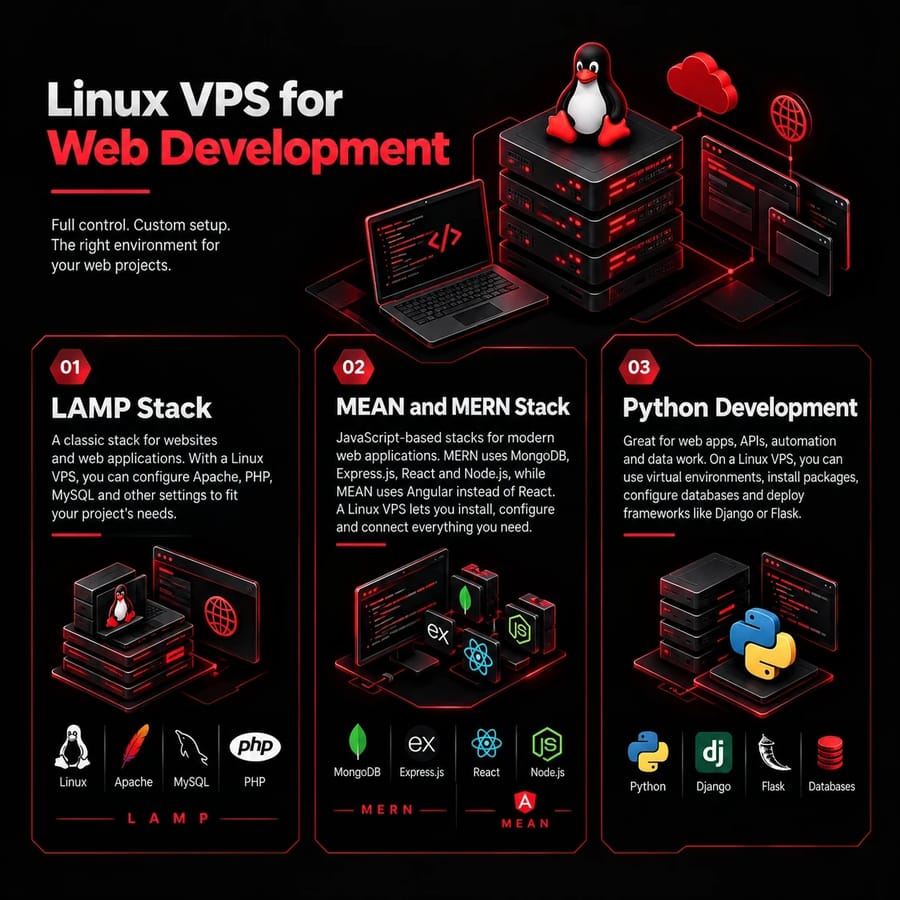
Linux VPS hosting is suitable for web development because developers can install and configure the complete software stack required by their applications. This is useful for projects that need more control than standard shared hosting can provide.
LAMP Stack
LAMP stands for Linux, Apache, MySQL, and PHP. It is a long-established stack used for websites and web applications. With a Linux VPS, developers can configure Apache, PHP, MySQL, permissions, and other server settings according to their application's needs.
MEAN and MERN Stack
MEAN and MERN are JavaScript-based development stacks used for building modern web applications. MERN commonly includes MongoDB, Express.js, React, and Node.js, while MEAN uses Angular instead of React. A Linux VPS allows developers to install Node.js, configure the application, connect databases, and use a web server or reverse proxy as required.
Python Development
Python is widely used for web applications, APIs, automation, and data-related workloads. Linux provides a flexible environment for running Python projects. Developers can create virtual environments, install required packages, configure databases, and deploy frameworks such as Django or Flask on a Linux VPS.
Linux VPS for DevOps and Modern Development
Linux VPS hosting also works well with modern DevOps practices. Developers can use a VPS for testing, staging, automated deployments, containers, and infrastructure management. Tools such as Docker, Jenkins, GitHub Actions, Ansible, and Terraform can be integrated into development workflows based on project requirements. For example, a team can use a VPS as a staging server and connect it to a CI/CD pipeline. Code can then be tested and deployed through an automated workflow.
Managed vs Unmanaged Linux VPS
The choice between managed and unmanaged Linux VPS depends on how much server administration the developer wants to handle.
Managed Linux VPS
- Provider handles selected management tasks
- Less Linux administration required
- Easier for teams with limited server expertise
- Usually costs more
- Less time spent on routine maintenance
Unmanaged Linux VPS
- Developer handles server administration
- More Linux knowledge required
- Better suited to experienced administrators
- Usually costs less
- Greater hands-on control
Managed Linux VPS
With managed VPS hosting, the provider handles some server administration tasks. Depending on the service, this may include updates, monitoring, backups, security assistance, or technical support. Managed hosting can allow developers to spend more time building applications instead of handling routine server maintenance. The exact level of management differs between providers, so developers should check what is actually included before choosing a plan.
Unmanaged Linux VPS
With an unmanaged VPS, the developer is responsible for most server administration tasks. This provides more hands-on control but requires stronger Linux knowledge. Typical responsibilities can include installing software, managing users, configuring firewalls, applying updates, monitoring resources, and troubleshooting server problems. Unmanaged hosting can be a good choice for experienced developers who are comfortable managing Linux servers themselves.
Best Use Cases for Linux VPS Hosting
Linux VPS hosting can support a wide range of development and production workloads.
Some common use cases include:
- Web applications and websites
- SaaS applications
- REST APIs
- Development and staging environments
- Database-driven applications
- E-commerce applications
- DevOps and automation workloads
- Testing environments
The required VPS configuration depends on the workload. A small development project may need fewer resources than a production SaaS application with a large database and multiple services.
How to Choose the Right Linux VPS for Development
Choosing the right Linux VPS requires more than comparing monthly prices. Developers should consider the application's technical requirements, expected workload, and future growth. If you'd rather start from a curated list, our guide on the best VPS for developers breaks down what to look for.
Choose the Right Linux Distribution
Start by selecting a distribution that supports your required software and fits your Linux experience. Ubuntu may be convenient for beginners, while Debian and AlmaLinux can be suitable for developers with specific stability or Enterprise Linux requirements.
Consider CPU, RAM, and Storage
CPU, RAM, and storage directly affect how well a VPS handles its workload. Developers should estimate resource requirements based on their application rather than choosing a plan only because it is inexpensive. For example, databases and multiple containers can require more RAM, while application builds and processing tasks may benefit from additional CPU resources.
SSD or NVMe storage can also be important for applications that perform frequent read and write operations.
Check Server Location and Network Performance
Server location can affect latency between users and the application. Developers should consider where most users are located when choosing a VPS data center. Network performance also matters for applications that handle frequent requests, APIs, remote development, or large amounts of data.
Consider Scalability and Support
Development requirements can change after deployment, so it is useful to choose a provider that offers straightforward resource upgrades. Support is also worth considering, particularly when the development team does not have dedicated server administration experience.
Check the provider's:
- Upgrade options
- Support availability
- Backup options
- Data center locations
- Management services
- Monitoring features
Review Pricing and Overall Value
Price should be compared with the complete set of resources and services included in the VPS plan. Look at CPU, RAM, storage, bandwidth, backups, support, management options, and upgrade costs before making a decision. For example, developers can compare providers such as 1Gbits based on their actual project requirements rather than choosing a VPS solely on advertised price.
Conclusion
Developers prefer Linux VPS because it gives them greater control over their server environment without requiring the cost of a complete dedicated server. Root access, customizable configurations, allocated resources, command-line tools, security controls, and the open-source ecosystem make Linux VPS suitable for many development workflows. It can support web applications, APIs, SaaS platforms, databases, staging environments, and DevOps workloads. The right choice ultimately depends on the project's resources, Linux distribution, server location, scalability needs, and level of technical expertise.
If you're still comparing providers, start with our roundup of the best Linux VPS providers to match specs against your workload. When you're ready to deploy, an Linux VPS or an AlmaLinux VPS gives you a ready-made environment that matches the distributions covered above — with full root access and the same stack you'd build yourself.
People are also reading:

Leave A Comment