
Artificial intelligence is becoming more demanding every year. From training large language models and running generative AI applications to processing real-time data, modern AI workloads require significant computing power, memory, storage, and network performance.
While virtual machines and shared cloud infrastructure can support many workloads, they may not always deliver the consistent performance required for compute-intensive AI applications. This is where bare metal hosting becomes an important option.
Bare metal servers provide dedicated physical hardware without a virtualization layer between the operating system and the underlying resources. Organizations can access the full processing power of CPUs, GPUs, memory, storage, and networking hardware. This makes bare metal infrastructure particularly suitable for AI training, machine learning, deep learning, inference, and other high-performance computing workloads.
In this guide, we explore what makes bare metal hosting different, why AI workloads benefit from dedicated servers, the top bare metal hosting providers in 2026, and how to choose the right infrastructure for your AI projects.
What Makes Bare Metal Hosting Different?
Bare metal hosting provides access to an entire physical server dedicated to a single customer. Unlike traditional virtualized cloud environments, server resources are not divided between multiple virtual machines or tenants. For a deeper explanation, see what is a bare metal hypervisor and how it differs from bare metal vs dedicated server.
With a dedicated server, you typically receive dedicated access to:
- CPU resources
- GPU hardware
- RAM
- Storage
- Network interfaces
- Server-level configuration options
The absence of a hypervisor layer can reduce virtualization overhead and provide more predictable access to hardware resources. For a comparison with virtualized environments, see bare metal server vs VPS.
This approach is particularly useful when applications require consistent performance. AI workloads can consume large amounts of compute power and memory for extended periods, making dedicated infrastructure an attractive option.
Bare metal hosting also gives organizations greater flexibility when configuring their environment. Depending on the provider, users may be able to select specific processors, GPUs, RAM capacity, storage configurations, operating systems, and networking options.
For AI teams that need predictable infrastructure rather than dynamically shared resources, bare metal servers can provide greater control over the computing environment.
Why AI Workloads Demand Bare Metal Servers
AI applications are not all the same. A small machine learning model may run effectively on standard cloud infrastructure, while training a large language model can require multiple high-performance GPUs, large memory pools, and high-bandwidth networking.
Bare metal servers are designed to support demanding workloads where performance consistency and direct access to hardware are important.
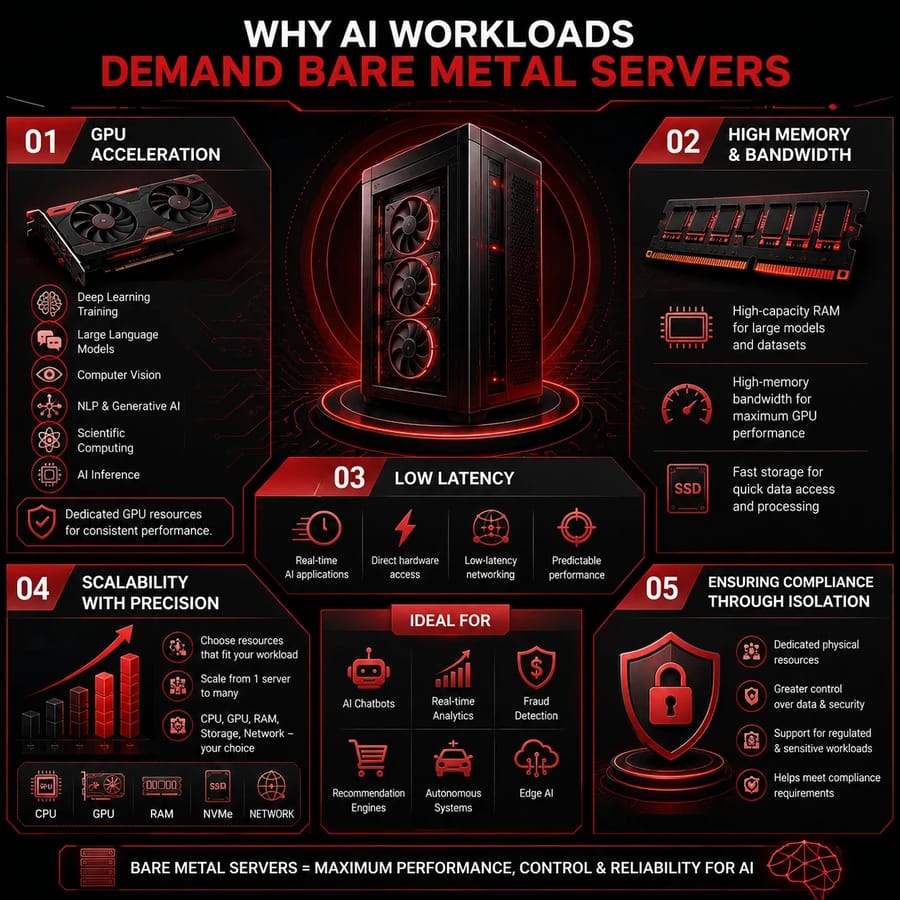
GPU acceleration
GPUs play a major role in modern AI infrastructure. Unlike traditional CPUs, GPUs contain many processing cores that can perform large numbers of calculations in parallel.
This parallel processing capability makes GPUs particularly useful for workloads such as:
- Deep learning model training
- Large language models
- Computer vision
- Natural language processing
- Generative AI
- Scientific computing
- AI inference
A dedicated bare metal server can provide direct access to GPU hardware without requiring workloads to share GPU resources with other tenants.
For organizations training large models or processing high volumes of AI requests, dedicated GPU resources can help deliver more predictable performance.
High memory and bandwidth
AI workloads often require substantial amounts of system RAM and GPU memory.
Large models need memory for:
- Model parameters
- Training datasets
- Intermediate calculations
- Batch processing
- Cached data
- Inference operations
Memory bandwidth is also important. A powerful GPU may not perform at its full potential if data cannot move efficiently between storage, memory, CPUs, and GPUs.
Bare metal servers can be configured with high-capacity memory and high-performance storage, allowing organizations to build infrastructure around their specific workload requirements.
Low latency
Latency can be a major concern for AI applications that need to process requests in real time.
Examples include:
- AI chatbots
- Fraud detection systems
- Recommendation engines
- Autonomous systems
- Real-time analytics
- Edge AI applications
Virtualized infrastructure can introduce additional layers between an application and physical hardware. Bare metal servers provide direct access to the underlying system, helping organizations create environments with more predictable performance characteristics.
Low-latency networking can also be important when AI workloads are distributed across multiple servers or GPUs.
Scalability with precision
AI infrastructure needs can change quickly. A development team may initially need one GPU server for experimentation and later require multiple servers for model training or large-scale inference. Bare metal hosting allows organizations to choose infrastructure configurations based on specific workload requirements.
For example, one project may require:
- High-core-count CPUs
- Large RAM capacity
- Multiple GPUs
- NVMe storage
Another may prioritize:
- High GPU memory
- Fast networking
- Distributed computing
- Geographic proximity to users
This ability to configure infrastructure more precisely can help organizations avoid paying for resources that do not match their workload.
Ensuring compliance through isolation
Many organizations working with AI handle sensitive or regulated information.
This can include:
- Financial data
- Healthcare information
- Customer records
- Enterprise data
- Proprietary machine learning models
Bare metal servers provide physical resource isolation because the server is dedicated to a single customer. This infrastructure model can support organizations that require greater control over where their workloads run and how their infrastructure is configured. For hardening your environment, see bare metal server security and bare metal server backup.
However, compliance depends on more than server isolation. Organizations must also consider data encryption, access controls, monitoring, backups, regional requirements, and the specific certifications offered by their infrastructure provider.
Use Cases for Bare Metal Hosting in AI
Bare metal infrastructure supports a wide range of demanding artificial intelligence workloads, from model training and inference to data processing and analytics.
Training Large Language Models (LLMs)
Training large language models requires significant computing resources. The process involves processing large datasets and performing billions or trillions of mathematical operations. Depending on the model size, organizations may need powerful GPUs, large amounts of memory, high-speed storage, and fast networking between systems.
Bare metal GPU servers can provide dedicated resources for these workloads.
They can be useful for:
- Training custom language models
- Fine-tuning existing models
- Running open-source LLMs
- Processing large datasets
- Experimenting with deep learning architectures
Organizations can also build multi-server environments when a single machine does not provide enough GPU capacity.
Real-Time Inference at the Edge
Training is only one part of the AI lifecycle. Once a model is trained, it must often process real-world requests.
This process is known as inference.
Examples include:
- AI-powered search
- Customer support bots
- Image recognition
- Video analysis
- Fraud detection
- Product recommendations
For real-time applications, reducing the distance between users and AI infrastructure can help improve response times. Bare metal servers deployed in strategically selected data center locations can support edge-oriented AI infrastructure where predictable hardware performance and low latency are priorities.
Federated Learning and Distributed AI
Some AI projects use multiple systems to process data or train models.
Distributed AI environments may require:
- Multiple GPU servers
- High-speed networking
- Data synchronization
- Large storage capacity
- Consistent compute performance
Federated learning can also involve training models across distributed environments while keeping certain data localized.
Bare metal infrastructure can provide dedicated resources for each node in a distributed architecture. Organizations can select server configurations based on the role of each system, such as training, inference, storage, or data processing.
AI in Regulated Industries
Industries such as healthcare, finance, government, and enterprise technology often have stricter requirements for infrastructure and data management. AI applications in these industries may process sensitive information and require organizations to maintain greater control over their computing environment.
Dedicated bare metal servers can support:
- Private AI environments
- Secure model training
- Enterprise machine learning
- Data processing
- Internal AI assistants
The level of compliance achieved will depend on the provider, deployment architecture, geographic location, and the security controls implemented by the organization.
Top Bare Metal Hosting Providers for AI Workloads
Choosing the right bare metal hosting provider depends on your AI workload, required hardware, GPU availability, budget, scalability, and preferred server locations. Below are some providers that offer infrastructure suitable for AI, machine learning, and other high-performance computing workloads.
1. 1Gbits
1Gbits provides dedicated server solutions designed for businesses and developers that require high-performance computing resources. AI and machine learning workloads often demand powerful CPUs, high RAM capacity, fast NVMe storage, GPU resources, and reliable network connectivity. With configurable dedicated server options, 1Gbits can be considered for AI projects that require infrastructure tailored to specific workload requirements. Businesses should evaluate CPU performance, GPU availability, memory capacity, storage speed, bandwidth, server location, scalability, and technical support before selecting a configuration. The best server setup should match the requirements of the AI model rather than simply offering the highest available specifications.
2. Atlantic.Net
Atlantic.Net provides dedicated servers and cloud infrastructure for businesses that require reliable computing resources. Its infrastructure can support organizations looking for dedicated environments for demanding applications, including data-intensive and AI-related workloads. When considering Atlantic.Net for AI, users should review available processor options, RAM capacity, storage performance, networking capabilities, security features, and managed service options. The right configuration will depend on whether the workload focuses on AI training, inference, data processing, or general machine learning applications.
3. IONOS
IONOS offers cloud and dedicated infrastructure solutions for businesses of different sizes. Its services can be considered by organizations looking for dedicated computing resources and flexible deployment options. For AI workloads, businesses should compare the available server hardware based on their specific requirements. Important factors include CPU performance, memory capacity, storage speed, networking, GPU availability, and scalability. Choosing the right configuration can help ensure that the infrastructure supports both current and future workload demands.
4. CoreWeave
CoreWeave specializes in infrastructure designed for GPU-intensive computing and is particularly relevant for organizations working with advanced AI applications.
Its infrastructure can support workloads such as:
- Generative AI
- Machine learning
- Large language models
- Deep learning
- AI model training
- AI inference
Organizations considering CoreWeave should evaluate GPU availability, memory capacity, scalability, networking architecture, and pricing based on their specific AI requirements.
5. OpenMetal
OpenMetal provides dedicated infrastructure and private cloud solutions for organizations that require greater control over their computing environment. Its infrastructure can be suitable for businesses looking to build customized environments for AI, machine learning, high-performance computing, or data-intensive applications. Before selecting a configuration, organizations should evaluate available hardware, storage, networking, deployment flexibility, and infrastructure management capabilities.
6. Latitude.sh
Latitude.sh provides bare metal infrastructure with a focus on automation, flexibility, and rapid server deployment. It can be useful for developers and businesses that require dedicated servers across different geographic locations. For AI workloads, users should evaluate the available hardware configurations, GPU options, memory capacity, network performance, and regional availability. Programmatic infrastructure management can also be valuable for teams that need to deploy and manage servers efficiently.
7. IBM Cloud
IBM Cloud provides bare metal infrastructure alongside enterprise-focused cloud and hybrid infrastructure solutions. It can be relevant for organizations that require dedicated computing resources combined with enterprise-level infrastructure capabilities. AI teams should evaluate available server configurations, processor performance, memory capacity, accelerator options, networking, and integration with other cloud services. It may be particularly suitable for larger organizations with complex infrastructure and hybrid deployment requirements.
8. AWS
AWS offers a broad range of cloud computing services, including dedicated infrastructure and high-performance compute options for demanding workloads. Its ecosystem includes services for data storage, analytics, machine learning, and AI application deployment. Organizations already using AWS may benefit from integrating AI infrastructure with other services within the platform. However, businesses should carefully compare available compute and GPU options, scalability, data transfer costs, and overall pricing, especially for long-running AI workloads.
9. Oracle Cloud Infrastructure
Oracle Cloud Infrastructure offers bare metal and GPU-focused compute options for organizations running demanding applications. Its infrastructure can support AI workloads that require dedicated computing resources, high-performance networking, and scalable cloud services. Businesses should evaluate available CPU and GPU configurations, memory capacity, storage performance, network capabilities, data center locations, and pricing. Comparing these factors with the requirements of the AI model can help organizations select an appropriate infrastructure setup.
How Much Does Bare Metal AI Hosting Cost?
Dedicated server pricing varies depending on the GPU, CPU, RAM, storage, bandwidth, server location, and contract length. High-performance GPU servers generally cost more because AI workloads require specialized hardware.
The main factors affecting AI bare metal hosting costs include:
- GPU and VRAM: Higher-end GPUs and larger VRAM capacities increase hosting costs.
- CPU and RAM: Powerful processors and larger memory configurations add to the overall price.
- Storage: High-performance NVMe storage can increase costs, especially for large AI datasets.
- Bandwidth: High-speed networking and higher bandwidth limits may affect pricing.
- Server location: Data center location can influence infrastructure and operating costs.
- Billing model: Monthly, hourly, reserved, and long-term pricing can have different costs.
Instead of choosing the most expensive server, select a configuration that matches your AI workload, performance requirements, and budget. This helps balance performance and overall hosting costs.
Choosing the Right Provider for Bare Metal Dedicated Servers
Choosing the best bare metal hosting provider for AI requires more than comparing CPU specifications. The right provider should match your technical and operational requirements. For a structured approach, see how to choose a bare metal server provider.
Evaluate your AI workload
Start by understanding what you plan to run.
Ask questions such as:
- Are you training or running inference?
- What framework are you using?
- How large is the model?
- How much GPU memory is required?
- How many users will access the application?
- Do you need multiple servers?
A small inference application and a large language model training environment have very different infrastructure requirements.
Check GPU availability
The GPU is often one of the most important components for AI workloads.
Compare:
- GPU architecture
- GPU memory
- Number of GPUs per server
- Interconnect capabilities
- Availability
- Pricing model
More powerful hardware is not always necessary. The best GPU depends on the model, framework, dataset, and expected workload.
Consider memory and storage
Insufficient RAM can become a bottleneck during data processing and model training.
Storage performance is also important when working with large datasets.
Look for infrastructure that provides:
- Sufficient RAM
- NVMe storage
- High I/O performance
- Expandable storage options
- Backup capabilities
Review network performance
Distributed AI workloads may require fast communication between servers.
Consider:
- Network bandwidth
- Latency
- Private networking
- Data transfer costs
- Geographic locations
Network limitations can affect the performance of multi-server AI environments.
For workloads that require sustained data transfer, unmetered dedicated servers can be another infrastructure option to consider.
Compare pricing carefully
AI infrastructure can become expensive, especially when GPU resources are used continuously.
Compare:
- Hourly pricing
- Monthly pricing
- Long-term commitments
- Bandwidth charges
- Setup fees
- Support costs
The cheapest option is not always the most cost-effective. A lower-priced server that creates performance bottlenecks can increase the overall cost of an AI project.
Check scalability options
Your infrastructure requirements may increase as your AI application grows.
Choose a provider that can support future requirements, such as:
- Additional GPU servers
- Higher RAM configurations
- More storage
- Additional geographic locations
- Private networking
Common Mistakes When Choosing a Provider
Selecting infrastructure without properly evaluating workload requirements can create performance and cost problems.
Here are some common mistakes to avoid.
Choosing hardware based only on CPU specifications
AI workloads often rely heavily on GPU performance, so choosing a server based only on CPU specifications can create bottlenecks. Evaluate GPUs, RAM, storage, and networking.
Ignoring GPU memory
GPU performance alone is not enough, as insufficient VRAM can prevent AI models from running effectively. Calculate your model's memory requirements before selecting a server configuration.
Underestimating data transfer needs
Large AI datasets require significant data movement, making it important to evaluate upload and download speeds, bandwidth limits, and potential data transfer costs.
Choosing the wrong server location
The distance between users, data sources, and AI infrastructure can increase latency. Choose a data center location based on where your application and users are located.
Overprovisioning resources
Buying the most powerful server is not always necessary. Choose a configuration that matches your current AI workload requirements and scale resources as demand grows.
Ignoring support and infrastructure management
Hardware problems, network issues, and configuration challenges can affect AI operations. Consider the level of technical support and infrastructure management available with managed dedicated servers.
Why Choose 1Gbits for AI Bare Metal Hosting?
AI workloads require infrastructure that can be configured around specific performance requirements. 1Gbits is worth considering for organizations that need dedicated server resources for demanding workloads such as artificial intelligence, machine learning, data processing, and other compute-intensive applications.
A suitable AI infrastructure environment should provide the flexibility to evaluate and configure resources based on:
- Processing requirements
- GPU needs
- RAM capacity
- Storage performance
- Network bandwidth
- Data center location
Instead of treating every AI project the same, organizations should select hardware based on the requirements of their models and applications.
Whether you are developing a machine learning application, processing large datasets, running AI inference, or building a more demanding AI environment, dedicated infrastructure can provide the control and resource consistency needed for specialized workloads.
Before deployment, it is important to discuss your technical requirements with the provider and select a server configuration that aligns with your workload and growth plans.
Conclusion
Choosing the best bare metal hosting for AI workloads in 2026 depends on your specific performance, GPU, memory, storage, networking, and scalability requirements. Bare metal servers provide dedicated resources, making them suitable for demanding AI applications such as model training, inference, deep learning, and large-scale data processing. Providers like 1Gbits and other leading infrastructure companies offer different configurations to meet varying workloads and budgets. Before making a decision, compare GPU availability, VRAM, server locations, bandwidth, pricing, support, and scalability. Selecting infrastructure based on your actual AI requirements can help avoid unnecessary costs while delivering reliable, consistent, and efficient performance for your projects.

Leave A Comment