

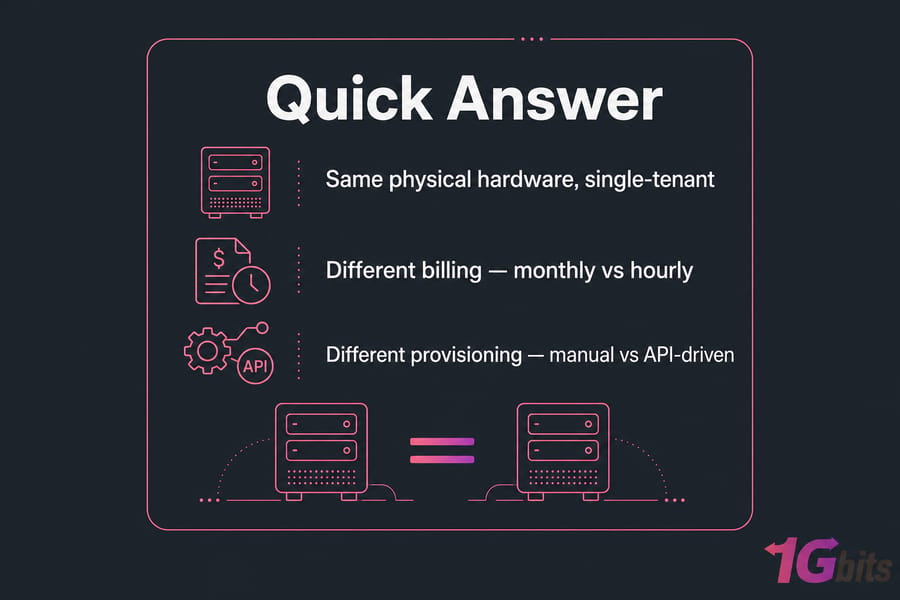
Short answer: yes, mostly. A bare metal server and a dedicated server are functionally identical a single-tenant physical machine with no hypervisor sitting between you and the hardware. Where they part ways is commercial: "dedicated server" usually means a monthly contract and traditional provisioning, while "bare metal" tends to imply hourly billing, API-driven deployment, and a cloud-style consumption model.
Same hardware. Same isolation. Different billing, different provisioning speed, different vendor culture.
Keep reading for the full breakdown — including where the terminology actually matters when you're writing the check.
What Is a Dedicated Server? Definition and Core Characteristics
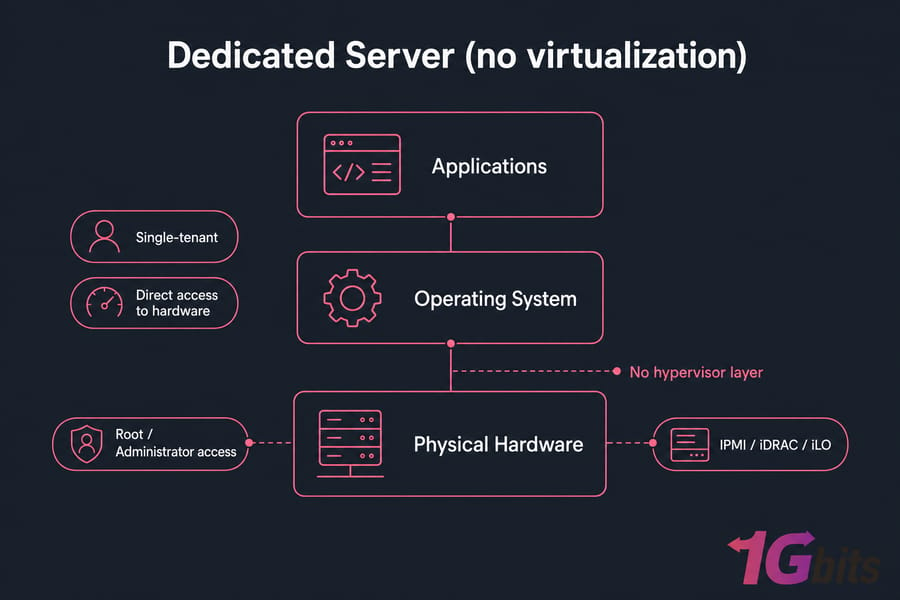
A dedicated server is a physical machine that belongs to one customer. You. Nobody else. No virtualization layer, no neighbors, no shared CPU cycles — just an actual box in a rack with your operating system installed directly on it.
I've been deploying these since the days when "dedicated" was the only word anyone used. The model is straightforward: a provider racks the hardware, hands you root access via SSH (or Administrator on Windows), and gives you out-of-band management through IPMI, iDRAC (Dell), or iLO (HPE) so you can reboot or reinstall without calling support.
How traditional dedicated server hosting works
You pick a config from the provider's inventory — say, an Intel Xeon E-2388G with 32GB DDR4 ECC and a pair of NVMe drives in RAID 1. The provider provisions the box, installs your chosen OS (Ubuntu, Debian, AlmaLinux, Windows Server), and emails you the credentials. Provisioning historically took 24–48 hours, though "instant deploy" providers have crushed that down to minutes.
Want the full primer? Here's what is a dedicated server, broken down piece by piece.
Typical specs, billing, and contract terms
Traditional dedicated server hosting is built around monthly contracts. Sometimes annual, with a discount. Pricing usually lands somewhere between $85/mo for entry-level configs and $500+/mo for high-core EPYC boxes with NVMe arrays.
- Tenancy: single-tenant — you own the entire machine
- Access: full root, IPMI/iDRAC for out-of-band recovery
- Billing: flat monthly or annual
- Hardware: Intel Xeon, AMD EPYC/Ryzen, ECC RAM, RAID, NVMe/SAS/SATA
So that's a dedicated server. Now let's see why "bare metal" became a thing.
What Is a Bare Metal Server? Meaning and Origin of the Term
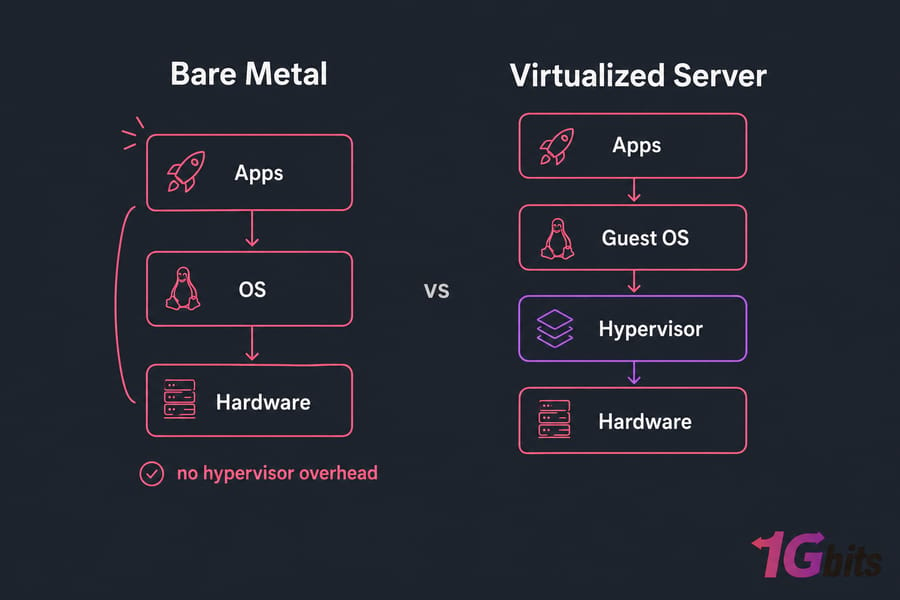
"Bare metal" literally means the OS is installed directly on the hardware — on the bare metal of the machine — with no virtualization layer in between. Which, if you've been paying attention, is exactly the definition of a dedicated server.
So why the new word?
Why the industry started using "bare metal"
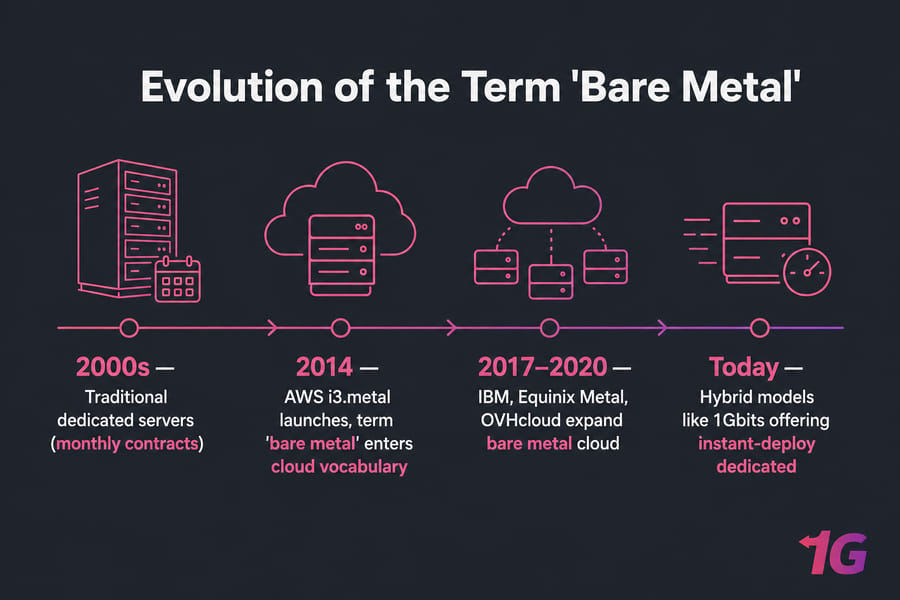
Around 2014, AWS launched i3.metal, and the cloud crowd needed a way to distinguish single-tenant physical instances from the virtual EC2 boxes they'd been selling for years. "Dedicated server" was already taken by traditional hosts (and felt dated), so "bare metal" stuck. IBM Cloud, Equinix Metal, OVHcloud, and others adopted the term for the same reason — to signal "physical hardware, but cloud-style consumption."
Bare metal cloud vs traditional bare metal hosting
Here's where it splits. "Bare metal cloud" means physical servers exposed through a cloud-style control plane: REST APIs, Terraform providers, hourly billing, auto-provisioning from a pool of standby hardware. "Bare metal hosting" — without the "cloud" qualifier — usually means the same thing as a dedicated server.
If you're shopping for 1Gbits Bare Metal Server Hosting, you're looking at the same physical isolation a hyperscaler offers without the hyperscaler markup.
Now let's compare them directly.
Bare Metal vs Dedicated Server: Side-by-Side Comparison Table
Here's the honest comparison. Most rows are identical because, technically, they should be. Where they differ, that difference is real and often decision-driving.
| Feature | Dedicated Server | Bare Metal Server (Cloud) |
| Tenancy | Single-tenant | Single-tenant |
| Hypervisor | None (unless you install one) | None (unless you install one) |
| Root / Administrator access | Full | Full |
| Out-of-band management | IPMI / iDRAC / iLO | API + IPMI |
| Billing model | Monthly / annual contract | Hourly, monthly, or reserved |
| Provisioning time | 5 minutes to 48 hours | ~5–15 minutes (API-driven) |
| Automation / IaC | Limited; cPanel/Plesk/manual | REST API, Terraform, SDKs |
| Typical customer | Long-term workloads, hosting, gaming, databases | Auto-scaling clusters, dev/test, Kubernetes nodes |
| Typical contract | 1–36 months | Hourly minimums or no commitment |
| Performance | Identical (same hardware class) | Identical (same hardware class) |
Key takeaway: same hardware, different billing, different deployment speed. Pick based on the workload, not the terminology.
The Real Differences: Billing, Provisioning, and API Access
This is the section that actually matters. Hardware-wise, the two are twins. Commercially, they're cousins.
Monthly contracts vs hourly bare metal billing
Traditional dedicated servers run on flat monthly pricing. You pay $129/mo for an EPYC 7443 box with 64GB RAM, and that's it — no surprise bill, no per-hour math.
Cloud bare metal flips that. AWS i3.metal runs around $4.99/hr. IBM Cloud Bare Metal lands somewhere between $1.50/hr and $3/hr depending on config. Hourly is great for short-running jobs. It's brutal for anything that runs 24/7 — multiply $4.99 by 730 hours and you're staring at $3,640/mo for a single server.
For long-running workloads, monthly billing wins by a wide margin. For burst workloads, hourly wins. If you're comparing all options side by side, our dedicated server pricing page lays out the real numbers across the fleet.
Manual provisioning vs API-driven deployment
Cloud bare metal is built around APIs. You hit an endpoint, Terraform spins up the server, your CI pipeline configures it, and you're running in 5–15 minutes. No tickets, no human in the loop.
Traditional dedicated providers historically required ticket-based provisioning that took a day or two. That gap has narrowed sharply 1Gbits offers an instant-deploy dedicated server that goes live in roughly the same window as a cloud bare metal box, but at flat monthly pricing.
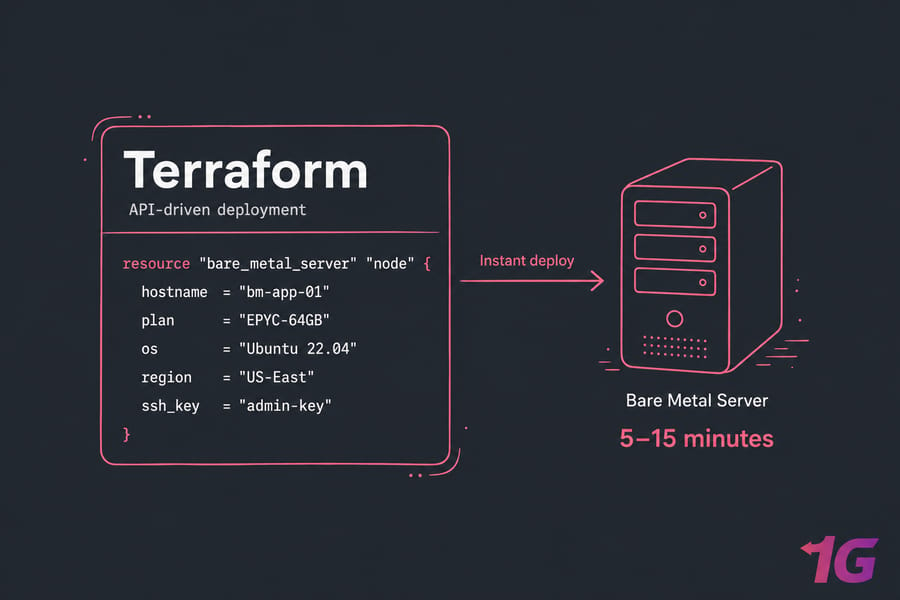
Pro tip: if you need a server in under 15 minutes, look specifically for "instant deploy" or "rapid provisioning" in the product description. Some providers still take 24+ hours, and they don't always say so up front.
Single-tenant hardware isolation (identical for both)
This is where they're indistinguishable. Both give you the entire physical box. No noisy neighbors. No hypervisor stealing CPU cycles. No shared L3 cache. The CPU, RAM, NICs, NVMe — yours alone.
If hardware isolation is your driver (compliance, predictable latency, hypervisor avoidance), either option delivers. The choice comes down to how you want to pay and how fast you need to deploy.
Bare Metal Cloud Explained: AWS, IBM, and Equinix Metal
"Bare metal cloud" deserves its own section because it's where the term gets the most marketing airtime. The big four:
- AWS EC2 Bare Metal (i3.metal, m5.metal, r5.metal): API-driven, hourly, deep AWS ecosystem integration. m5.metal runs ~$4.60/hr. Great if you're already deep in AWS. Painful for the bill.
- IBM Cloud Bare Metal: hourly or monthly, strong enterprise support, popular for VMware and SAP workloads. Configs typically $500–$2,000/mo. Decent flexibility, slower provisioning than AWS.
- Equinix Metal (formerly Packet): API-first, deployable in 20+ Equinix data centers, popular with Kubernetes operators. Pricing comparable to IBM, often a touch cheaper.
- OVHcloud Bare Metal: closer to traditional dedicated pricing with cloud-style provisioning. Entry configs from ~€60/mo. Solid middle ground.
What makes them "cloud" isn't the hardware — it's the consumption layer. APIs, hourly billing, infrastructure-as-code, and pools of standby hardware ready to spin up.
Looking at hyperscaler bills and getting nervous? You're not alone here are AWS alternatives that don't require selling a kidney.
1Gbits sits in the same category functionally — single-tenant physical hardware, fast deployment, full root — but at price points closer to traditional dedicated. Bare-metal-class performance, no hyperscaler premium.
Performance: Is Bare Metal Faster Than a Dedicated Server?
No. Same hardware = same performance. Don't let any vendor tell you otherwise.
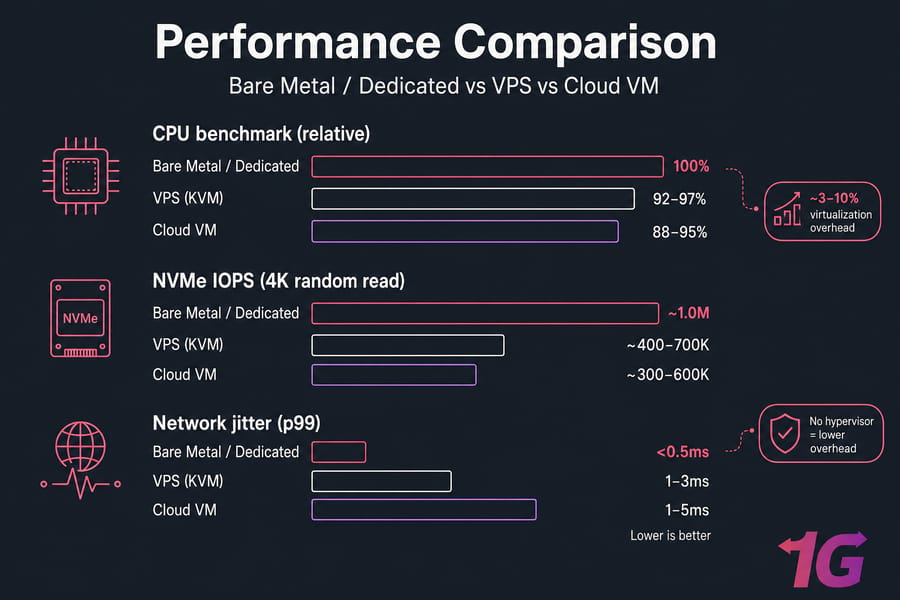
Both bare metal and dedicated outperform virtualized hosting (VPS, cloud VMs) by roughly 3–10% on CPU-bound workloads, with bigger gaps on disk and network jitter. That's because there's no hypervisor stealing cycles, no virtual NIC adding latency, no virtual disk layer between your application and the NVMe controller.
Stat callout: bare metal eliminates the ~3–10% virtualization overhead — which matters more than it sounds for HFT, AI inference, and latency-sensitive databases.
| Metric | Bare Metal / Dedicated | VPS (KVM) | Cloud VM |
| CPU benchmark (relative) | 100% | 92–97% | 88–95% |
| NVMe IOPS (4K random read) | ~1.0M | ~400–700K | ~300–600K |
| Network jitter (p99) | <0.5ms | 1–3ms | 1–5ms |
| NUMA / CPU pinning | Full access | Limited | Limited |
| Direct hardware features (SR-IOV, RDMA) | Yes | Partial | Partial |
Curious about the silicon side? Here's our breakdown of Intel Xeon vs AMD EPYC for picking the right CPU class.
When to Choose Bare Metal vs a Traditional Dedicated Server
Now the practical part — which one do you actually buy?
Choose bare metal cloud if…
- Your workload is short-lived (hours to days)
- You need to spin up and tear down servers via API or Terraform
- You're scaling Kubernetes nodes or batch jobs dynamically
- You don't know how long you'll need the box
- You're already paying for a hyperscaler's ecosystem (VPC peering, IAM, S3)
Choose a traditional dedicated server if…
- The workload runs 24/7 for months or years
- You want predictable, flat monthly costs
- You're hosting a high-traffic site, game server, or production database
- You need specific data center locations or compliance jurisdictions
- You want to maximize price-to-performance
Decision matrix
| Use Case | Recommended | Why |
| Production web app, 24/7 traffic | Traditional dedicated | Flat pricing, long-term value |
| Auto-scaling Kubernetes nodes | Bare metal cloud | API provisioning, hourly billing |
| Long-running database (PostgreSQL, MySQL) | 1Gbits dedicated, $129/mo tier | Predictable cost, NVMe + ECC |
| Short-term ML training run (3 days) | Bare metal cloud | Pay only for hours used |
| Game server hosting | Traditional dedicated | Low-latency single-region, flat cost |
| Dev/test environments rebuilt nightly | Bare metal cloud | API-driven teardown |
| VMware ESXi hypervisor host | 1Gbits VMware-ready dedicated | Lower TCO, full hardware access |
| Compliance-bound workload (HIPAA, PCI) | Traditional dedicated | Known physical location, single-tenant |
Stuck on which spec to choose? Walk through how to choose the right dedicated server step by step. Need to pick between hands-on or hands-off support? See managed vs unmanaged dedicated.
Bare Metal vs Dedicated vs VPS vs Cloud: The Full Landscape
It helps to see all four side by side. Bare metal and dedicated occupy the same column — VPS and cloud share virtualization, but with different commercial models.
| Feature | Bare Metal | Dedicated | VPS | Cloud (VM) |
| Tenancy | Single | Single | Multi | Multi |
| Hypervisor | No | No | Yes | Yes |
| Billing | Hourly / monthly | Monthly | Monthly | Hourly / per-second |
| Provisioning | Minutes (API) | Minutes to hours | Seconds | Seconds |
| Performance | Highest | Highest | Good | Good (variable) |
| Best for | Burst, IaC | 24/7 production | Small apps | Elastic web tier |
Want the deep dives? Here's dedicated server vs VPS, and the full dedicated vs cloud server.
Pricing Comparison: What Should You Actually Pay?
Real numbers. No fluff.
| Provider | Entry Spec | Price | Billing Model |
| 1Gbits Dedicated | Xeon E-2388G, 32GB ECC, NVMe | From $85/mo | Flat monthly |
| Hetzner | Ryzen, 64GB, NVMe | ~€40–€150/mo | Monthly |
| OVHcloud Bare Metal | Xeon, 32GB | ~€60–€200/mo | Monthly / hourly |
| IBM Cloud Bare Metal | Xeon Gold, 64GB | $500–$2,000/mo | Hourly / monthly |
| AWS i3.metal | Xeon, 512GB, NVMe | ~$4.99/hr (~$3,640/mo) | Hourly / reserved |
| AWS m5.metal | Xeon Platinum, 384GB | ~$4.60/hr (~$3,358/mo) | Hourly / reserved |
Warning: cloud bare metal hourly rates compound fast. At $4.99/hr running 24/7, you'll pay roughly $3,640/mo for an i3.metal box. A comparable 1Gbits dedicated server costs a fraction of that. For 24/7 workloads, traditional dedicated saves 60–80% on the same class of hardware.
If price-to-performance is your priority, our cheap dedicated server are where most cost-conscious teams end up.
Common Misconceptions About Bare Metal and Dedicated Servers
I see these five myths repeated constantly. Let's kill them.
- "Bare metal is newer technology." False. The hardware model is identical to dedicated hosting that's existed for 20+ years. Only the term and the cloud-style billing are new.
- "Dedicated servers can't have hourly billing." Increasingly false. Many providers (including 1Gbits with instant-deploy) offer flexible billing that mirrors cloud bare metal.
- "Bare metal is always cheaper." False. Cloud bare metal often costs 3–10x traditional dedicated for identical specs running 24/7.
- "You can't run VMs on bare metal." Completely false. Install Proxmox, VMware ESXi, or KVM and you've got your own private virtualization stack. Many teams run our VMware-ready dedicated servers as ESXi hosts. If you're weighing hypervisors, here's KVM vs Proxmox.
- "AWS bare metal = AWS Dedicated Host." False. AWS Dedicated Host is a billing/licensing construct on top of EC2 virtualization. AWS bare metal (i3.metal et al) is genuinely hypervisor-free.
How 1Gbits Delivers Both Bare Metal and Dedicated Server Power
Here's where I'll be direct, because it's the whole point of this article. Most providers force you to pick: either traditional dedicated (cheap but slow to deploy) or cloud bare metal (fast and flexible but expensive). 1Gbits hits the middle.
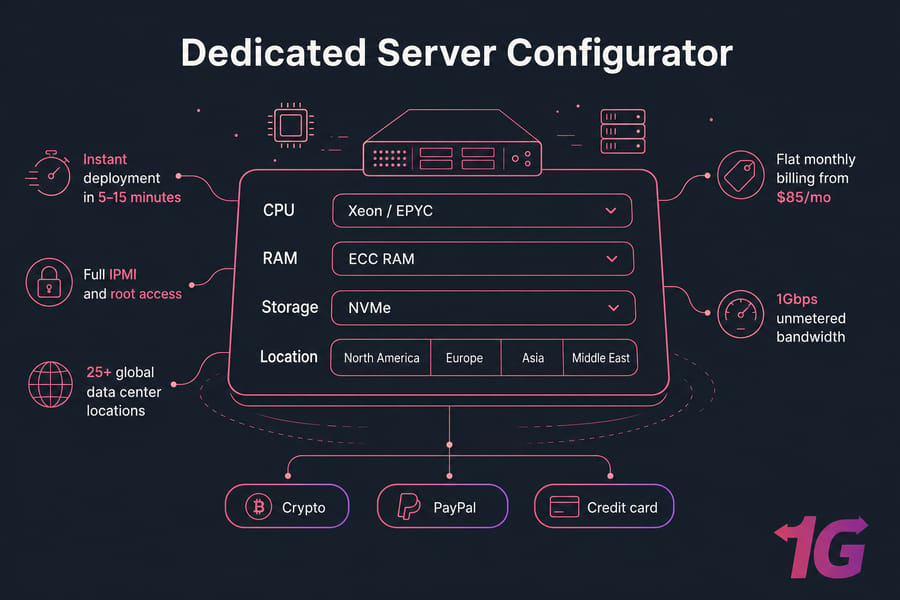
What you get:
- Instant deployment in 5–15 minutes — same speed as cloud bare metal
- Flat monthly billing from $85/mo — same predictability as traditional dedicated
- Full IPMI and root access, ECC RAM, NVMe storage, 1Gbps unmetered bandwidth
- 25+ global data center locations, including North America, Europe, Asia, and the Middle East
- Crypto, PayPal, and credit card payments — privacy-friendly checkout
- 24/7 expert support from engineers who actually know the hardware
You can buy a dedicated server in minutes, or jump straight to the instant dedicated server if speed is non-negotiable.
People Also Read:

Leave A Comment