
A forex trading robot is automated trading software that opens, manages, and closes currency trades for you based on pre-set rules. Most run as Expert Advisors inside MetaTrader 4 or MetaTrader 5, executing signals from indicators like moving averages or RSI without human input. Think of it as a set of instructions with trading permissions — you define the conditions, and the software watches the market tick by tick, doing exactly what you told it. No hesitation, no revenge trades, no "just one more" at 2am.
In this comprehensive guide, we'll explore the mechanics, benefits, costs, and best options available for automated Forex trading. Whether you're a beginner curious about automation or a seasoned trader considering a switch to AI-powered bots, this article will walk you through everything you need to know.
🤖 What Is a Forex Trading Robot?
A Forex trading robot — also known as a Forex bot, robot trader, or automated trading bot — is a software application designed to automatically execute buy or sell orders in the foreign exchange market. These bots rely on pre-programmed trading strategies based on technical indicators, statistical models, and sometimes even machine learning algorithms. Unlike human traders, who may be affected by emotions or fatigue, a Forex trading robot operates with precision and discipline 24/7, processing vast amounts of market data within milliseconds.
Forex Robot vs Expert Advisor (EA)
Here's the distinction most beginners miss. An Expert Advisor is specifically a program written in MQL4 or MQL5 that runs inside the MetaTrader terminal. "Forex robot" is broader — it covers EAs, cTrader cBots, cloud-hosted bots, and AI-driven systems that never touch MetaTrader at all. In practice, if you're buying a bot in 2026, it's probably an EA.
Forex Robot vs Automated Trading Software
These terms overlap heavily. "Automated trading software" is the umbrella; a forex bot is the retail-facing version of it. Institutional algorithmic trading systems and a $199 EA off a marketplace both belong to the same family — they just differ wildly in engineering quality.
⚙️ How Does a Forex Trading Robot Work?
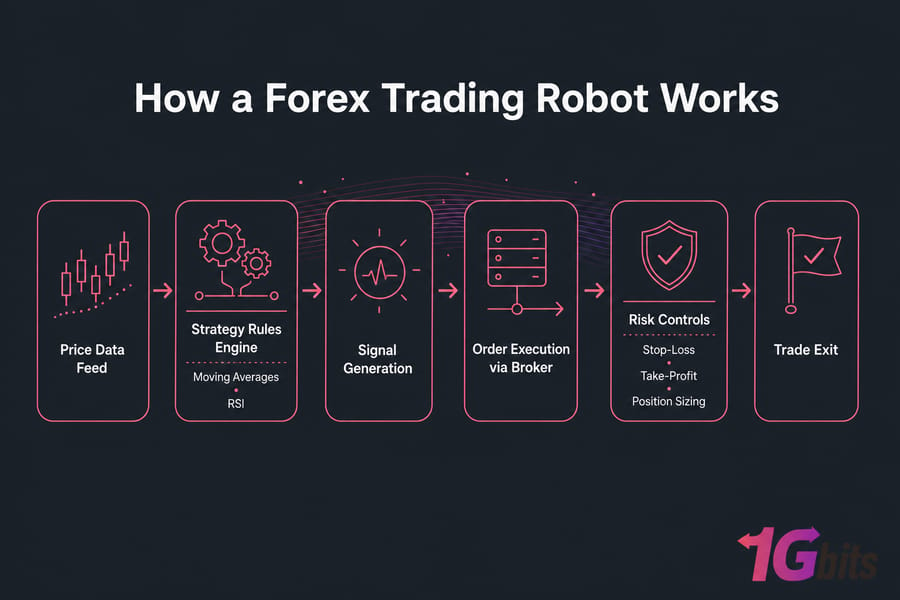
To understand how Forex trading bots work, let's break down the core components of their operation:
1. Market Analysis
A Forex robot starts by scanning real-time price charts and economic indicators. It ingests live price feeds and runs them through technical tools like Moving Averages for trend direction, Relative Strength Index (RSI) for identifying overbought or oversold conditions, MACD for signal confirmation, and Bollinger Bands for volatility assessment. Some advanced bots even incorporate economic news releases, sentiment data, or correlation metrics.
2. Signal Generation
Rules fire when conditions align. A simple example: buy when RSI drops below 30 and the 50-period moving average crosses above the 200-period. Sell when the reverse happens. If a short-term moving average crosses above a long-term one, it might signal an upward trend. Complexity varies, but the logic pattern doesn't — these triggers are precise and repeatable, eliminating emotional bias from the equation.
3. Trade Execution
The order goes to your broker's server. Bots execute trades with high-speed accuracy, ensuring you enter the market at optimal price points. This is where spread and slippage start eating your edge — a strategy that averages 4 pips per trade in a backtest can go negative live if your real spread is 2.5 pips instead of the modelled 1.0.
4. Risk Management
Good bots are equipped with risk management tools, such as Stop-Loss Orders to cap potential losses, Take-Profit Targets to lock in profits, Trailing Stops to maximize profits as a trade moves favorably, and position sizing rules. Any bot without hard stops is a liability — these settings ensure your capital is protected even if the market turns against you.
5. Continuous Monitoring and Exit
The robot doesn't stop after the trade is placed. It tracks open positions and closes them on target, stop, time-based exit, or a reversal signal. If the terminal goes offline mid-trade, those exits don't fire — which is exactly why hosting matters. Some bots even include dynamic exit rules based on volatility or time elapsed.
Want to improve your trading skills before deploying a robot? Learn how to become a successful trader in the Forex financial market.
📊 What Is Automated Forex Trading?
Automated Forex trading, also known as algorithmic trading or auto trading, refers to the use of technology to execute trading decisions without manual input. Automation removes emotion from execution — it doesn't remove risk. A bad strategy just loses money faster and more consistently.
| Factor | Manual Trading | Robot Trading | Copy Trading |
| Execution speed | Seconds to minutes | Milliseconds | Depends on provider latency |
| Emotional discipline | Weakest point | None involved | You still panic-disconnect |
| Flexibility in odd markets | High | Low — rules are fixed | Depends on the trader you follow |
| Oversight needed | Constant | Periodic checks | Moderate |
| Main failure mode | Poor discipline | Over-optimization | Provider blows up |
Where MT4 and MT5 Fit In
Automated trading platforms like MetaTrader 4 (MT4) and MetaTrader 5 (MT5) support integration with trading bots and Expert Advisors (EAs), making them the go-to tools for robot-based trading. MT4 still dominates retail EA distribution; MT5 gives you better backtesting with multi-currency and real ticks. If you're starting fresh, lean MT5. If you're buying a specific bot, check which platform the developer actually supports — and read up on forex algorithmic trading explained before committing money.
✅ Do Forex Trading Robots Really Work?
What They Can Do Well
Consistent rule execution across sessions. Trading Asian-hour ranges while you sleep. Managing eight pairs at once without missing an entry. Enforcing position sizing rules exactly.
Where They Fail
Overfitting is the big one. A developer optimizes parameters until the equity curve looks like a staircase, then the bot meets a market that doesn't match 2019–2023 conditions. Grid and martingale systems are especially deceptive — smooth gains for months, then one trending move wipes the account. Most bots don't work forever. Plan for degradation.
Why Market Conditions Matter
Regimes shift. A mean reversion bot that printed money during low-volatility ranges gets shredded when central banks start surprising people. What worked in a backtest won't necessarily work tomorrow.
📋 Pros and Cons of Using a Forex Trading Robot
| Benefits | Risks and Limitations |
| Trades 24/5 without fatigue | Technical failures — disconnects, terminal crashes |
| Zero emotional interference | Weak or overfitted strategy logic |
| Strategies can be backtested before risking capital | Backtest results routinely overstate live performance |
| Handles multiple pairs and timeframes at once | Broker-dependent: spread, slippage, execution quality |
| Enforces position sizing rules exactly | Hidden drawdown risk in grid or martingale designs |
🧩 Types of Forex Trading Robots
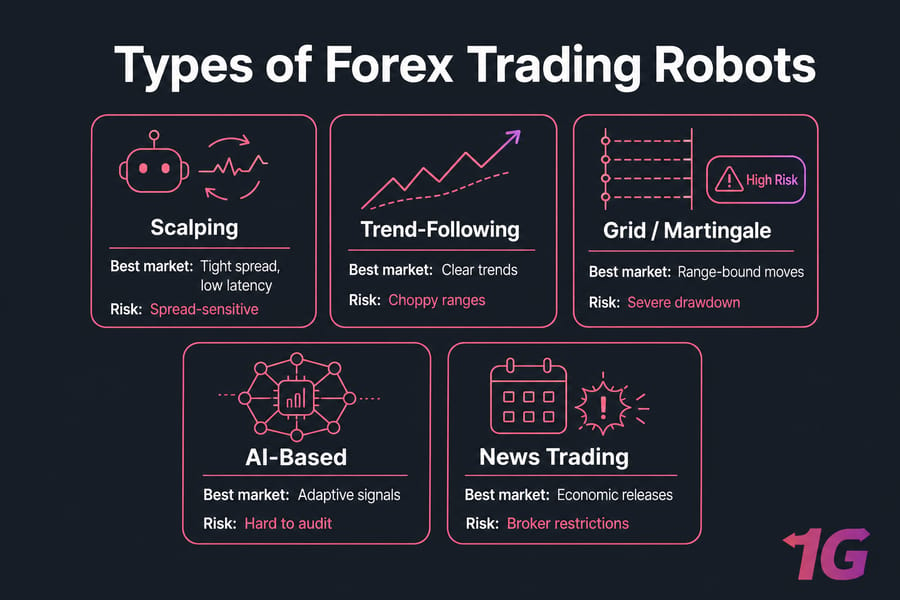
- Scalping Robots: Dozens of small trades, extremely sensitive to spread and latency. Operate on low timeframes like 1-minute or 5-minute charts. Needs an ECN or STP broker and a server close to the broker — which is why using a Forex VPS is highly recommended.
- Trend-Following Robots: Fewer trades, longer holds, low win rate but strong risk-reward. Ride strong market trends and can hold trades for hours or even days. Suffers in choppy ranges.
- Grid Robots: Stacks buy and sell orders at fixed intervals above and below the current price. Works beautifully until it doesn't — one trending move can wipe the account. Treat drawdown claims here with real suspicion.
- AI-Based Robots: Machine learning on price and sometimes sentiment data. Over time, they refine their strategies by learning from previous trades. Harder to audit; "AI" is also the most abused label in this market.
- News Trading Bots: Fire on economic releases like interest rate decisions or employment data. Typically fast and aggressive in trade execution. Latency-critical, and many brokers restrict this explicitly.
💡 Want to keep your robots running 24/7 without interruptions? Learn why VPS is used in Forex trading.
🔍 How to Choose a Forex Trading Robot
Supported Platforms and Broker Compatibility
Confirm MT4, MT5, or cTrader support, and whether the bot needs a specific account type. Some EAs break on brokers with five-digit pricing or non-standard symbol suffixes.
Verified Results and Transparency
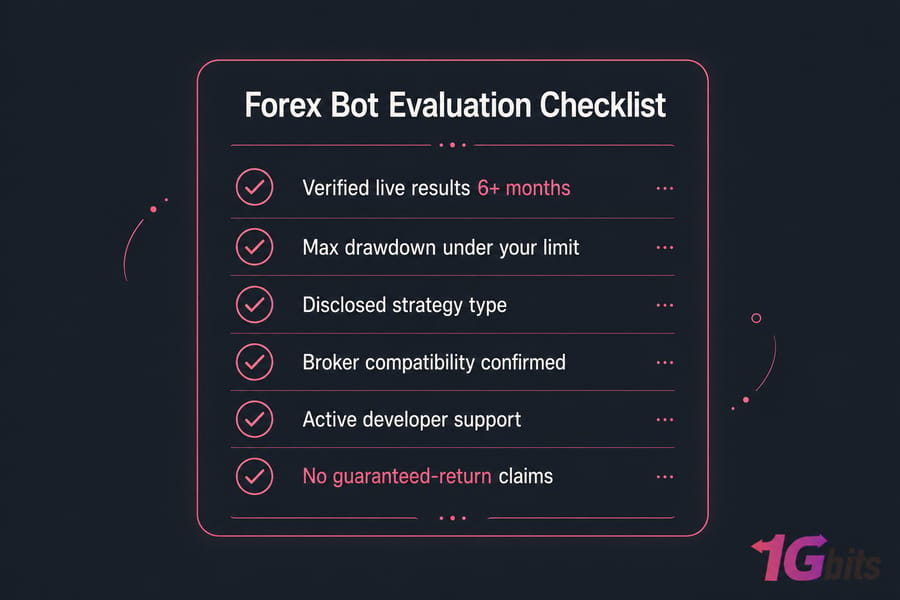
Ask for a live account track record on Myfxbook or a comparable verified service — minimum six months, ideally longer. Demo results prove almost nothing. If the developer won't show the strategy type, walk away.
Risk Profile and Maximum Drawdown
Decide your drawdown ceiling first, then filter bots against it. A 45% historical drawdown means you'll likely see worse eventually.
Pricing, Support, and Updates
Active development matters. Brokers change symbol names, platforms push builds, spreads shift. An abandoned EA rots.
Red Flags Worth Memorizing
- "Guaranteed returns" or fixed monthly percentages
- No verified live record — only screenshots or demo curves
- Hidden martingale or grid logic buried in the settings
- Copy-paste reviews posted within days of each other
- Bundled sign-up links to unregulated brokers
🧪 How to Test a Forex Robot Safely
Backtest first. Use several years of historical data across different market regimes, and be skeptical of "99% modeling quality" claims — MT4's tick modelling is approximate, and results can be gamed. Then run a demo account for at least a month. Then forward test on a small live account, because demo fills and live fills aren't the same animal.
While testing, log your actual spread, slippage, and execution latency. Compare them against the backtest assumptions. And verify your platform stayed online the whole time — a stability gap invalidates the test.
📈 Key Metrics to Evaluate a Forex Trading Robot
| Metric | What it means | What to watch out for |
| Win rate | % of trades closed in profit | 90% win rates usually hide huge losers |
| Profit factor | Gross profit ÷ gross loss | Below 1.2 is fragile; above 3.0 smells overfitted |
| Maximum drawdown | Largest peak-to-trough equity drop | Live drawdown typically exceeds backtest |
| Risk-reward ratio | Average win vs average loss | Tiny targets with wide stops = grid risk |
| Sharpe ratio | Return adjusted for volatility | Needs long samples to mean anything |
| Average trade duration | How long positions stay open | Very short = latency and spread sensitive |
🛠️ How to Use a Forex Trading Robot on MT4 or MT5
- Pick your platform and open an account with a regulated ECN or STP broker. Most robots are designed for MT4 or MT5. Get your MT4 VPS hosting or MT5 VPS hosting.
- Copy the
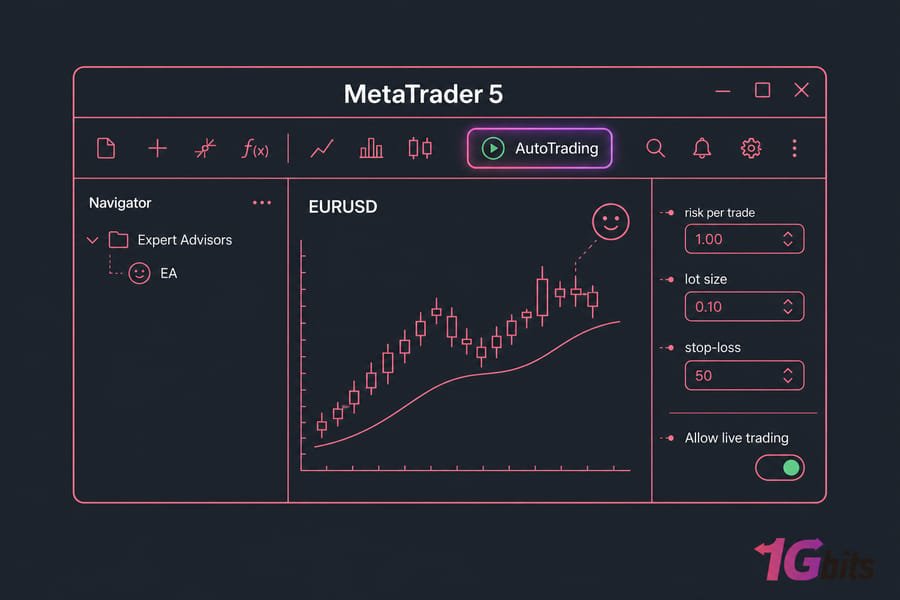
.ex4or.ex5file into theMQL4/ExpertsorMQL5/Expertsfolder, then restart the terminal. Full walkthrough: install a forex robot on MT4/MT5. - Drag the EA onto a chart and set your parameters — risk per trade, lot size, stop-loss, magic number.
- Enable AutoTrading and tick "Allow live trading" in the EA properties.
- Check the Experts and Journal tabs daily for errors, and confirm trades match expected behaviour.
- To avoid interruptions, use a dedicated Forex VPS for 24/7 trading.
🖥️ Why Traders Use a VPS for Forex Robots
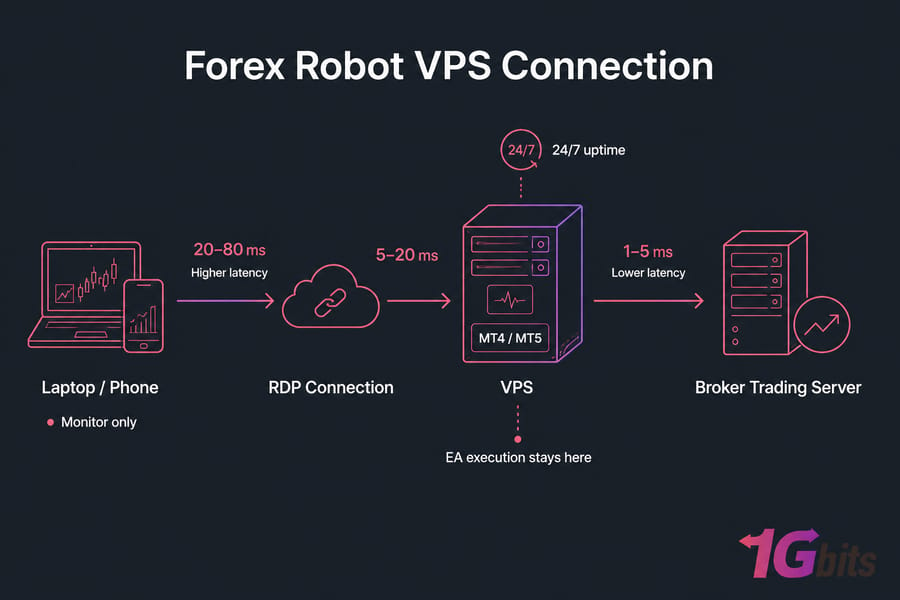
Your bot can only trade if the terminal is running. Home internet drops, Windows updates reboot at midnight, power flickers and your open positions sit unmanaged. A VPS in a datacenter near your broker's server fixes all three problems at once.
Lower latency means less slippage on entries, which matters enormously for scalpers and news bots. You also get real 24/7 uptime, plus room to run several EAs on separate charts without your laptop fan screaming. Read more on why traders use a VPS, or compare VPS vs home PC for trading and specialized forex VPS vs regular VPS before buying.
Looking to get started with a reliable server? Buy Forex VPS now to ensure smooth automated trading operations.
📱 Forex Trading Robot for Android and Mobile Users
You can monitor open trades, close positions, and check balance from the MT4/MT5 mobile app. Popular apps like MetaTrader 4 Android or MetaTrader 5 iOS allow seamless mobile control of your automated trading strategies. Some bots also include cloud-based dashboards, letting you control your bot from any browser on your smartphone. However, you cannot reliably host an EA on a phone — mobile OSes suspend background apps, and phones lose connectivity constantly. Keep execution on a VPS; use your phone as a dashboard.
💰 How Much Does a Forex Trading Robot Cost?
| Cost item | Typical range | Notes |
| Free bots | $0 | Fine for learning, rarely for live capital |
| One-time paid EA | $80–$800 | Usually licensed to 1–2 accounts |
| Subscription bots | $25–$150/month | Includes updates and support |
| VPS hosting | $10–$40/month | Non-negotiable for 24/7 operation |
| Spreads and commissions | Ongoing | The biggest hidden cost for scalping bots |
| Data or signal feeds | $0–$60/month | Only some strategies need them |
Want a cost-effective setup? Consider combining a free or affordable bot with a high-performance Forex VPS to boost your trading success. Read more: How to make money with Forex VPS.
⚖️ Are Forex Trading Robots Legal?
Automated trading is legal in most jurisdictions. Brokers regulated by the FCA, ASIC, CySEC, or under CFTC/NFA rules generally permit EAs, but many restrict latency arbitrage, news scalping, or trade copiers — check the client agreement, not the marketing page. Legality also varies by country, and using a bot doesn't waive your tax or compliance obligations.
While using robots is permitted, be cautious of scam bots that promise guaranteed profits, unregulated platforms offering suspiciously high returns, and over-optimized strategies that work in backtests but fail in live markets. Always test the robot on a demo account before going live. And remember: no robot can guarantee profits — risk is always present in trading.
🏆 What Is the Best Forex Trading Robot?
There isn't one. Anyone claiming otherwise is selling something. The right bot depends on your capital, drawdown tolerance, broker execution, and whether you can babysit it. A low-frequency trend bot suits a $2,000 account with wide-ish spreads; a scalper needs raw-spread execution and sub-5ms latency to survive. Some of the most popular names in the market include Forex Fury, GPS Forex Robot, Flex EA, Robotron, and AI Forex Bot — but popularity doesn't equal profitability. Test before you trust.
👤 Who Should Use a Forex Trading Robot?
- Beginners — demo only, conservative settings, and learn forex basics first. Automation won't rescue a missing strategy.
- Intermediate traders — best fit. You can read a backtest report critically and spot when the bot's edge is gone.
- High-frequency or latency-sensitive users — a VPS isn't optional, it's infrastructure.
🎯 Final Thoughts
Forex robots are powerful tools that can streamline your trading and eliminate emotional decision-making. But they're not magic money machines. A forex robot is a tool that executes your rules faithfully — nothing more. Success depends on choosing the right bot for your goals, using proper risk management, and testing and tweaking the strategy over time. The traders who do well with automation are the ones who test properly, cap their risk, and keep the platform running without gaps.
That last part is the easiest to solve: run your trading bot 24/7 on low-latency hosting and stop losing trades to a dropped connection. Also worth your time: build better trading discipline. To maximize performance, make sure to get a Forex VPS and enjoy ultra-low latency execution across global markets.

Leave A Comment