

If you've shopped around for hosting recently, you've probably noticed something: a growing slice of the market advertises "no KYC" or "anonymous" VPS plans. The pitch sounds simple pay with crypto, skip the ID upload, get a server. But the reality has more nuance than the marketing suggests, and getting it wrong can cost you money, uptime, or both.
So let's clear it up. This guide explains what no KYC VPS hosting actually is, where the privacy benefits are real, where they're overstated, and how to choose a provider without getting burned.

What Is No KYC VPS Hosting?
No KYC VPS hosting refers to virtual private server plans that require little or no identity verification at signup. You usually don't upload a passport, a driver's licence, or a utility bill. Pair that with crypto payment and you've reduced the personal data trail considerably but you haven't erased it.
That last part matters. "No KYC" is not the same as "no information collected" and it's definitely not the same as "untraceable." Most providers still hold an email address, payment metadata, server logs, and connection details. The privacy floor goes up, not to infinity.
What "no KYC" means in hosting
KYC — Know Your Customer — is the standard practice of verifying who a customer is before accepting their money. Banks and exchanges do it because regulators require it. Hosting companies usually do a lighter version, often through automated fraud screening rather than a formal document check. When a host calls itself "no KYC," they're typically saying: no government ID, no selfie verification, no proof of address.
No KYC vs low KYC vs full verification
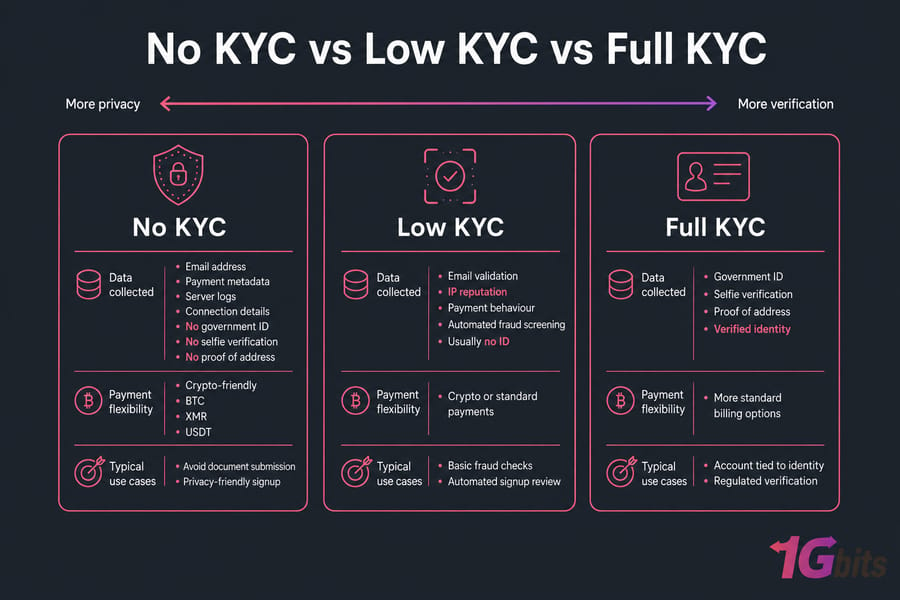
Think of it as a spectrum. Full KYC means you upload documents and your account is tied to your verified identity. Low KYC means the host runs basic checks — email validation, IP reputation, payment behaviour — without asking for ID. No KYC sits at the privacy-friendly end, where signup is mostly automated and identity documents aren't requested.
Why the term is often misunderstood
A lot of buyers conflate "no KYC" with "anonymous." They're related, not identical. You can have a no-KYC signup that still leaves a trail through your payment processor, ISP, or the apps you run on the server. Privacy is a stack — the hosting layer is only one part. If you want a refresher on the basics, see what is VPS hosting.
How No KYC VPS Signup Works in Practice
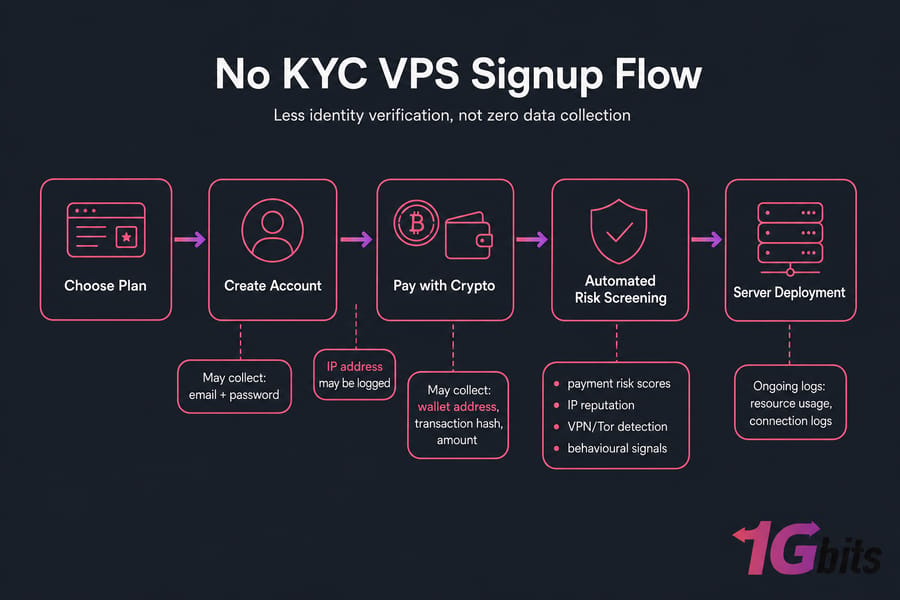
The flow is usually straightforward. You pick a plan, create an account (often just email + password), pay, and wait for deployment. The whole thing can take minutes if everything checks out.
Payment methods often used for private VPS hosting
Crypto dominates here. Bitcoin VPS hosting is the classic option, but Monero VPS has grown in popularity because Monero's privacy properties are stronger than Bitcoin's by design. Stablecoins like USDT VPS hosting are also common because they avoid the volatility headache. Some hosts also accept Litecoin, Ethereum, or various altcoins.
What providers may still collect
Even without an ID upload, you should expect a host to log:
- Your signup email address
- The IP address you used to register and log in
- Payment metadata (wallet address, transaction hash, amount)
- Server resource usage and connection logs
- Support ticket history
None of that makes them dishonest. It's normal operations data. The right question is: how long do they keep it, and what's their policy when someone asks for it?
Why fraud screening can still happen without full ID checks
Here's the thing — hosts get hammered by fraud. Stolen cards, chargebacks, abuse-prone signups. Even a no-KYC provider runs automated checks: payment risk scores, IP reputation, VPN/Tor detection, behavioural signals. If something looks off, your order may go through manual review or get cancelled. That's not the host being shady. That's them protecting their network and their other customers.
Anonymous VPS Hosting vs Bitcoin VPS vs Offshore VPS
These terms get tossed around interchangeably and it causes real confusion. They overlap, but each one points to a different aspect of privacy.
| Term | What It Means | Privacy Level | Main Trade-Off | Best For |
| No KYC VPS | No ID upload at signup | Medium | Provider may still log payment + IP data | Users avoiding document submission |
| Anonymous VPS | Minimal data collection + privacy-friendly payment | Medium-High | Limited support channels in some cases | Privacy-focused buyers |
| Bitcoin VPS | VPS paid for in BTC | Medium (BTC is pseudonymous, not private) | On-chain traceability | Crypto-native customers |
| Monero VPS | VPS paid for in XMR | Higher (private by design) | Fewer providers accept it | Strong payment privacy needs |
| Offshore VPS | Server hosted in a different jurisdiction | Varies | Latency, legal complexity | Jurisdictional separation |
Anonymous VPS hosting and where it overlaps
An anonymous VPS hosting plan usually combines no-KYC signup with privacy-friendly payment options. The overlap with "no KYC" is heavy — most anonymous VPS offers are also no-KYC, but the reverse isn't always true.
Bitcoin VPS hosting and crypto-only billing
Bitcoin VPS just means you pay in BTC. That's a payment-method label, not a privacy guarantee. Bitcoin is pseudonymous: every transaction is on a public ledger. With enough effort, transactions can be linked to identities through exchanges. Privacy here depends entirely on how you got the coins.
Offshore VPS hosting and jurisdiction trade-offs
Offshore means the server lives in a different country than yours. Useful for jurisdictional separation, but it's not automatically more private. Some "offshore" jurisdictions cooperate with international requests anyway. Latency and support hours also suffer. Pick locations based on real needs, not folklore.
Which option fits which use case
If you mostly want to skip the ID upload, no-KYC is enough. If you want minimal data exposure end-to-end, look at anonymous VPS with Monero payment. If your concern is which legal system the server sits under, that's an offshore question. They're different problems.
Benefits of Privacy-Focused VPS Hosting
Why bother? For most legitimate buyers, the appeal is reduced data exposure rather than evasion of anything.
- Less personal data in third-party systems. Every breach you read about contains customer data nobody needed to collect in the first place. If a host doesn't have your passport scan, it can't leak your passport scan.
- Cleaner project separation. Developers running multiple side projects often want each one isolated from their personal identity for clean compartmentalization.
- International convenience. Crypto removes friction for buyers in countries with limited card support or strict currency controls.
- Legitimate self-hosting. Running a personal VPS for VPN, a V2Ray server, a private password manager, or a small Nextcloud instance — all reasonable use cases.
- Journalists, researchers, activists. People whose work depends on not lighting up a billing database every time they spin up a test environment.
None of this is suspicious. It's the same reason people use cash for some purchases or keep an unlisted phone number.
Risks of No KYC VPS Hosting
Now for the part most marketing pages skip. There are real downsides, and you should weigh them honestly before paying with a non-reversible method.
Scam providers and low-accountability vendors
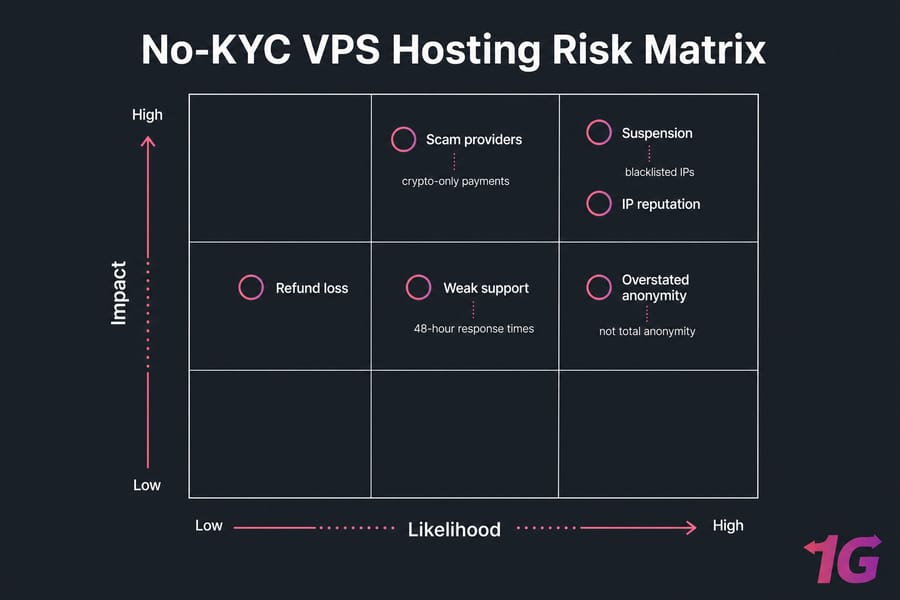
The hosting industry has its share of fly-by-night operations. A flashy website, a Telegram-only support channel, and crypto-only payment — three months later the site is gone and so is your money. I've watched buyers lose hundreds of dollars chasing the cheapest "anonymous" plan from operators with no track record.
Suspension, abuse complaints, and IP reputation issues
Privacy-friendly networks often attract more abuse. That can mean blacklisted IPs (bad for mail, bad for SEO), more frequent DDoS attacks, and aggressive automated suspension when a single neighbour misbehaves. A DDoS-protected VPS helps with one of those, but the IP reputation problem is harder to fix retroactively.
Refund, support, and compliance limitations
Crypto transactions don't reverse. If you pay and the service doesn't deliver, your recourse is whatever the provider's refund policy says — and many don't offer one. Support quality varies wildly. A provider with a single email address and 48-hour response times is fine for a hobby project, painful for anything critical.
Why no-KYC does not equal total anonymity
| Risk | Why It Happens | How to Reduce It |
| Scam host | Low accountability, crypto-only payments | Check reviews, look for years in business, test with small purchase |
| Account suspension | Abuse complaints, TOS violation, fraud flags | Read AUP carefully, host legitimate workloads only |
| IP blacklisted | Previous tenant misuse, network reputation | Test IP before deploying mail or production |
| Lost crypto payment | No refund policy, vanished provider | Start with one-month plans, never prepay annually |
| Overstated anonymity | Marketing vs technical reality | Treat your own OPSEC as the primary layer |
The hosting layer is one piece. Your apps, your login behaviour, the way you funded your wallet — all of these leak information. Securing your VPS properly does more for your privacy than any provider's marketing copy.
How to Choose a No KYC VPS Provider
This is where the real work happens. A provider with clear policies and slightly more screening will almost always serve you better than one promising "no questions asked" hosting.
Check payment options, privacy policy, and TOS
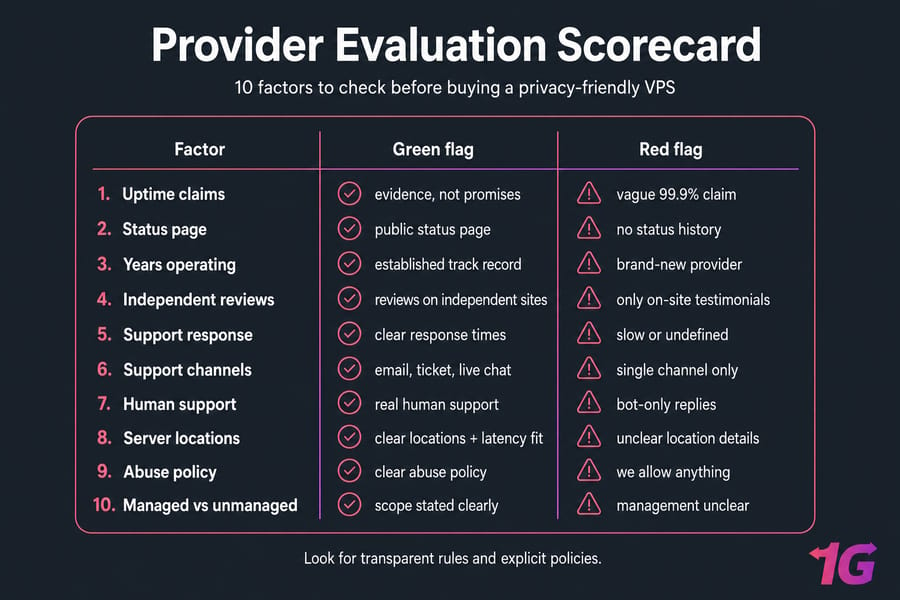
Read the privacy policy and acceptable use policy before you pay. If they don't have one, that's your answer. Look for plain language about what data they collect, how long they keep it, and what their abuse process looks like. A host that publishes clear rules is signalling that they intend to be around in a year.
Review uptime, support, and location choices
Uptime claims are cheap. Real signals include public status pages, years of operation, and customer reviews on independent sites. Support matters more than people realise — check response times, available channels, and whether you can reach a human when something breaks. VPS locations matter for both latency and the legal framework your data sits under.
Look for clear abuse handling and transparent rules
Counterintuitively, the providers most worth trusting are the ones with the most explicit abuse policies. "We allow anything" usually means "we're not equipped to deal with the consequences when something bad happens on our network." A real host has procedures, response times, and a relationship with their upstream. Use the criteria in this guide on evaluating a VPS provider as your starting point.
Compare unmanaged vs managed privacy-friendly VPS
Most privacy-focused plans are unmanaged VPS — you handle the OS, the patches, the security. That's fine if you're comfortable in a terminal. If you'd rather have someone else handle updates and monitoring, look at managed VPS options, accepting that managed plans usually involve a bit more account information.
Best Practices After Buying a Private VPS
Buying the server is step one. Step two is making sure it doesn't leak your information through bad configuration. This part trips up more buyers than the provider choice does.
- Use SSH keys, not passwords. Generate a key pair on your local machine and disable password login on the server. Here's a quick walkthrough on how to generate an SSH key.
- Change defaults immediately. Default ports, default usernames, default everything. Attackers scan for these within minutes of a fresh server going live.
- Turn on a firewall. Block everything except what you actually need. Our guide on configuring a firewall on your VPS covers the basics with UFW and iptables.
- Patch the OS regularly. Unattended security updates are usually the right call for personal servers.
- Run only the services you need. Every open port is a potential entry point.
- Set up backups. If the provider vanishes or your account is suspended, you'll want a copy of your data. Off the provider's network.
- Separate identities. Don't log into your private VPS from accounts tied to your real identity unless you have to. Don't reuse SSH keys across projects.
- Mind your own logs. Your apps log things. Web servers log IPs. Be deliberate about what your stack retains.
A small but important point: the server protects nothing about your local machine. If your laptop is compromised, the most anonymous VPS in the world won't help.
Common No KYC VPS Mistakes to Avoid
I see the same handful of mistakes over and over. They're easy to dodge once you know to look for them.
| Mistake | Why It Matters | Better Approach |
| Assuming crypto = anonymous | BTC is pseudonymous, traceable on-chain | Use Monero or treat BTC as one layer, not the whole solution |
| Ignoring TOS and AUP | Suspension wipes your work and your payment | Read the rules; host workloads that comply |
| Choosing by price alone | $2 hosts often disappear or oversell | Pay for a track record, not just specs |
| No backups | Single point of failure for data and access | Automate off-network backups from day one |
| Mixing personal and private projects | One slip links everything together | Separate accounts, keys, browsers, even devices |
| Skipping monitoring | You won't notice abuse until the provider does | Basic monitoring + alerts on resource spikes |
Is No KYC VPS Hosting Right for You?
Honest answer: it depends on what you're optimising for.
Good fit if you are: a privacy-conscious individual, a developer running compartmentalised side projects, a crypto-native buyer who prefers paying in BTC/XMR/USDT, a self-hoster running a personal VPN or password vault, or an international buyer working around payment friction.
Probably not the right fit if you: need formal invoicing for tax or business compliance, want a heavily managed environment with hand-holding support, run a business with strict procurement rules, or need enterprise SLAs with legal recourse. For those cases, a standard managed VPS with full billing is the more honest choice.
There's no shame in choosing standard hosting. It's simpler, support is usually better, and the privacy gap is smaller than the marketing suggests if you're not actively trying to keep your billing data minimal.
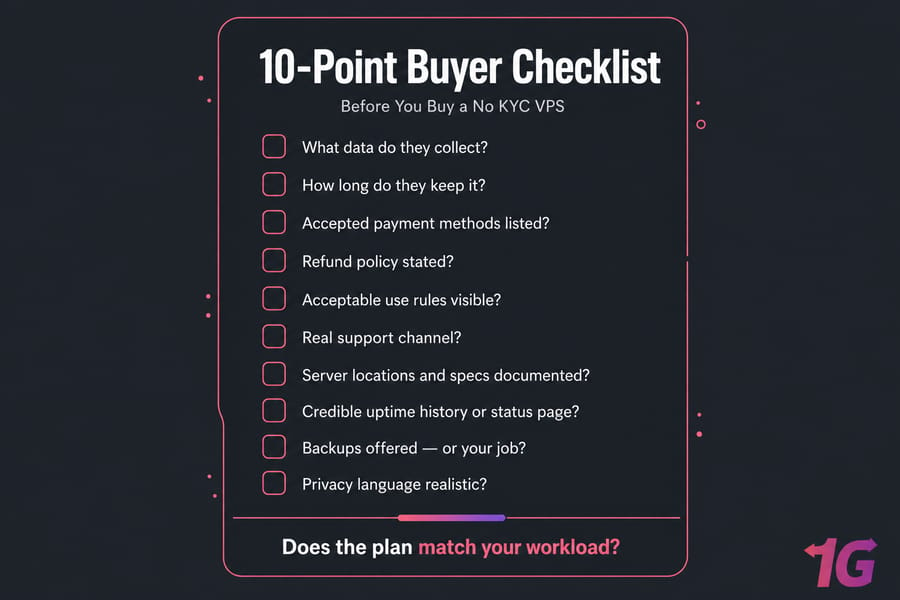
Final Checklist Before You Buy a No KYC VPS
Run through these ten questions before sending any crypto. If you can't answer most of them clearly from the provider's website, that's a signal.
- Does the provider explain what data they collect and how long they keep it?
- Are the accepted payment methods clearly listed?
- Is there a stated refund policy?
- Are the acceptable use rules visible and specific?
- Can you reach support through a real channel (ticket, chat, email)?
- Are server locations and specs documented?
- Is there a credible uptime history or status page?
- Are backups offered, or is it your responsibility?
- Does their privacy language sound realistic, not magical?
- Does the plan actually match what you'll run on it?
If you want to compare options that meet most of these criteria, the anonymous VPS and Bitcoin VPS plans are reasonable starting points, with transparent specs and policies. When you're ready to commit, the main buy VPS hosting page lays out the full range.

Leave A Comment