
🌍 Why Choose a German Dedicated Server?
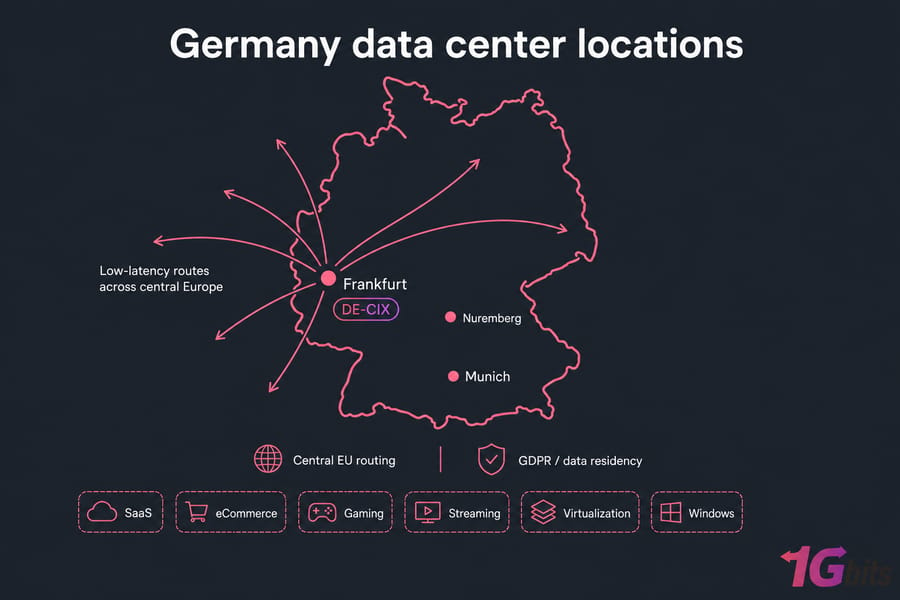
Germany is still one of the strongest locations in Europe for dedicated hosting. You get central EU routing, mature data center infrastructure, strong privacy expectations, and — if Frankfurt is in play — access to one of the biggest internet exchange ecosystems on the planet through DE-CIX.
Businesses and developers alike turn to German dedicated hosting for reliable performance and compliance advantages.
-
High-quality infrastructure with a central EU location for seamless access
-
Strict data privacy regulations under GDPR compliance
-
Low latency and fast connectivity across Europe
-
Flexible, customizable hardware and network options for different workloads
If you need a primer on dedicated hardware first, here's the complete introduction: What is a Dedicated Server
To know more about speed, compliance, and advanced control options, check out Germany Dedicated Server: Speed, Security & Control
📊 Detailed Comparison
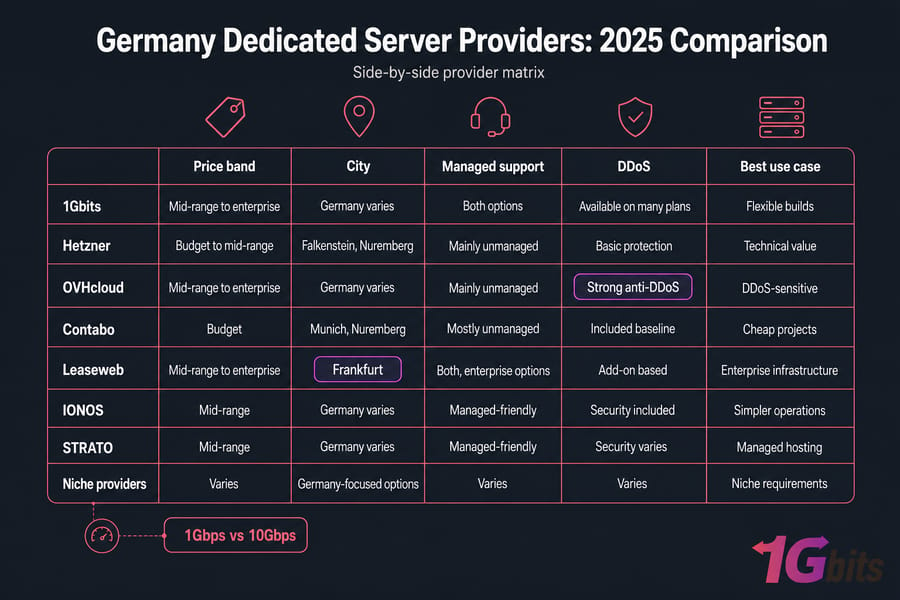
If you want the short version first, here it is. The table below is the fastest way to compare dedicated server hosting Germany options without bouncing between eight sales pages.
| Provider | Starting price / range | Managed or unmanaged | DDoS | Port speed / bandwidth | Best for |
| 1Gbits | Affordable pricing with enterprise-tier performance and no setup fees | Both options available | Available on many plans | 1Gbps and higher custom options | Flexible builds, mixed workloads, global businesses |
| Hetzner | Excellent price-to-performance; auctions for cheaper servers | Mainly unmanaged | Basic protection, options vary | 1Gbps standard, traffic allowances vary | Technical users who want value |
| OVHcloud (Germany) | Affordable, scalable plans | Mainly unmanaged with add-ons | Strong anti-DDoS reputation | 1Gbps, 10Gbps on higher tiers | DDoS-sensitive and large-scale deployments |
| Contabo | Budget-friendly with generous specs | Mostly unmanaged | Included baseline protection | High traffic focus, plans vary | Cheap Germany dedicated server projects |
| Leaseweb | Mid-to-high pricing, enterprise focus | Both, with strong enterprise options | Available, often add-on based | 1Gbps, 10Gbps, private networking options | Custom enterprise infrastructure |
| IONOS | Enterprise pricing, SLA-backed | Managed-friendly business approach | Security features included, specifics vary | Business-grade bandwidth options | SMBs wanting simpler operations |
| STRATO | Competitive managed pricing | Managed-friendly | Security features vary by package | Standard business uplinks | Simplified managed hosting |
| Webgo / COLOBRIDGE / HOSTKEY | Varies; premium for niche services | Varies by provider | Varies | Varies | Niche requirements, local support, custom requests |
And yes, price moves around a lot in this market. A Ryzen dedicated server Germany offer can look cheap until you add backup storage, IPv4 addresses, Windows licensing, or a 10Gbps port. You can read more about compliance advantages in the Germany Dedicated Server Compliance and Data Protection guide.
Top Providers at a Glance
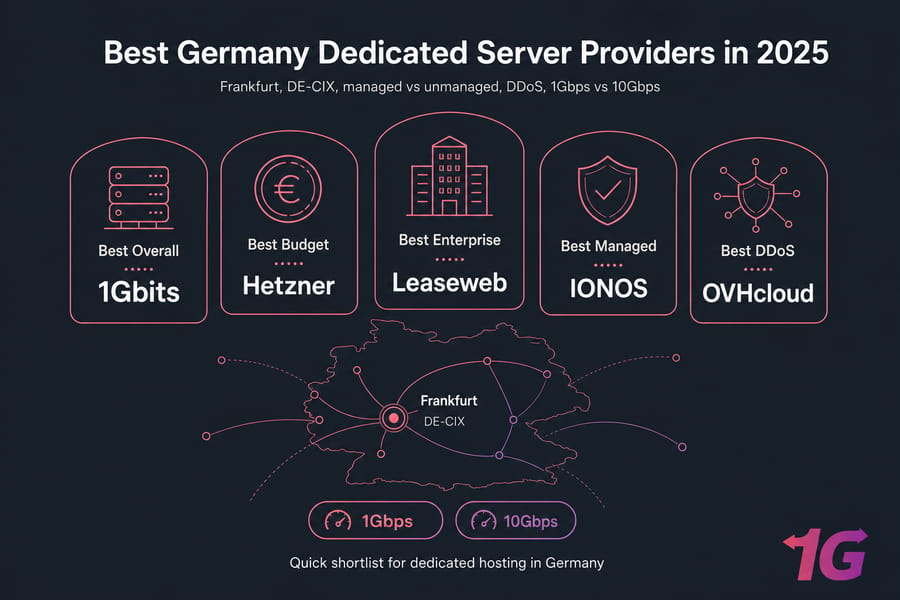
Germany hosts some of the most reputable dedicated server providers in the world, ranging from cost-effective options for startups to enterprise-grade solutions for corporations. Below is a closer look at the leading Germany dedicated server providers, their strengths, and what makes each stand out in 2026.
1Gbits
1Gbits is a strong all-rounder if you need customization, multiple workload profiles, and room to scale beyond a simple off-the-shelf server. It tends to appeal to buyers who want more than a single fixed dedicated hosting Germany package.
-
Affordable pricing with no setup fees and strong performance value
-
Wide support for Windows, Linux, VPS, RDP, and gaming servers
-
Global footprint with Frankfurt plus 20+ data centers worldwide
-
Options for managed and unmanaged setups; suitable for Linux and Windows use cases
-
24/7 expert support and 99.99% uptime guarantee for maximum reliability
Notable features: Custom bare metal server Germany options, high-bandwidth plans, root access, and pathways for businesses that need more than a one-size-fits-all build. If you already know your target is a Germany dedicated server, this is one of the more flexible paths to check first.
Hetzner
Hetzner has been the value benchmark for years, especially among sysadmins and developers comfortable managing their own stack. Its Germany footprint, especially around Nuremberg, is a big part of why it shows up in almost every dedicated server Deutschland conversation.
-
Offers AMD, Intel, and EPYC servers with strong performance
-
Budget-friendly options through Hetzner's popular server auctions
-
Multiple German data centers with high uptime and security
-
Excellent price-to-performance ratio; appeals to developers, SMBs, and large-scale businesses alike
Notable features: Intel Xeon and AMD EPYC options, NVMe SSD availability, IPv4 and IPv6 support, and remote management tools depending on line and generation.
OVHcloud (Germany)
OVHcloud is often shortlisted when DDoS resilience is near the top of the requirements list. For public-facing apps, game services, and traffic-heavy platforms, its anti-DDoS reputation carries real weight.
-
Affordable plans with scalable performance options
-
Well-known DDoS mitigation capabilities and good network depth across Europe
-
Commitment to sustainability and eco-friendly operations
-
High availability and compliance with European regulations
Notable features: Anti-DDoS, high-bandwidth options, private networking in some environments, and stronger suitability for large fleets than many budget-first hosts.
Contabo
Contabo is usually in the conversation when the budget is tight and the hardware spec list matters more than premium support. It's one of the better-known names for affordable dedicated server Germany and budget dedicated hosting Germany plans.
-
Excellent price-to-performance ratio for small and medium projects
-
High RAM and storage allocations, even on entry-level plans
-
Data centers in Munich and Nuremberg with redundant infrastructure
-
Popular choice for developers and budget-conscious businesses
Notable features: Cheap Germany dedicated server options, high storage configurations, and decent fit for developers who can self-manage.
Leaseweb
Leaseweb is a serious option for organizations that need enterprise-grade flexibility, custom networking, and cleaner procurement conversations. It tends to make more sense as requirements become more specific.
-
Highly customizable configurations tailored to business needs
-
Advanced DDoS protection and strong security measures
-
Frankfurt relevance for performance-sensitive EU deployments; high-bandwidth options suitable for global enterprises
-
Good fit for hybrid and private network scenarios
Notable features: 1Gbps and 10Gbps port options, custom hardware paths, private networking, and enterprise-oriented service design.
IONOS
IONOS is often a comfortable middle ground for SMBs that want a recognized brand, business-facing support, and a more guided setup. It's a practical option when a company wants dedicated resources without becoming its own hosting engineering team overnight.
-
Enterprise-level SLAs with strong uptime guarantees
-
Managed-friendly approach accessible for less technical buyers
-
Suitable for Windows-focused environments; strong focus on compliance and corporate clients
-
Backed by decades of experience as one of Germany's largest hosting providers
Notable features: Business support positioning, manageable onboarding, and useful fit for teams comparing dedicated server vs VPS because they've outgrown shared or virtual resources.
STRATO
STRATO is a long-established name in the German hosting market, primarily focused on managed servers with a strong emphasis on Windows environments. If you want something straightforward and Germany-based without building a custom architecture from scratch, it can be a reasonable shortlist candidate.
-
Managed solutions with strong support services
-
Specialized in Windows-based dedicated hosting
-
Easy to understand for business buyers; long-standing reputation in the German hosting industry
-
Appeals to businesses seeking reliability and ease of use; works for standard business applications
Notable features: Simpler operations, managed-friendly positioning, and business hosting usability.
Webgo, COLOBRIDGE, HOSTKEY
These providers won't fit everyone, but they deserve mention because niche hosting needs are common in the real world. For more niche requirements, providers like WebGo, COLOBRIDGE, and HOSTKEY offer specialized hosting, colocation, and fast provisioning.
-
Webgo: Known for managed hosting and automated backups
-
COLOBRIDGE: Offers colocation services with flexible packages
-
HOSTKEY: Premium provider with fast provisioning and enterprise focus
-
Often better for direct pre-sales discussion; useful when mainstream catalogs don't quite match
If you're comparing this list against a broader market, it also helps to review a wider best dedicated server provider roundup so you can see whether Germany is truly your best-fit region.
🧭 Choosing the Right Provider for Your Needs
Hosting systems are not a one-size-fits-all solution. The best Germany dedicated server provider for you depends on your specific priorities — whether that's saving costs, scaling for mass traffic, focusing on eco-friendly infrastructure, or having fine-grained control over server configuration.
-
Budget-focused (SMBs, startups): 1Gbits, Contabo, Hetzner
-
Enterprise/Managed needs: 1Gbits, IONOS, STRATO
-
Eco-conscious or performance-critical: 1Gbits, OVHcloud, Leaseweb
-
Tech-savvy users wanting auctions/custom servers: 1Gbits, Hetzner, HOSTKEY
✅ Quick Selection Checklist
Before finalizing a German dedicated hosting provider, it helps to outline your key requirements clearly. Use this checklist to narrow down your choices and ensure the provider you pick aligns with both your technical needs and business priorities.
-
Define your budget & performance needs: Decide how much you're willing to spend and what level of CPU, RAM, and storage you require.
-
Prioritize managed vs. unmanaged services: Determine whether you need full management or prefer handling server administration yourself.
-
Assess data protection and location requirements: Consider GDPR compliance, backup policies, and the importance of Frankfurt or other German data centers.
-
Compare DDoS/network additions: Check what level of network security and DDoS mitigation is included or available as an add-on.
-
Evaluate eco or sustainability importance: If sustainability matters, providers like 1Gbits (global reach) or OVHcloud (eco focus) may be more appealing.
-
Check uplink speed and bandwidth: Compare 1Gbps vs 10Gbps port availability, metered vs unmetered bandwidth, and traffic policies before buying.
By going through this checklist, you can confidently choose a provider that aligns with your technical requirements and long-term growth strategy.
Germany Dedicated Server Pricing: What You Should Expect
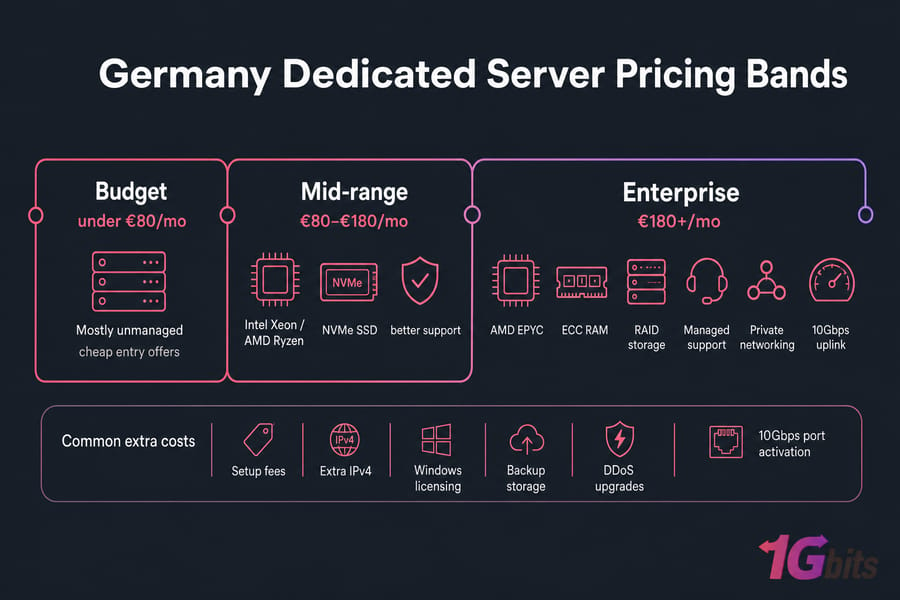
Pricing is all over the place, but there are still useful bands. As a rule, older Xeon boxes with SATA SSD or HDD storage sit at the low end, while EPYC, large ECC RAM footprints, NVMe SSD, Windows licensing, managed support, and 10Gbps uplinks push you into much higher monthly spend.
Budget servers
Budget dedicated server Germany plans generally start under €80 per month. Expect older CPUs, lower RAM ceilings, basic storage, and mostly unmanaged service. This is where you'll find many cheap Germany dedicated server and cheapest dedicated server Germany offers.
Mid-range business servers
The €80 to €180 range is where things get practical for many SMBs. You start seeing newer Intel Xeon or AMD Ryzen chips, better NVMe SSD options, more RAM, and more reasonable support paths. For a lot of agencies and SaaS teams, this is the sweet spot.
Enterprise dedicated servers
Once you cross €180 per month, you're often paying for newer EPYC platforms, larger ECC RAM footprints, RAID storage choices, private networking, managed service layers, compliance extras, and faster uplinks. Enterprise dedicated server Germany buyers can easily go much higher than that if they need 10Gbps, backup retention, clustering, or VMware-ready capacity.
Common extra costs to watch for
- Setup fees
- Extra IPv4 addresses
- Windows Server licensing for a Windows dedicated server
- Control panels and management add-ons
- Backup storage and snapshot services
- DDoS upgrades beyond baseline protection
- 10Gbps port activation or higher traffic commits
And here's the annoying part: some providers advertise low monthly numbers but charge enough in extras to move the box into a totally different category. Double-check everything before checkout.
Managed vs Unmanaged Germany Dedicated Servers
This choice matters more than brand in some cases. I've seen companies buy a cheap unmanaged box, then spend three weeks discovering they actually needed patching, monitoring, backup validation, and someone else to troubleshoot kernel panic logs.
Who should choose managed hosting
Managed dedicated server hosting is the right move if your team doesn't want day-to-day server administration. That usually includes OS updates, security patching, service monitoring, incident response help, and sometimes backup management. It's a strong fit for agencies, SMBs, eCommerce teams, and companies that care more about outcomes than root-level tinkering. If that sounds like you, look at managed dedicated server hosting options first.
Who should choose unmanaged hosting
Unmanaged dedicated server Germany plans are best for sysadmins, developers, DevOps teams, and anyone who wants full root access with minimal provider interference. You install, secure, monitor, and repair it yourself. This is usually cheaper and more flexible. But when something breaks, it's your problem.
Questions to ask before buying
- Do you need root access or just application-level access?
- Who's responsible for patching and firewall rules?
- Do you need monitoring, backups, and alerting included?
- Will you run Linux or a Linux dedicated server stack that your team already knows well?
- Do you need compliance documentation or just raw compute?
- What uptime SLA applies, and what does it actually cover?
Frankfurt vs Other German Data Center Locations
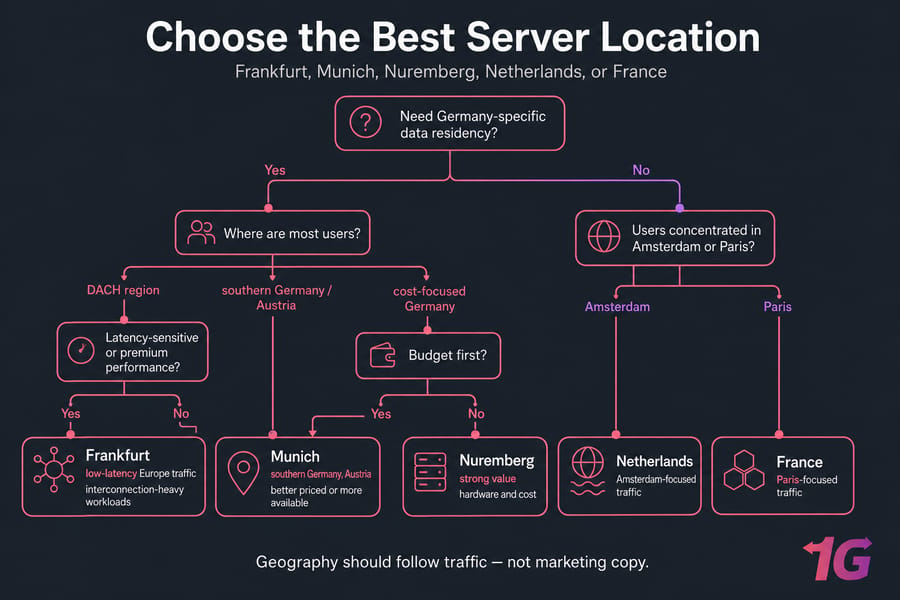
People often search for a Frankfurt dedicated server because Frankfurt has the strongest name recognition. Fair enough. But other German cities can be the better buy depending on your traffic profile and budget.
Frankfurt
Best for low-latency Europe traffic, interconnection-heavy workloads, finance-adjacent applications, and businesses that want the easiest network-location explanation in a boardroom. A dedicated server Frankfurt Germany deployment is often the premium or performance-first choice. DE-CIX makes it one of Europe's major interconnection hubs, which usually means excellent peering paths and strong network density.
Munich
Munich can work well for southern Germany, Austria, and nearby regional demand. It's also a practical option when the provider's Munich inventory is better priced or more available than Frankfurt.
Nuremberg
Nuremberg is especially relevant because of providers like Hetzner and Contabo. It often offers very strong value for technical teams that care more about hardware and cost than the prestige of a Frankfurt label.
When Germany is better than other EU locations
Compared with the Netherlands, Germany may be the stronger choice when you want more direct Germany-specific data residency messaging or when your largest user base is in the DACH region. Compared with France, Germany often has broader dedicated server catalog depth and stronger Frankfurt-led connectivity narratives. Still, if your users are concentrated in Amsterdam, Paris, or Warsaw, those locations can be just as sensible. Geography should follow traffic — not marketing copy.
Best Germany Dedicated Server by Use Case
This section is the practical recap. If you don't care about every provider detail and just want the best match for your situation, start here.
Best for startups and budget projects
Contabo is the obvious budget-first option for startups, labs, and cost-sensitive deployments. Hetzner is close behind for technical buyers who want better value discipline and are comfortable self-managing.
Best for enterprise workloads
Leaseweb is a strong enterprise candidate for customization, networking, and larger deployment planning. 1Gbits also makes sense when configuration flexibility matters and you're not shopping purely on lowest monthly cost.
Best for DDoS-sensitive applications
OVHcloud is the standout here. If you're running game services, public APIs, streaming, or anything that attracts attack noise, this is one of the first names I'd compare against other DDoS-protected dedicated servers.
Best for Windows dedicated hosting
IONOS is often easier for business-oriented Windows workloads, while 1Gbits is worth considering when you need more custom resource planning for a Windows dedicated server Germany deployment.
Best for custom hardware and power users
Hetzner is excellent for technical users chasing value, while Leaseweb and 1Gbits are stronger when the build gets more specialized or network design becomes part of the conversation.
Best for virtualization or VMware
Leaseweb and 1Gbits are both solid picks for virtualization server Germany projects, especially when you need higher RAM ceilings, modern AMD EPYC options, or a more configurable environment.
How to Choose the Right Germany Dedicated Server Provider
You don't need a 50-point procurement sheet to make a good decision. But you do need a few hard questions answered before you buy.
Check CPU, RAM, and storage type
Start with workload reality. Is this a database-heavy app, a game server, a backup node, a hypervisor, or a Windows line-of-business stack? Match that to CPU family, ECC RAM, and storage type. NVMe SSD is usually the right default now. HDD-only boxes are fine for bulk storage, but not for latency-sensitive production apps.
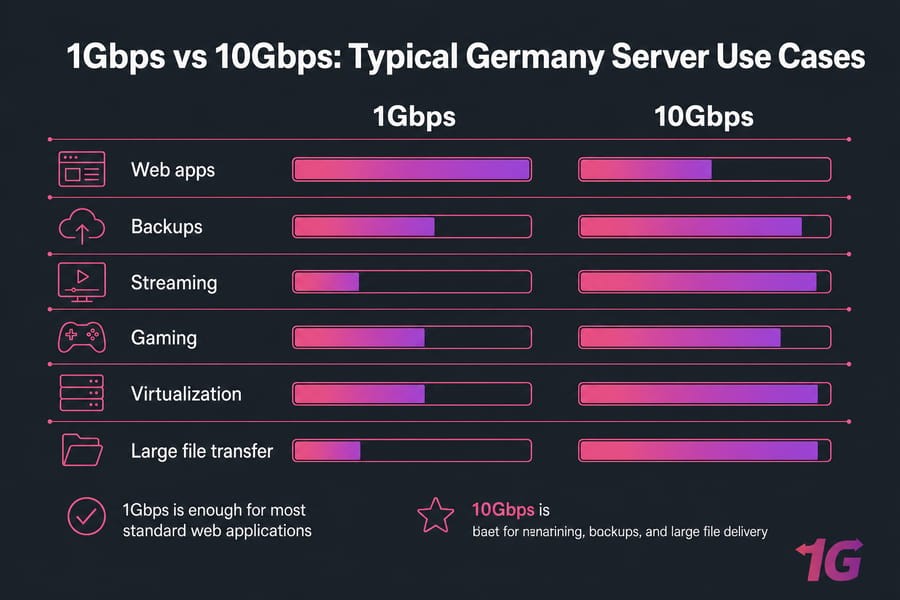
Compare uplink speed: 1Gbps vs 10Gbps
A 1Gbps port is enough for many business applications. A 10Gbps port is worth paying for when you move large data sets, run streaming services, host CDN-like workloads, or expect serious traffic bursts. Also check whether bandwidth is metered, capped, or unmetered bandwidth with fair-use language.
Review SLA, support, and setup times
Ask how fast the server is provisioned, what the uptime SLA actually promises, and whether support is infrastructure-only or genuinely helpful. A server can look great on paper and still be a lousy choice if provisioning time is slow and support disappears when you ask technical questions.
Confirm security, backups, and compliance
Look for DDoS protection, firewall controls, backup options, monitoring, and contract-level documentation for compliance requirements. If you need data residency assurances or vendor review approval, ask before you buy — not after.
Key Features to Compare Before Buying
These are the fields too many buyers skip on the first pass — then regret later.
| Feature | Why it matters | What to check |
| CPU family | Affects single-core speed, virtualization density, and power efficiency | Intel Xeon, AMD EPYC, Ryzen generation |
| RAM | Critical for databases, virtualization, and caching | ECC RAM capacity and upgrade ceiling |
| Storage | Directly impacts latency and throughput | HDD vs SSD vs NVMe SSD, RAID options |
| Network | Shapes transfer speed and burst handling | 1Gbps port, 10Gbps port, metered or unmetered bandwidth |
| Remote management | Essential for recovery and OS installs | IPMI, KVM, iKVM, remote reboot |
| IP allocation | Useful for multiple services and routing needs | Included IPv4, IPv6 support, extra IP pricing |
| OS options | Changes licensing and support path | Linux, Windows, custom ISO support |
| Security | Protects availability and compliance posture | DDoS protection, firewall, monitoring, backups |
| Provisioning | Impacts project timelines | Instant, same day, or several business days |
Germany Dedicated Server Compliance, Security, and GDPR
Let's be a bit blunt here: "GDPR-ready" marketing language is cheap. Actual compliance work is not. A German dedicated server can help with data residency and vendor selection, but it doesn't replace application security, access control, retention policy, encryption, or contract review.
What you should look for is straightforward:
- A clear DPA or equivalent contractual option
- German or EU data residency clarity
- Provider security documentation where available
- DDoS protection and firewall controls
- Backup options, monitoring, and incident response pathways
- Evidence of mature operations, such as ISO 27001-style practices when disclosed
For regulated or procurement-heavy environments, I usually recommend documenting exactly why Germany was chosen. It helps later when legal, security, or compliance teams ask why this host made the cut.
Latency, Network Performance, and Port Speed
Network performance is where a lot of Germany server hosting decisions are won or lost. The difference between a clean 1Gbps port and a congested one isn't theoretical — you feel it during backups, replication, media delivery, and patch windows.
For most standard web applications, 1Gbps is enough. For streaming server Germany setups, large file delivery, high-traffic APIs, or storage-heavy sync workloads, 10Gbps can be worth every extra euro. Just make sure the upstream traffic policy doesn't quietly limit the practical benefit.
Latency matters too. Frankfurt usually offers the strongest low-latency Europe profile for broad regional traffic, but actual user experience depends on peering, congestion, and where your customers really are.
Alternatives: Germany vs Netherlands vs France Dedicated Servers
If your audience is spread across Europe, Germany is often the safe default. But it isn't automatically the winner every time.
| Location | Best for | Strength | Watch out for |
| Germany | DACH markets, central EU routing, GDPR-sensitive buyers | Frankfurt connectivity, strong provider choice, data residency appeal | Premium locations can cost more |
| Netherlands | Western Europe traffic, international hosting fleets | Excellent connectivity and mature hosting market | Not always the strongest pick for Germany-specific residency messaging |
| France | France-heavy audiences and some enterprise deployments | Good regional reach and enterprise options | May offer fewer obvious Germany-centric routing benefits for DACH users |
So what does this actually mean? If your customers are mostly in Germany and nearby central Europe, Germany usually wins. If your traffic is more west-facing and globally mixed, the Netherlands may compete closely. France is sensible when the audience is France-first.
Conclusions
Germany, with its solid infrastructure, guarantees GDPR compliance and low latency throughout Europe, and is conspicuous among destinations for devoted hosting.
Ready to deploy? Browse all dedicated server plans here: Buy Dedicated Server
While each provider from Hetzner, Contabo, OVHcloud, Leaseweb, IONOS, and STRATO takes pride in its distinctly individual strengths, 1Gbits should rightly be considered the overall winner in 2026 because of competitive pricing, absence of setup fees, the presence of data centers across the globe, including Frankfurt, flexible OS support, and an enterprise-grade uptime backed by round-the-clock expert support.
Ready to get started? Explore 1Gbit's high-performance German dedicated servers:

Leave A Comment