


Picking a dedicated server provider sounds easy until you actually start comparing them. Then you realize every company claims top-tier performance, rock-solid uptime, premium support, and "enterprise" hardware even when the plans are wildly different.
This guide is for developers, sysadmins, SMB owners, ecommerce teams, agencies, and IT buyers who need a real comparison, not a thin listicle. I'm looking at dedicated server hosting through the lenses that actually matter in production: hardware quality, network reliability, security, support, management options, global reach, and overall value.
And one quick disclosure: 1Gbits offers dedicated servers, so it's included here. That inclusion is based on the same criteria used for the rest of the list, and where there are tradeoffs, I'll call them out plainly.
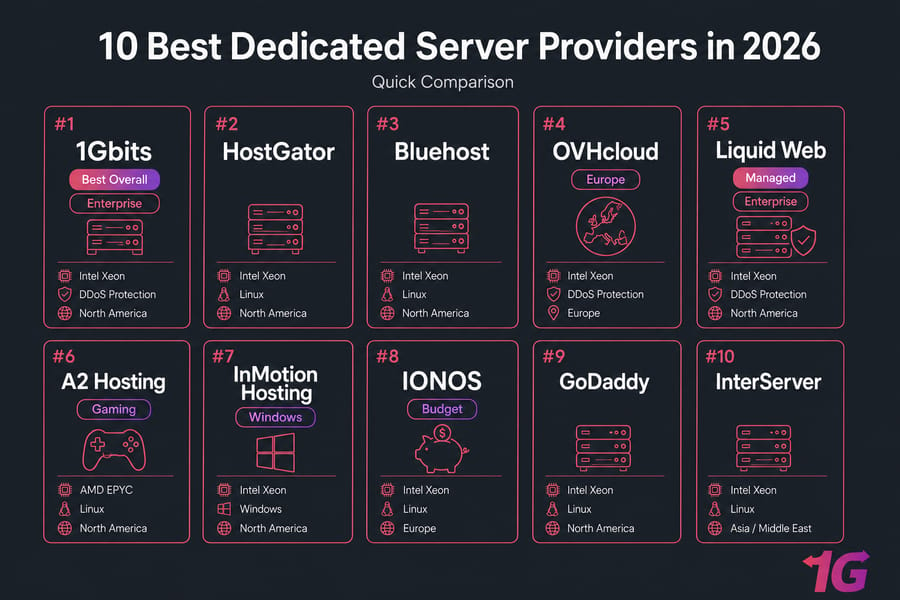
Quick Comparison of the Best Dedicated Server Providers
If you want the short version first, here it is. These are the providers that stand out for different reasons — not because one company magically fits everyone.
Dedicated server provider comparison table
| Provider | Best for | Starting price | Managed/Unmanaged | OS options | Data center regions | Support channels |
| 1Gbits | Global locations and flexible dedicated server plans | Pricing varies by configuration | Managed and unmanaged | Linux, Windows | North America, Europe, Asia, Middle East | Ticket, sales, support |
| HostGator | Support-focused users | Pricing varies by plan | Primarily managed-style support experience | Linux, Windows availability varies | Mainly US-focused | Chat, phone, ticket |
| Bluehost | WordPress-friendly environments | Pricing varies by configuration | Managed-style tooling, not fully hands-off | Linux-focused | Mainly US | Chat, phone |
| OVHcloud | European hosting and network scale | Pricing varies by region and hardware | Mostly unmanaged | Linux, Windows | Europe, North America, Asia-Pacific | Ticket, phone on some plans |
| Liquid Web | Managed dedicated hosting | Pricing varies by server class | Managed | Linux, Windows | US, Europe | Phone, chat, ticket |
| A2 Hosting | Performance-focused SMBs | Pricing varies by plan | Managed and unmanaged options | Linux, some Windows options vary | US, Europe, Asia | Chat, ticket, phone |
| InMotion Hosting | Business hosting | Pricing varies by term and server | Managed and unmanaged | Linux, Windows on select offerings | US, Europe options vary | Phone, chat, ticket |
| IONOS | Budget entry point | Pricing varies by promotion and region | Mostly self-managed with add-ons | Linux, Windows | US, Europe | Phone, chat, help center |
| GoDaddy | Brand familiarity | Pricing varies by server generation | Managed and self-managed options vary | Linux, Windows | North America, Europe, Asia | Phone, chat |
| InterServer | Straightforward unmanaged value | Pricing varies by configuration | Unmanaged and add-on management | Linux, Windows | Mainly US | Ticket, chat, phone |
How We Chose the Best Dedicated Server Providers
A "best dedicated server providers" page without a methodology is basically just opinion dressed up as research. So here's the framework I used.
I weighted six factors most heavily: performance and hardware quality, uptime and network reliability, security protections, support and management options, pricing and value, and global data center coverage. Use-case fit mattered too. A provider can be excellent for gaming or enterprise workloads and still be a poor fit for a budget-conscious small business.
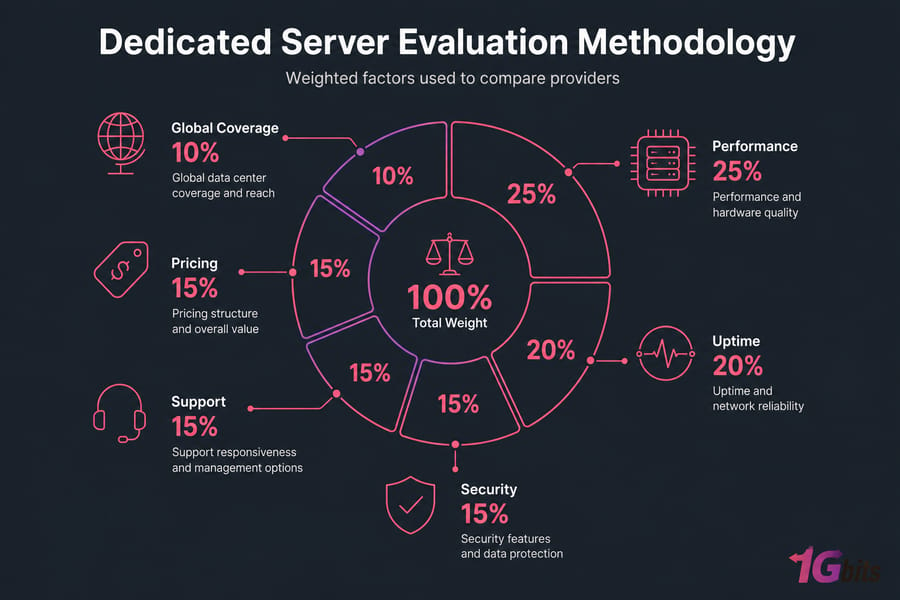
Performance and hardware
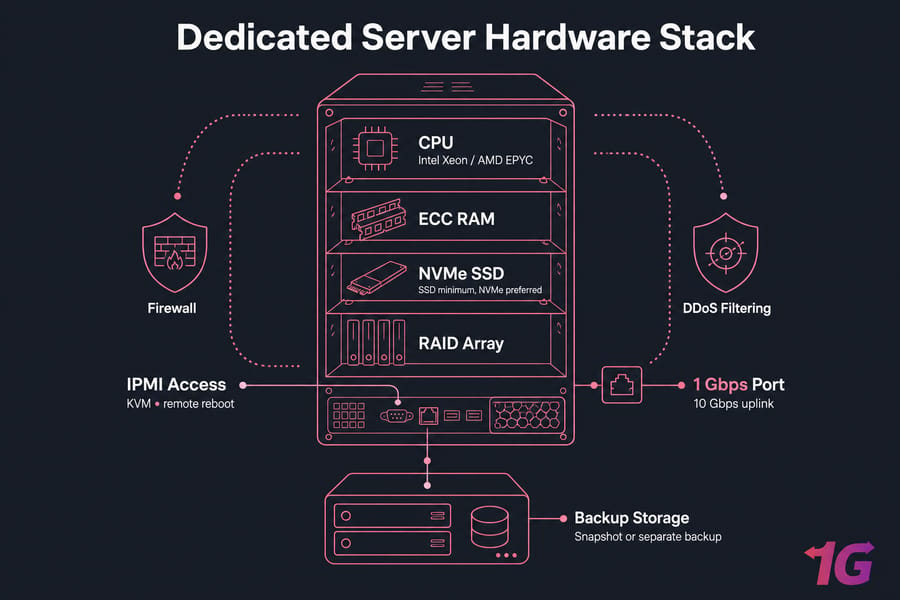
Not all dedicated server plans are built on equal hardware. I looked for current or still-competitive CPU families like Intel Xeon and AMD EPYC, realistic RAM ceilings, ECC RAM availability, NVMe SSD options, RAID storage support, and 1 Gbps or 10 Gbps uplink potential. That stuff sounds dry, but it directly affects whether your app stays responsive under load.
Uptime and network reliability
Uptime SLA matters, but so does the network behind it. I gave extra credit to providers with strong backbone connectivity, low latency network design, multiple data center regions, and a track record of stable routing.
Security and DDoS protection
Secure dedicated server hosting should include more than a login page and good intentions. I looked for DDoS mitigation, firewall options, access control, backup options, monitoring, RAID support, and signs that the provider takes incident response seriously.
Support and management options
Some teams want root access, IPMI, remote reboot, and nothing else. Others need help with patching, migrations, cPanel or Plesk setup, and ongoing server management. I scored providers differently based on how clear and usable their managed or unmanaged hosting paths are.
Pricing and value
I didn't simply reward the cheapest plan. Cheap dedicated server hosting can be fine, but only if the hardware, bandwidth allocation, and support still make sense. I looked at the total picture: setup fees, backup charges, control panel licensing, Windows licensing, overage costs, and whether the configuration matched the asking price.
Global data center coverage
Location can make or break your deployment. If your users are in Frankfurt and your server is in Dallas, no amount of marketing copy will remove that latency. Providers with wider global footprints got a boost, especially if they offer region-specific deployment options. If you're still evaluating hardware and location together, read how to choose a dedicated server.
The Best Dedicated Server Providers Reviewed
Each provider gets a practical summary: what it's good at, where it falls short, and who should actually buy it.
1Gbits — Best for global locations and flexible dedicated server plans
1Gbits stands out for buyers who care about deployment flexibility. The catalog covers dedicated server plans in multiple regions, with Linux and Windows options, managed and unmanaged paths, and adjacent products like GPU dedicated servers and instant dedicated server deployments. That breadth matters if you're running international workloads, agency client stacks, or applications that need hardware in a specific geography.
1Gbits delivers high-performance servers with powerful processors, high-speed SSD/NVMe storage, and ample RAM. The global network of data centers ensures low latency across North America, Europe, and Asia. Security includes DDoS protection, firewall management, and 24/7 monitoring. Support is available round-the-clock via telephone, live chat, and knowledge base.
Pricing is flexible with options ranging from cheap dedicated servers to enterprise-grade setups. For deals, check the dedicated server outlet. Full pricing at dedicated server pricing. Both Linux and Windows are supported. There's also an dedicated server with crypto.
The limitation? Breadth can make buying feel configuration-heavy. But if you know what you need or know you'll need room to grow it's a strong option.
Best for: Global deployments, flexible dedicated hosting, mixed Linux/Windows estates
Key strengths: Region choice, customization, managed and unmanaged options, broad product range
Weaknesses: Less simplified than beginner-centric brands
Ideal user: Sysadmins, agencies, SMBs, and scaling teams with specific location or hardware needs
HostGator — Best for support-focused users
HostGator appeals to users who value a familiar interface and accessible support. Its dedicated server hosting works well for businesses wanting a recognizable provider and lower-friction onboarding. Support accessibility and approachable product positioning are the main draws. For basic business applications, internal sites, moderate ecommerce, or busy client properties, it does the job.
Where it loses points is cutting-edge infrastructure depth. If you need top-end AMD EPYC, broad region selection, or specialized networking, you'll outgrow it. Competent rather than elite.
Best for: Buyers who prioritize support and familiar hosting workflows
Key strengths: Accessible support, easier onboarding, business-friendly packaging
Weaknesses: Less appealing for advanced custom infrastructure needs
Ideal user: SMB owners moving up from shared or VPS hosting
Bluehost — Best for WordPress-friendly environments
Bluehost comes up when people move from WordPress hosting into more isolated infrastructure. Its dedicated offerings make sense as a smoother jump without learning a new ecosystem overnight. For WordPress-heavy stacks or consolidating busy sites onto one machine, it's a reasonable bridge.
Not the pick for highly customized enterprise builds, compliance-heavy apps, or globally distributed workloads. It feels tuned to general web hosting customers rather than hardcore infrastructure buyers.
Best for: WordPress-oriented deployments graduating to dedicated hosting
Key strengths: Familiar ecosystem, accessible management, decent business use fit
Weaknesses: Limited appeal for complex custom infrastructure projects
Ideal user: Content sites, agencies, and growing WordPress businesses
OVHcloud — Best for European hosting
OVHcloud is one of the first names for dedicated server hosting in Europe, anti-DDoS capabilities, or a more infrastructure-centric provider. Strong European presence and serious reputation in the bare metal market. Hardware range is compelling, and the network side is where OVHcloud earns attention. For gaming, public-facing apps, edge-sensitive workloads, or cost-conscious self-managed deployments, it's a very strong fit.
Not beginner-friendly. The unmanaged feel is strong, and support expectations should be set accordingly.
Best for: European hosting, DDoS-sensitive workloads, self-managed infrastructure
Key strengths: Strong anti-DDoS, broad hardware, solid network reputation
Weaknesses: Less polished for users wanting concierge-style management
Ideal user: Sysadmins, gaming operators, infrastructure-savvy businesses
Liquid Web — Best managed dedicated server option
Liquid Web belongs near the top for managed dedicated hosting. Built around support, server management, business continuity, and higher-touch service. Attractive for ecommerce brands, SaaS teams, agencies, and companies without a full in-house ops bench. Less time on patching, troubleshooting, migrations, and late-night fire drills. The premium is often worth it if downtime is expensive.
The downside is price. It won't win a budget shootout, and if you're comfortable handling your own stack, you may pay for services you don't need. Read more in managed vs. unmanaged dedicated servers.
Best for: Managed dedicated hosting
Key strengths: Strong support, managed services, business-oriented service model
Weaknesses: Higher cost than lean unmanaged providers
Ideal user: Ecommerce stores, SaaS teams, agencies, ops-light businesses
A2 Hosting — Best for performance-focused SMBs
A2 Hosting has built its reputation around speed. For SMBs that care about faster storage and responsive hosting without enterprise pricing, it deserves a look. Dedicated plans work well for web apps, business sites, and stores needing better throughput than entry-level hosting.
The tradeoff: not the deepest option for global reach or highly specialized plans. Good middle ground, though.
Best for: Performance-conscious small and midsize businesses
Key strengths: Fast storage options, practical plan range, business-friendly fit
Weaknesses: Not the broadest global or enterprise-focused platform
Ideal user: SMBs, agencies, fast-growing sites, app owners
InMotion Hosting — Best for business hosting
InMotion Hosting lands in the "safe business choice" category. Solid blend of support, business hosting features, and dedicated server options that don't feel stripped down or overcomplicated. For line-of-business apps, multisite stacks, ecommerce storefronts, or agency projects, the balance works.
Top-end enterprise workloads may demand more specialized hardware or networking than InMotion is known for. For most mainstream business cases, a dependable shortlist candidate.
Best for: Business hosting and practical dedicated deployments
Key strengths: Balanced plans, support availability, good SMB fit
Weaknesses: Less compelling for highly specialized enterprise requirements
Ideal user: SMBs, agencies, established online businesses
IONOS — Best budget entry point
IONOS is where people look for an affordable dedicated server without premium pricing. For smaller apps, staging environments, internal tools, modest ecommerce, or first dedicated migration, it's a realistic starting point. Monthly costs don't spiral immediately.
The catch: budget hosting involves tradeoffs — fewer premium support layers, less hardware flexibility, more self-management.
Best for: Budget-conscious dedicated hosting buyers
Key strengths: Lower barrier to entry, decent starter value, broad appeal
Weaknesses: Less premium support and hardware depth than higher-end competitors
Ideal user: Small businesses, developers, first-time dedicated server users
GoDaddy — Best for brand familiarity
GoDaddy gets shortlisted because people know the brand. Inside small companies where owners or procurement teams want a familiar vendor, that matters. Its dedicated hosting and bare metal-style options fit buyers who prefer staying under one well-known umbrella.
Rarely at the top for value or infrastructure sophistication. Compare specs and included services carefully before committing.
Best for: Buyers who value a familiar hosting brand
Key strengths: Brand trust, broad product ecosystem, accessible buying path
Weaknesses: Value and technical depth may lag more infrastructure-focused providers
Ideal user: Small businesses already using the broader GoDaddy ecosystem
InterServer — Best for straightforward unmanaged value
InterServer is often underrated. It appeals to buyers who don't need a fancy marketing wrapper and are comfortable managing the environment themselves. Decent dedicated hardware, practical monthly billing, fewer layers of unnecessary polish. For developers and sysadmins, that simplicity saves money.
Weaker in premium managed services and broad international presence.
Best for: Self-managed buyers seeking solid value
Key strengths: Straightforward pricing, customization, good fit for technical users
Weaknesses: Limited premium management and narrower geographic reach
Ideal user: Developers, sysadmins, smaller technical teams
Best Dedicated Server Providers by Use Case
There isn't one universal winner. There are several good fits depending on what you're actually deploying.
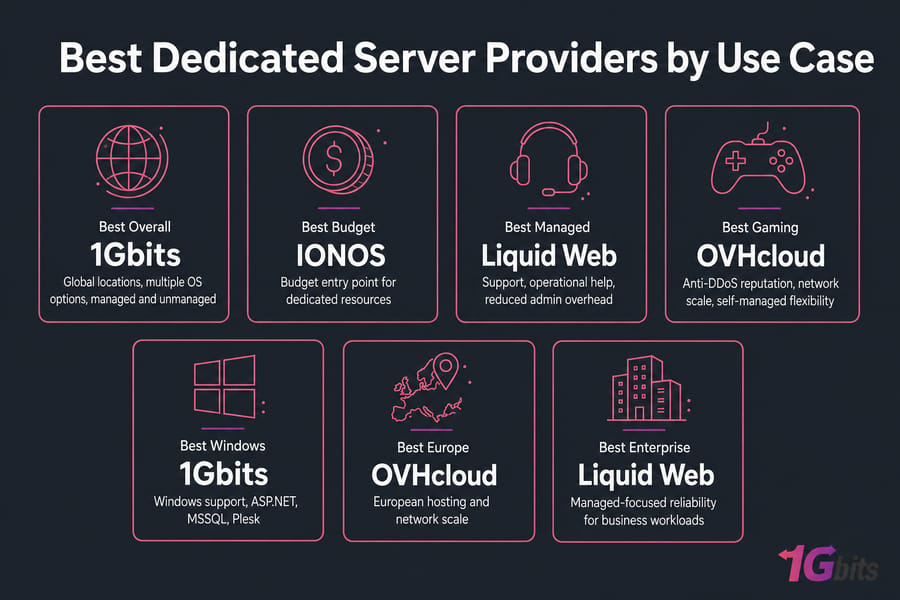
Best overall
1Gbits gets the nod for overall flexibility. It covers global locations, multiple OS options, both managed and unmanaged hosting, and a broad range of hardware styles. Start from the main dedicated server page to explore plans.
Best budget dedicated server
IONOS is the best budget entry point for buyers who need dedicated resources without premium managed pricing on day one.
Best managed dedicated server
Liquid Web is the pick for support-heavy deployments.
Best dedicated server for gaming
OVHcloud stands out for gaming due to anti-DDoS reputation, network scale, and self-managed flexibility. We also offer game dedicated servers optimized for this use case.
Best Windows dedicated server hosting
1Gbits is the strong option for Windows-specific needs like ASP.NET, MSSQL, or Plesk. Compare Windows dedicated server hosting configurations directly.
Best for Europe
OVHcloud remains the natural choice for Europe thanks to regional strength and network footprint. Also explore Europe Dedicated Server options and the benefits of hosting in Europe.
Best for enterprise workloads
Liquid Web and 1Gbits are both solid contenders depending on whether you need heavier management or more deployment flexibility. Enterprises care more about uptime, support quality, and scaling path than sticker price.
What to Look for in a Dedicated Server Provider
When you compare dedicated server hosting companies, you're really asking: will this box handle my workload without causing operational pain?
CPU, RAM, and storage
Modern Intel Xeon or AMD EPYC processors are the baseline. RAM: 16-32 GB for smaller sites, 64-128 GB for larger stores and databases. Storage should be SSD minimum, NVMe preferred for IOPS-heavy apps. RAID support matters for redundancy.
Bandwidth and port speed
Check port speed and acceptable use policy. 1 Gbps is common and often enough. 10 Gbps matters for high-throughput media, streaming, and gaming. Watch for overage costs on cheap plans.
Uptime SLA
An SLA gives a contractual baseline. Read the remedies and exclusions. A 99.9% SLA with slow incident response is still miserable in practice.
DDoS protection and security
Look beyond the checkbox: what level of filtering is included? Is mitigation always-on? How is traffic rerouted during attacks? Especially critical for gaming, fintech, and public APIs.
Root access and control panel
Technical teams want root access, IPMI, KVM, and remote reboot. Less technical buyers prefer cPanel or Plesk. Make sure the host supports how you work.
Backup and monitoring
Backups should be automatic, tested, and stored off-server. Monitoring should cover CPU, RAM, disk health, and service checks. Incomplete backup verification is incomplete protection.
Managed vs unmanaged options
Managed saves time for ops-light teams. Unmanaged gives control and price efficiency for skilled admins.
Dedicated Server Features to Compare
- CPU generation: Modern Intel Xeon or AMD EPYC over old inventory
- ECC RAM: Better stability for business-critical and database workloads
- Storage: SSD minimum, NVMe preferred for performance-heavy apps
- RAID support: Helpful for fault tolerance
- Port speed: 1 Gbps common, 10 Gbps uplink for heavier throughput
- Bandwidth allocation: Watch caps and overages
- DDoS protection: Included vs paid add-on makes a big difference
- OS options: Linux and Windows availability, plus licensing clarity
- Control panel support: cPanel, Plesk, or none
- Remote management: IPMI, KVM, remote reboot
- Backup options: Snapshot or separate backup storage
- Monitoring: Basic server monitoring vs active managed oversight
- Provisioning time: Instant, same day, or several days
- Migration support: Especially useful for ecommerce and agency moves
Dedicated Server Pricing: How Much Should You Pay?
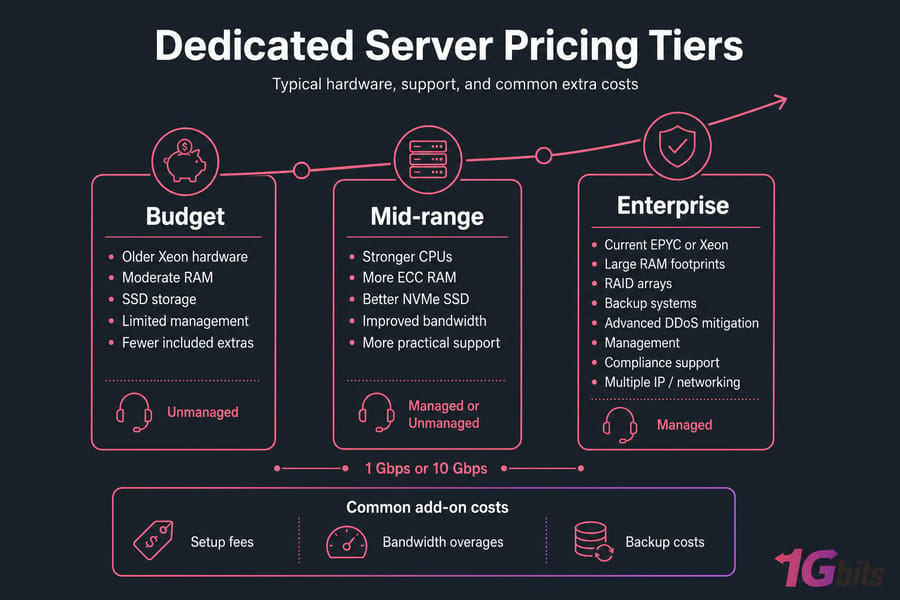
Dedicated server pricing varies widely because "dedicated server" can mean anything from an older entry box to a current-generation enterprise system. Here are practical ranges.
Budget servers
Budget dedicated servers usually feature older Xeon hardware, moderate RAM, SSD storage, and limited management. Acceptable for staging, lighter workloads, dev environments, or modest apps. Explore cheap dedicated server options.
Mid-range servers
Mid-tier plans are where serious SMB and ecommerce deployments live. Stronger CPUs, more ECC RAM, better NVMe availability, improved bandwidth, and more practical support.
Enterprise servers
Enterprise pricing climbs with large RAM footprints, current EPYC or Xeon chips, RAID arrays, backup systems, advanced DDoS mitigation, and compliance support. Expensive because operational expectations are expensive.
Hidden costs to watch for
- Setup fees: Some providers still charge one-time provisioning fees
- Bandwidth overages: Cheap plans may punish heavy traffic
- Backup costs: Off-server backups are often extra
- Control panel licensing: cPanel and Plesk not always included
- Windows licensing: Can materially raise monthly cost
- Managed service add-ons: Monitoring, patching, and admin time may cost more
- DDoS protection upgrades: Basic protection may be limited
Best Dedicated Server Hosting for Gaming
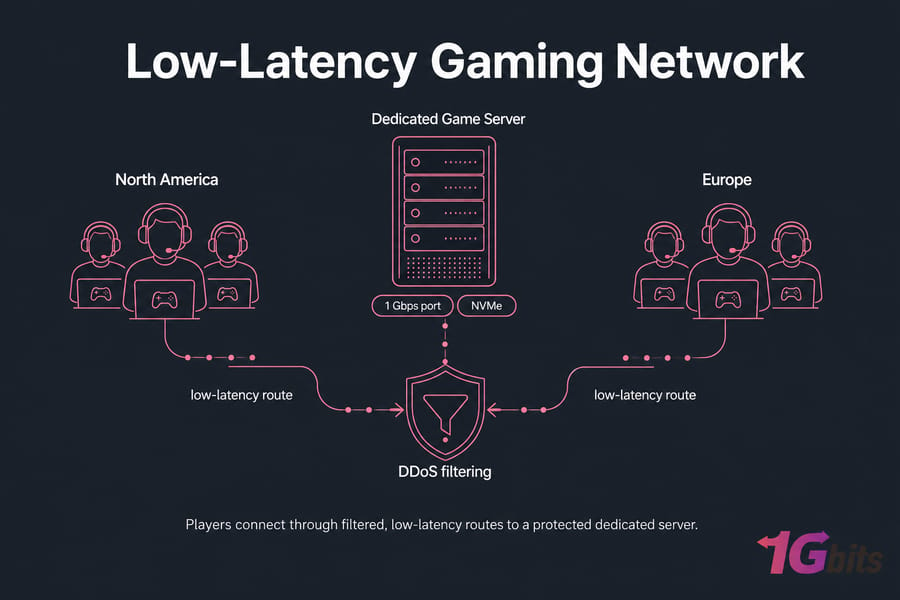
Gaming workloads are their own beast. Players notice latency, jitter, CPU bottlenecks, and packet loss immediately.
Required specs for game hosting
Focus on strong single-core performance, enough RAM for player count and mods, NVMe storage, low latency routing, 1 Gbps port minimum, and real DDoS mitigation. Gaming communities are frequent attack targets.
Best dedicated server for Minecraft
Minecraft benefits from fast cores, ample RAM, and storage that handles chunk generation and modded environments. Compare a dedicated box against specialized Minecraft server hosting sometimes purpose-built is enough, sometimes you outgrow it.
Best for low-latency multiplayer
OVHcloud is a strong pick for anti-DDoS and network design. 1Gbits is worth a look if location flexibility matters more to your player base.
📊 Top 10 Dedicated Server Hosting Companies
- 1Gbits
- HostGator
- Bluehost
- OVHcloud
- Liquid Web
- A2 Hosting
- InMotion Hosting
- IONOS
- GoDaddy
- InterServer
Final Verdict: Best Dedicated Server Provider for Different Needs
There isn't a single best dedicated server provider for everyone.
Best overall: 1Gbits, for flexibility, global locations, and broad plan coverage.
compare buy dedicated server options, or narrow by bare metal servers, managed dedicated servers, or unmanaged dedicated servers.
Best budget: IONOS, for lower-cost entry into dedicated hosting.
Best managed: Liquid Web, for support-heavy business deployments.
Best for Europe: OVHcloud, for regional strength and network reputation.
Best for gaming: OVHcloud, with 1Gbits as a strong alternative where location flexibility matters.
Best for Windows hosting: 1Gbits, for Windows-specific deployment options.
Next: For OS-specific needs, start with Windows dedicated servers or Linux dedicated servers

Leave A Comment