

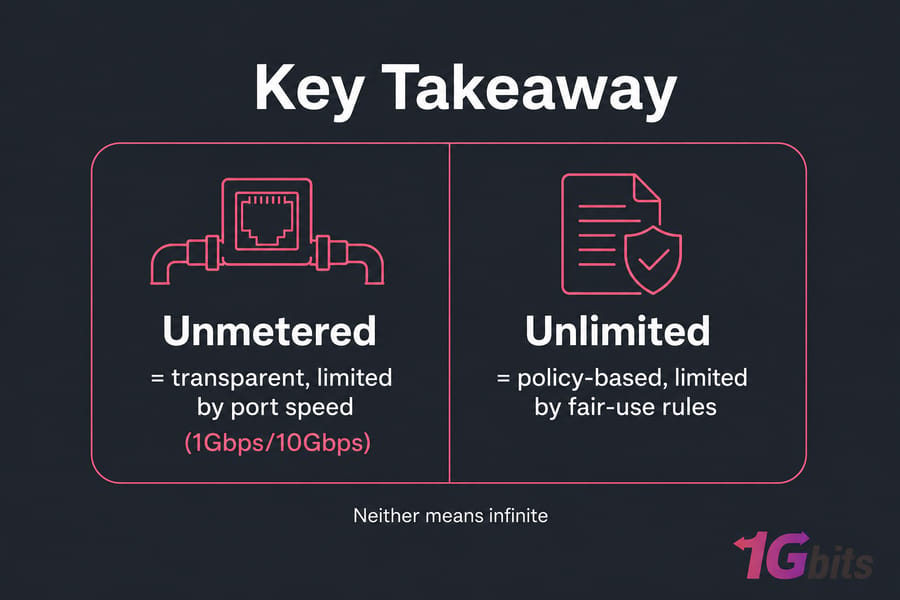
Here's the short version. Unmetered bandwidth means your hosting traffic isn't billed by how many gigabytes you move each month but it's still capped by your server's port speed, like 1Gbps or 10Gbps. Unlimited bandwidth is mostly a marketing term that usually means no published transfer cap, but fair-use rules, throttling, or shared-resource limits can still kick in.
So when you compare unmetered vs unlimited bandwidth, neither one literally means "infinite." That word doesn't exist in real hosting. One limits you by raw line speed; the other limits you by policy.
| At a glance | Unmetered | Unlimited |
| Real limit | Port speed (line rate) | Fair-use / acceptable use policy |
| Billing | No metered transfer charges | No published cap |
| Best for | Heavy, predictable traffic | Light to moderate traffic |
Is unmetered the same as unlimited?
No. They get used interchangeably in ads, but they're not the same thing. Unmetered tells you exactly what your ceiling is the port. Unlimited hides the ceiling inside a policy document.
Which one is usually better for hosting buyers?
For anyone running real traffic streaming, downloads, game servers — unmetered is usually the more honest deal. You can check 1Gbits unmetered VPS hosting and unmetered dedicated server options if predictable throughput matters to you. To choose correctly, though, you first need to understand what each term actually means.
What is unmetered bandwidth in hosting?
Unmetered bandwidth means the provider doesn't count or bill you for the total amount of data you transfer in a month. There's no "you used 5TB, here's an overage charge" surprise. You pay a flat rate, and you move as much traffic as your connection physically allows.
And that last part matters. The limiting factor isn't a monthly cap it's your port speed, also called the uplink or line rate.
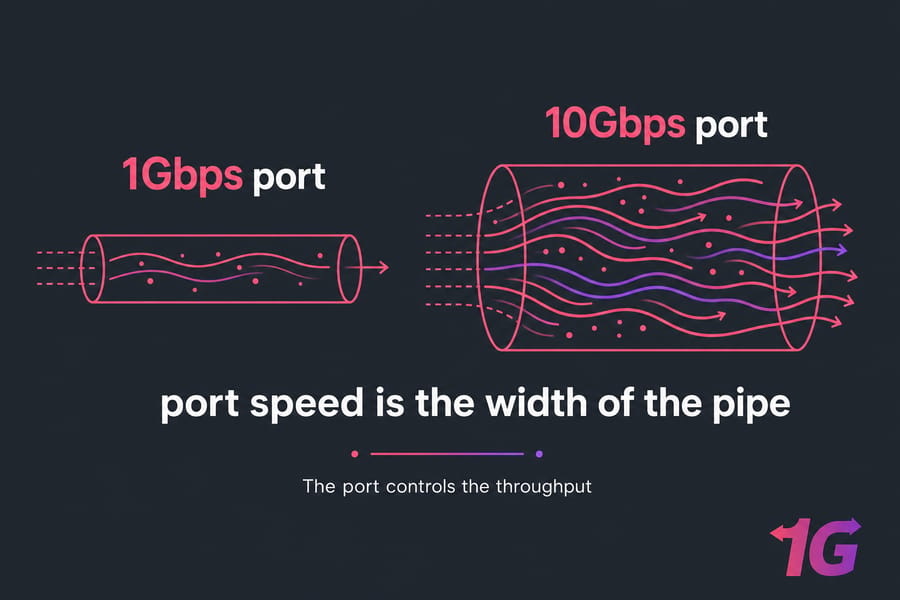
How unmetered bandwidth works on a 1Gbps or 10Gbps port
Think of the port as a pipe. A 1Gbps port can push data at up to 1 gigabit per second. A 10Gbps port pushes ten times that. Unmetered means you can run that pipe full all month long without paying per gigabyte — but you can never exceed the pipe's width.
That's the key. Unmetered controls the billing. The port controls the throughput. People mix these up constantly. For more on the speed side, our guide on Mbps meaning breaks it down further.
Does unmetered bandwidth still have limits?
Yes — two of them. First, the port speed ceiling I just described. Second, the provider's network policies. Most hosts still have an acceptable use policy banning things like illegal content or network abuse. Unmetered doesn't mean "do whatever you want." It means "we won't charge you by the gigabyte."
Who should choose unmetered bandwidth?
If your traffic is heavy and somewhat predictable, unmetered is a clean fit. Streaming platforms, download mirrors, backup targets, busy game servers — these all benefit from knowing exactly what their throughput ceiling is. 1Gbits offers unmetered VPS and dedicated server plans built specifically for workloads that need sustained, high-throughput capacity.
Unmetered can be ideal when your traffic is heavy and steady. But that doesn't make it identical to unlimited.
What is unlimited bandwidth and how do hosts define it?
Unlimited bandwidth, in hosting marketing, usually means there's no advertised transfer cap. No "500GB/month" number on the plan page. Sounds great. And honestly, for a lot of small sites, it works fine.
But "unlimited" lives in the fine print. The real limits are usually buried in the provider's terms.
Is unlimited bandwidth really unlimited?
Almost never in a literal sense. Here's what typically holds it back:
- Fair-use policy — vague language that lets the host throttle or suspend "excessive" accounts
- Throttling — your speed gets dialed down after heavy usage
- Shared resources — CPU, disk I/O, and RAM limits cap how much you can actually push
- Acceptable use policy — restrictions on streaming, file-sharing, proxies, and similar data-heavy uses
What fair-use policies usually mean
A fair-use policy is the host's way of saying "unlimited, within reason." It exists because if one customer maxed out the line 24/7, everyone else on shared infrastructure would suffer. That's why unlimited shows up far more often on shared and entry-level plans than on high-performance servers. It's easier to market and easier to oversell.
When unlimited bandwidth can be enough
Don't write off unlimited entirely. For a brochure site, a blog, a small business page with moderate traffic — unlimited is often perfectly fine. You'll likely never hit the fair-use ceiling. If you're new to this, our explainer on what VPS hosting is gives helpful context. Now let's compare both terms side by side in the ways that actually matter to buyers.
Unmetered bandwidth vs unlimited bandwidth: key differences
This is where it clicks. The two terms differ across billing, transparency, performance expectations, and risk.
| Feature | Unmetered Bandwidth | Unlimited Bandwidth |
| Definition | No metered transfer billing | No published transfer cap |
| How limits work | Capped by port speed (1Gbps/10Gbps) | Capped by fair-use & resource policy |
| Transparency | High — you know the exact ceiling | Lower — limits live in the terms |
| Risk of throttling | Low (you control the pipe) | Possible after heavy use |
| Best use case | Streaming, downloads, gaming, backups | Websites with light-to-moderate traffic |
| Ideal user | Buyers who need predictable throughput | Buyers with modest, bursty needs |
Unmetered is easier to model technically. You take your port speed, do a little math, and you know your hard ceiling. Unlimited is easier to market but its real limits depend on policy — and policy can change.
For buyers, the takeaway is simple. If you can predict heavy usage, go unmetered. If your needs are modest, unlimited might save you money. Browse VPS hosting plans or dedicated servers once you know which camp you're in.
One reason this whole topic confuses people is that buyers mix up bandwidth with speed.
Bandwidth vs speed: why this hosting term causes confusion
Let's clear this up, because it trips up almost everyone.
Bandwidth (in the data-transfer sense) is the total amount of data moved over time — say, terabytes per month. Speed, or port speed, is the rate at which data flows — measured in Mbps or Gbps. Throughput is the actual rate you achieve in practice.
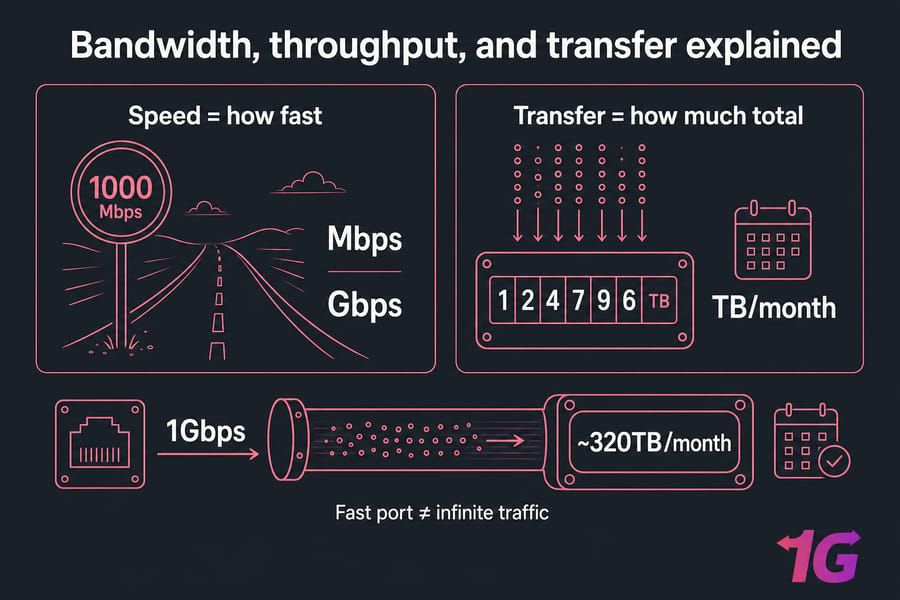
Bandwidth, throughput, and transfer explained
Picture a highway. Speed is how many lanes wide it is — how fast cars move at once. Monthly transfer is how many cars passed through over the whole month. A wide highway lets a lot of cars through, but it's still not infinite.
Why a fast port does not mean infinite traffic
This is the core misunderstanding. A 1Gbps unmetered port is fast, sure. But "fast" and "infinite" aren't the same. The pipe has a width. You can fill it, but you can't make it wider than 1Gbps.
Example: 1Gbps speed vs monthly TB transfer
Here's the rough math (theoretical, real-world is lower due to overhead). A 1Gbps port running flat-out for a full month could move somewhere around 320TB. A 10Gbps port? Roughly 3,200TB. Big numbers — but bounded numbers.
| Port Speed | Theoretical max monthly transfer* | Best for |
| 100Mbps | ~32TB | Small sites, low traffic |
| 1Gbps | ~320TB | Streaming, downloads, gaming |
| 10Gbps | ~3,200TB | Heavy media, CDN origin, mirrors |
*Theoretical line-rate figures. Real throughput is lower after protocol overhead and network congestion.
Want more on the speed and quality side? See our pieces on what latency is and packet loss explained. With the terminology clear, the next question is when each model makes sense.
High bandwidth hosting use cases: when unmetered makes more sense
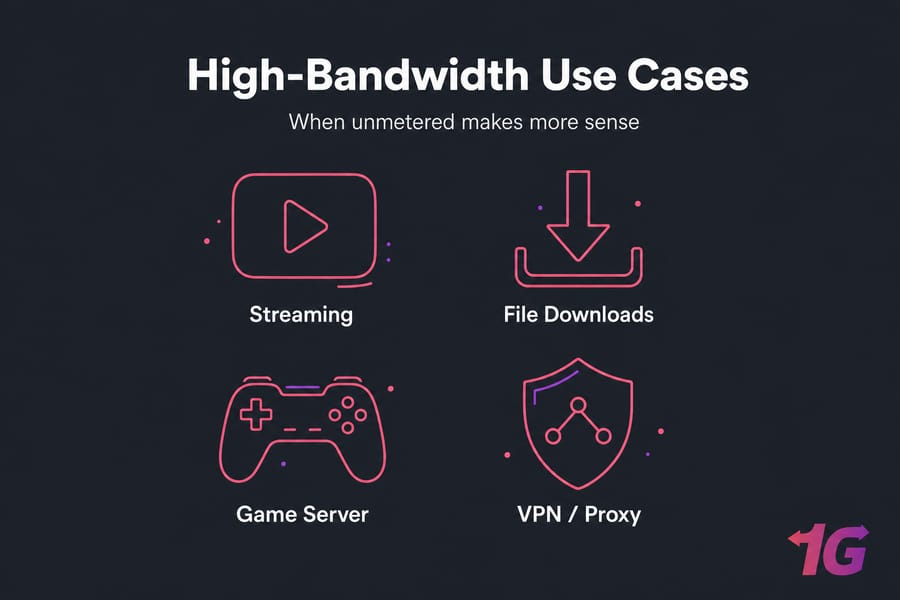
Some workloads eat bandwidth for breakfast. For these, unmetered usually wins because you get predictable throughput without per-gigabyte anxiety.
Streaming servers and media delivery
Video streaming is sustained, outbound, and heavy. Every concurrent viewer pulls a steady stream. Metered billing here gets expensive fast, and unlimited plans often throttle streaming under fair-use. A dedicated streaming VPS or a properly specced unmetered server makes more sense. Our server for streaming bandwidth guide goes deeper.
File hosting, backups, and large downloads
Mirror servers, backup targets, large file distribution — these push enormous sustained transfer. This is exactly where unlimited plans tend to flag your account. Look at storage server solutions built for high-transfer work.
Game servers and high-concurrency traffic
Game servers don't move massive data per player, but concurrency and consistency matter enormously. Throttling kills the experience. An unmetered game VPS hosting plan gives you steady throughput when the lobby fills up.
VPNs, proxies, and data-heavy apps
VPNs and proxies are almost always restricted or banned under unlimited fair-use terms. They're sustained and bandwidth-hungry by nature. Unmetered with a clear acceptable-use policy is the safer route.
For a brochure site or low-traffic blog? Unlimited is genuinely fine. The split comes down to sustained vs bursty traffic. If your workload sounds familiar, the next step is estimating how much bandwidth you actually need.
How much bandwidth do you need for hosting?
You don't need a networking degree for this. Here's a simple formula:
Average page or file size × number of visits/downloads/streams × frequency = monthly transfer
Concurrency matters too. Ten people downloading at once is very different from ten people spread across a day. And in most hosting cases, outbound traffic (what you send to users) dominates.
| Use case | Avg transfer per unit | Traffic volume | Recommendation |
| Small business website | ~2MB/page | 20k visits/mo | Unlimited often fine |
| Busy media site | ~5MB/page | 500k visits/mo | Unmetered VPS |
| Game patch/download server | ~3GB/download | 50k downloads/mo | Unmetered, 1Gbps+ |
| Video streaming | ~1.5GB/hour viewed | High concurrency | Unmetered 1Gbps–10Gbps |
A CDN can offload some delivery and smooth out traffic spikes, but it's a helper — not a replacement for solid core bandwidth planning. If your origin server can't keep up, the CDN won't save you. Keep an eye on performance with our guides on monitoring VPS speed and VPS performance bottlenecks.
Once you know your workload, choosing between VPS and dedicated infrastructure gets much easier.
How to choose between an unmetered VPS and other hosting plans
When an unmetered VPS is enough
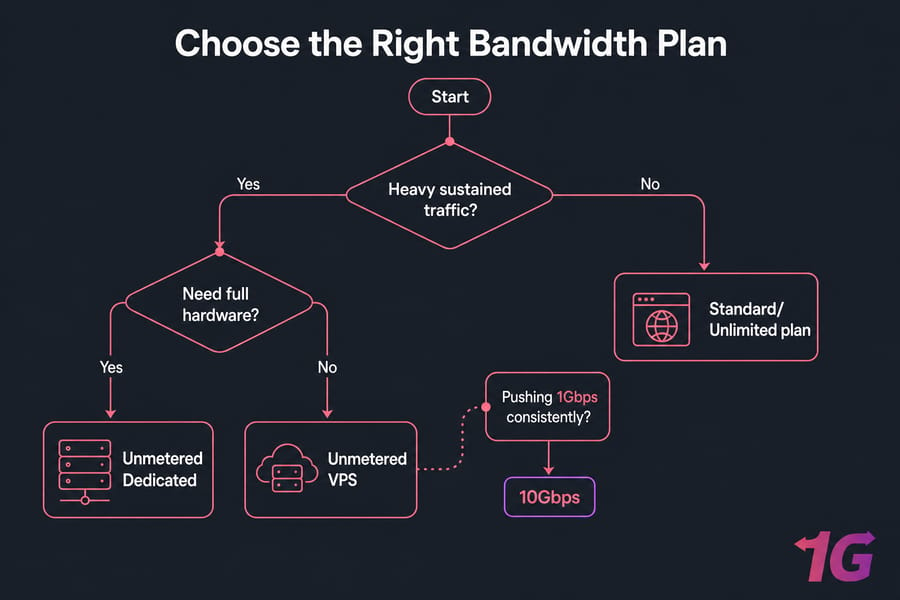
An unmetered VPS handles moderate-to-high traffic, flexible apps, and cost-sensitive growth nicely. If you need room to scale without per-gigabyte bills, this is your sweet spot. Pro tip: always check the port speed first, then the fair-use terms.
When to upgrade to an unmetered dedicated server
Move up to an unmetered dedicated server when transfer is heavy and sustained, when CPU/RAM/storage demands outgrow a VPS, or when you need high concurrency without neighbors competing for resources.
Signs you should look at 10Gbps hosting
If you're consistently saturating a 1Gbps line, it's time. A 10Gbps VPS gives you ten times the ceiling — ideal for big media, CDN origins, and large-scale distribution. Remember: bandwidth is one piece. RAM, CPU, storage, network quality, and server location all shape your real-world experience.
Questions to ask before buying unlimited or unmetered bandwidth
Treat this as buyer protection. Before you hand over a card, run through this checklist.
- What's the port speed? 1Gbps? 10Gbps? This is your real ceiling.
- Is traffic throttled after heavy use? Find the exact threshold if there is one.
- Is there a fair-use policy? Read it. Don't skim it.
- Are streaming, file-sharing, or proxy uses allowed? Some plans ban them outright.
- Are there overage charges? Unmetered shouldn't have any — confirm it.
- Is DDoS protection included? A DDoS-protected VPS saves headaches.
- What are the network routes and data center locations? Good routing beats raw speed.
Our guide on how to evaluate a VPS provider walks through this in more detail. Even strong plans disappoint when buyers make a few common bandwidth mistakes.
Common bandwidth mistakes hosting buyers make
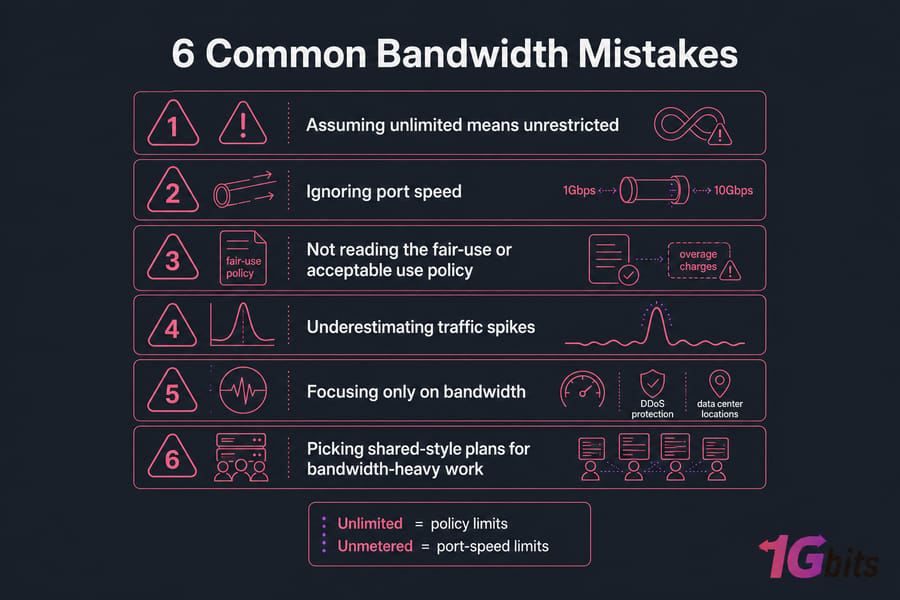
- Assuming unlimited means unrestricted. It almost never does. Fair-use rules always lurk.
- Ignoring port speed. Unmetered on a slow port is still slow. The pipe width is everything.
- Not reading the fair-use or acceptable use policy. The limits you didn't read about will find you.
- Underestimating traffic spikes. Your average is fine until a launch or a viral moment hits.
- Focusing only on bandwidth. Latency and packet loss wreck user experience even on a fat pipe.
- Picking shared-style plans for bandwidth-heavy work. Shared hosting and sustained heavy transfer don't mix.
So which option should most buyers actually choose?
Final verdict: unmetered or unlimited bandwidth?
Here's the bottom line:
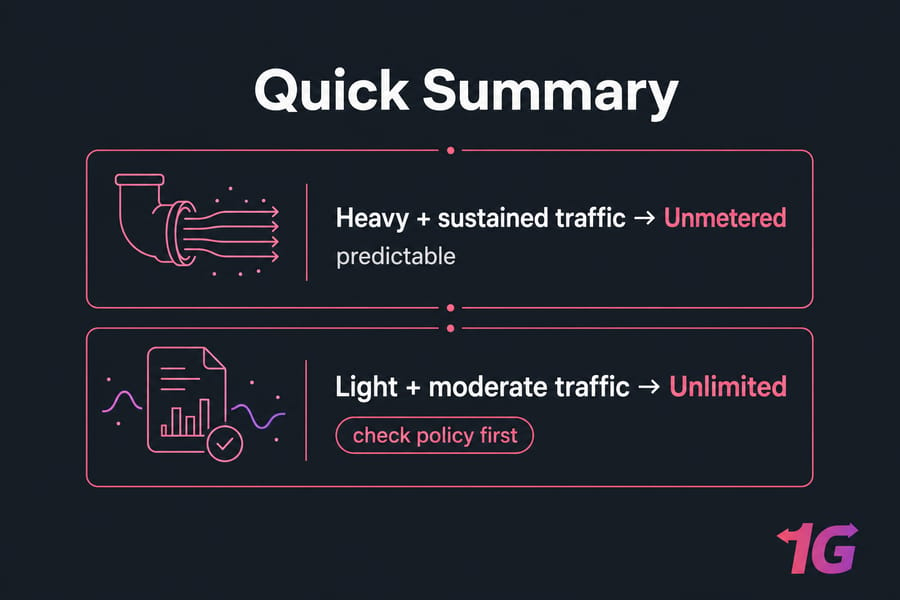
- Choose unmetered when you want transparent, predictable, high-traffic capacity — streaming, downloads, gaming, backups. You know your port speed; you know your ceiling.
- Choose unlimited when your workload is lighter and the provider's fair-use policy is reasonable. For many normal sites, it's genuinely enough.
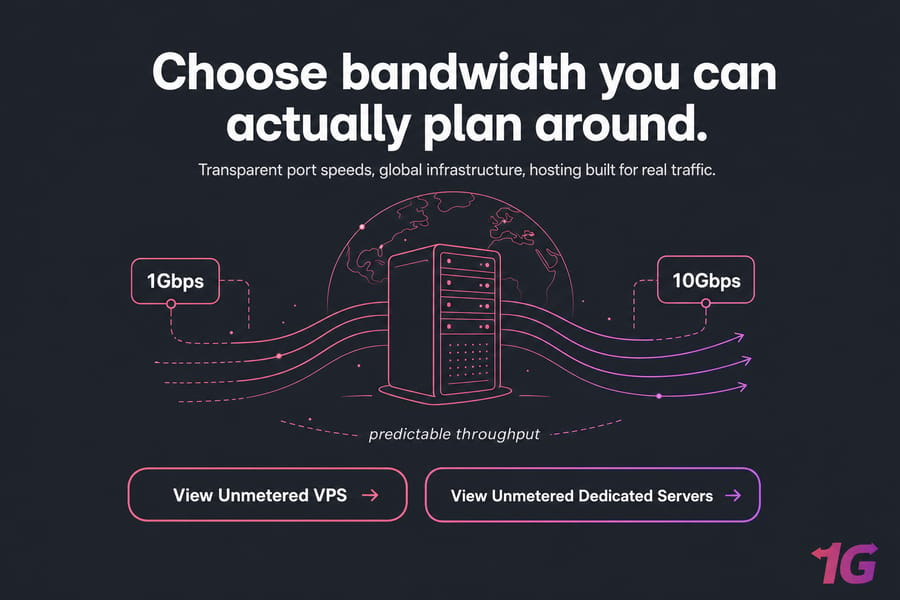
Either way, read the specs not the slogans. Check the port speed, the fair-use terms, and whether your VPS or dedicated server actually fits your traffic. If you want bandwidth you can plan around, compare 1Gbits unmetered VPS and unmetered dedicated server plans, or browse all VPS hosting options.

Leave A Comment