

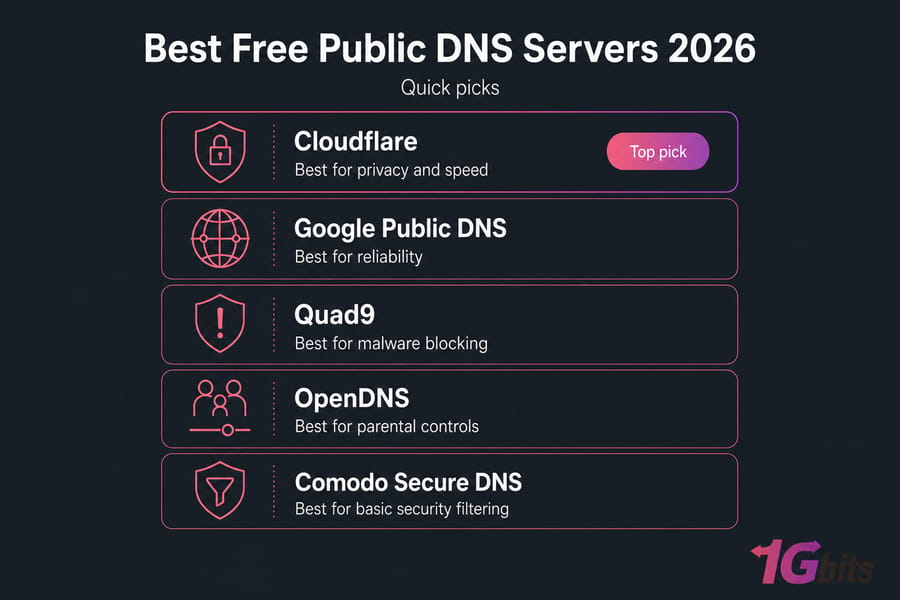
If you just want the short list, start here. The best public DNS servers for most people in 2026 are Cloudflare, Google Public DNS, Quad9, OpenDNS, and Comodo Secure DNS.
- Cloudflare DNS — best for privacy-minded users who want fast, simple recursive DNS.
- Google Public DNS — best for dependable global coverage and broad protocol support.
- Quad9 DNS — best for security, threat blocking, and DNSSEC validation.
- OpenDNS — best for family filtering, policy control, and small office networks.
- Comodo Secure DNS — best for basic phishing and malware filtering with easy setup.
Now, a quick reality check. Changing DNS can improve DNS lookup time, privacy, and filtering. It usually won't increase your raw download speed, and it rarely lowers gaming ping in a meaningful way. DNS isn't magic. Before getting to DNS servers, if you want to fully understand this core infrastructure, you can read our comprehensive guide on what is an IP address to grasp how web communications are initiated.
🌐 What Is a DNS Server and How Does It Work?
A DNS server translates human-friendly names like example.com into IP addresses your device can use. Technically, every resource accessible through the Internet is hosted on some web server, and each web server has a unique IP address. For a deeper technical perspective, explore our breakdown of what is a DNS server.
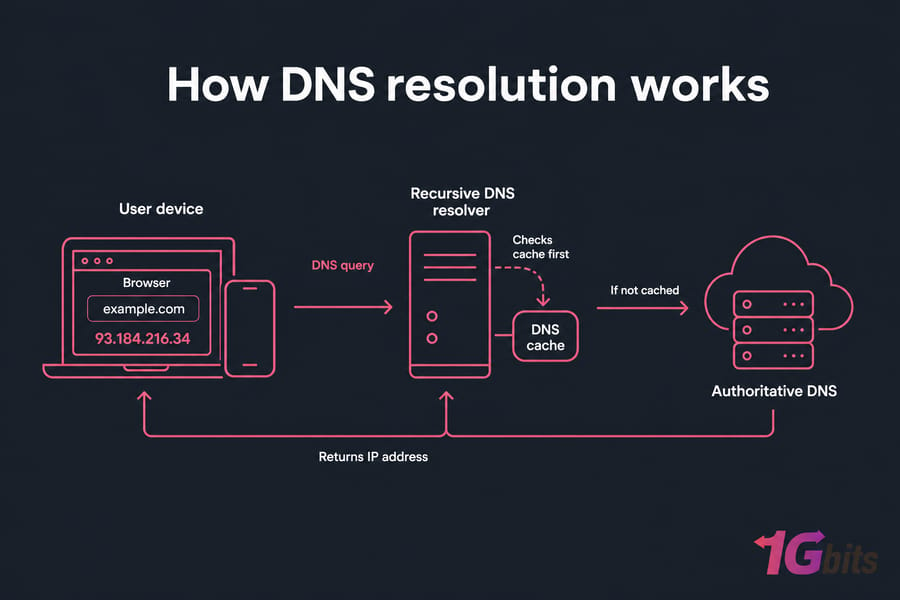
How DNS resolution works
Most people are using a recursive DNS resolver. Your phone, laptop, or router sends a DNS query to that resolver. The resolver checks its DNS cache first. If it already knows the answer, great — fast response. If not, it performs DNS resolution by asking other DNS servers until it finds the authoritative answer. DNS servers act as bridges between hostnames and IP addresses. Whenever you enter a website URL in your web browser, your Internet Service Provider's DNS works in the background to locate the IP address of the webserver on which that website is hosted.
Public DNS vs ISP DNS
Your ISP usually gives you default DNS automatically. That's called ISP DNS. Public DNS resolvers are alternative DNS services you can set manually, either on one device or across your whole network. If you're fuzzy on the provider side of that, this explains what is ISP and how they manage their routing infrastructure. If you are experiencing network friction or slow lookups, it may be due to regional network configurations or your internet carrier.
Public DNS often gives you better features: encrypted DNS, cleaner privacy policies, malware blocking, or more consistent resolver performance. But not always better latency. That depends heavily on your location and how your ISP routes traffic.
What changing DNS can and cannot improve
What it can improve: DNS query latency, DNS filtering, phishing protection, DNSSEC validation, and sometimes reliability during provider outages.
What it usually won't improve: raw bandwidth, Wi-Fi signal quality, or game server latency. And no, DNS is not a VPN. It doesn't encrypt all of your traffic, and it won't bypass every geo-block you run into.
🌐 Why Is It Beneficial to Use Third-Party DNS Servers?
Your ISP provides you with a DNS server by default for all your browsing needs. But looking beyond what your ISP offers can serve your best interests. There are several reasons for looking for alternative or third-party best DNS servers:
- Depending on your location, selecting a third-party DNS server can give better speeds while browsing the Internet. This is especially vital when configuring critical business systems or launching performance-reliant setups such as virtual machine hosting environments where delay reduction is paramount.
- It can help you unlock region-blocked content.
- Using an alternate DNS server gives you the best data privacy since your ISP isn't able to track your browsing history and sell it to advertisers.
- It gives you the best protection against security attacks like phishing, ransomware, malware, and more.
📊 How We Evaluated These DNS Servers
This comparison is based on provider documentation, public feature sets, privacy and logging policies, protocol support, known use cases, and long-standing operational reputation. No unsourced speed rankings were used.
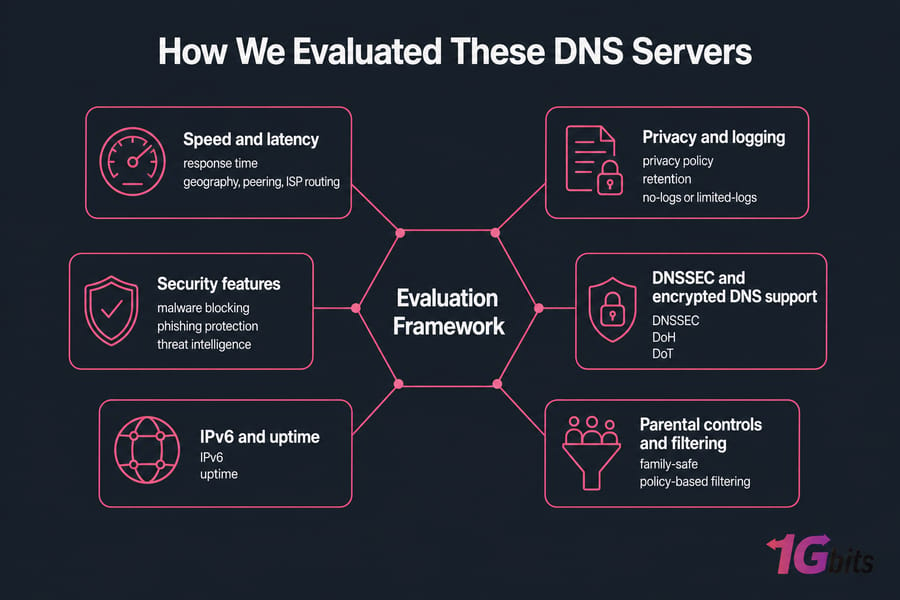
Speed and latency
The fastest DNS server is the one with the lowest response time from your network. Not mine. Not a benchmark posted from another country. Resolver performance changes by geography, peering, and ISP routing.
Privacy and logging
We looked at privacy policy language, retention practices, and whether the provider offers a sensible no-logs or limited-logs stance. Privacy depends on both transport encryption and what the resolver stores.
Security features
That includes malware blocking, phishing protection, and threat intelligence feeds. DNS filtering can block known bad domains. It cannot inspect every payload or replace endpoint security.
Protocol support: DNSSEC, DoH, DoT
DNSSEC helps validate that DNS answers haven't been tampered with. DNS over HTTPS encrypts DNS inside HTTPS traffic. DNS over TLS encrypts DNS over a dedicated TLS session. I usually prefer having both DoH and DoT available — more client flexibility.
IPv6 and reliability
IPv6 support matters more every year, especially on mixed networks. We also weighed long-term uptime and operational maturity.
Parental controls and filtering
Some providers offer family-safe or policy-based filtering. Others don't. If you need household rules, that feature matters far more than shaving 4 ms off a DNS query.
🏆 Top 5 Best DNS Servers
There are several public DNS servers you can use. Discussed below are the features and highlights of the top 5 such servers that individuals, as well as businesses, can use.
⚡ Cloudflare DNS — Best for Privacy and Speed
Cloudflare DNS is one of the best public DNS servers from the well-structured web-infrastructure company Cloudflare. The consumer DNS service is known for its wonderful performance and independently audited privacy policy. Launched in 2018, the public DNS service is powered by a variety of advanced technologies like global CDN, reverse proxy, recursive DNS service, and many more. Cloudflare openly declares that its DNS service has access to more than 7 million domain names on the server on which it runs its DNS service.
🛠️ Features
Ease-of-use is an important factor that contributes to Cloudflare's popularity. It has an address that's quite simple to remember. The server's primary DNS address is 1.1.1.1, and the secondary one is 1.0.0.1. When you use these DNS servers, the Cloudflare service won't block any content by design. However, if you need to block malicious and adult content, you can use 1.1.1.3 and 1.0.0.3 addresses. The company is very vocal about privacy issues and never uses your browsing data for targeting ads. User IP addresses are never stored on the server, though it does store some data to deal with abuse or debug issues; that too is deleted within 24 hours.
⭐ Highlights
- The average query speed of Cloudflare DNS is 13.89ms
- Through their app, you can use Cloudflare DNS on your Android smartphone or iPhone. The highlight of the app is that it comes with a free VPN service known as WARP. If you want better performance, you can subscribe to their paid service WARP+
- It supports both security mechanisms, DNS-over-TLS and DNS-over-HTTPS
Pros: fast in many regions, simple addresses, modern protocol support. Cons: standard endpoints don't block threats by default. Recommended if: you want a clean default with strong privacy positioning. Avoid if: your top priority is aggressive threat filtering.
🔍 Google Public DNS — Best for Reliability and Global Reach
Google introduced its DNS service in 2009 as a secure and faster alternative to local ISPs' default DNS servers. The search engine major then introduced DNSSEC (DNS Security Extensions) validation for all its DNS queries. In 2018, it became the largest DNS service handling a trillion queries per day. Like Cloudflare, Google Public DNS also has easy-to-remember addresses. Its primary address is 8.8.8.8, and its secondary address is 8.8.4.4.
🛠️ Features
Google Public DNS is focused on performance and security. The servers use DNS resolvers that cache tens of billions of entries worldwide and return the address of your domain queries without additional lookups, thus allowing you to connect faster to your desired websites. The DNSSEC security makes it possible to protect cryptographically signed domains against man-on-the-side and man-in-the-middle attacks. In addition to protecting the integrity of DNS queries, the service also works to block DNS Denial of service attacks by limiting the rate of queries.
⭐ Highlights
- For DSL connection, the Google Public DNS is 192.2 percent faster than your local ISP DNS server.
- The average ping time is 300ms, but in most cases, the DNS service resolves domain names in 1ms.
Pros: reliable, easy to remember, works well almost everywhere. Cons: no built-in malware or parental filtering. Recommended if: you need consistency and global coverage. Avoid if: filtering is the main goal.
🛡️ Quad9 DNS — Best for Security and Malware Blocking
Unlike other DNS servers, which are run by corporate entities, Quad9 is run by a non-profit entity called the Global Cyber Alliance. This alliance was founded by a group of research organizations and law enforcement agencies to reduce cyber-crime. Quad9 DNS was launched by the alliance in partnership with PCH (Packet Clearing House) and IBM to protect users from the deluge of malware propagating domains. The server addresses used by this DNS are 9.9.9.9 and 149.112.112.112 for IPv4 and 2620:fe::fe and 2620:fe::9 for IPv6.
🛠️ Features
Quad9 DNS service's sole intention is to prevent users from accidentally landing on malicious or phishing domains, exploit kit compromised domains, C2 command-and-control domains, and such. The server uses threat intelligence from multiple sources like the Anti-Phishing Working Group (APWG), IBM X-Force, Cisco, F-Secure, Netlab, and others. Quad9 provides DNSSEC validation on its resolvers that protect users against domain spoofing and other kinds of attacks that begin with sharing false DNS data.
⭐ Highlights
- Quad9 DNS is the only service that supports the DNS64 mechanism that translates IPv4 addresses for IPv6-exclusive networks (IPv4 vs IPv6). The two top DNS servers (Google Public DNS and Cloudflare DNS) don't support this feature.
- Quad9 uses DNS-Over-HTTPS, DNS-Over-TLS, and the DNSCrypt protocols to authenticate, encrypt, and anonymize the communication between your computer and Quad9's resolver.
Pros: excellent phishing protection, strong security story. Cons: may not be the fastest resolver in every region. Recommended if: safety matters more than squeezing out the last bit of latency. Avoid if: you need advanced family category controls.
🔒 OpenDNS — Best for Parental Controls and Filtering
Introduced in 2005 and now owned by Cisco, OpenDNS is one of the biggest names in the public DNS arena. The free service offers plenty of advantages like 100% uptime, high speeds, default blocking of phishing sites, and much more. The DNS service also allows you to create a locked-down environment to keep your children safe from Internet threats. The addresses to use this service are 208.67.222.222 and 208.67.220.220.
🛠️ Features
OpenDNS comes with built-in protection from malicious and phishing domains. With this, no malware script can hijack your browser and send you to any malicious domain. It comes with a custom filter option that allows you to block content by tuning the filters. The basic service is pre-configured to block adult content. The service also supports the DNS64 mechanism, allowing IPv6 networks to resolve IPv4 addresses.
⭐ Highlights
- It features parental controls that allow you to protect every device in your home instantly.
- It can restrict Internet access to specifically allowed domains which is a good option for parents who have kids at home accessing the Internet in their absence.
- It comes with free email support.
Pros: strong content filtering, familiar admin tools. Cons: less appealing if you just want a plain free resolver. Recommended if: you need rules for family or small office networks. Avoid if: you want the most minimalist setup possible.
🛡️ Comodo Secure DNS — Best for Basic Security Filtering
Comodo Secure DNS is a free-for-all DNS service. The company doesn't speak much about its services but always mentions that they're based on Comodo's worldwide network of redundant DNS frameworks. The address of the public DNS servers is 8.26.56.26 and 8.20.247.20.
🛠️ Features
The Comodo Gold version service allows users to customize different aspects of DNS protection for their devices when connecting to unfamiliar networks. It can block malicious sites, malware domains, and phishing attempts. The server can also tackle Command-and-Control callback events, botnets, spyware, and various other types of web-based attacks.
⭐ Highlights
- It gives you detailed insights into every Internet session. The dashboard gives you real-time information about the protected devices.
- It allows you to create policies based on the IP address of the connected devices or subnet.
Pros: straightforward, easy to set manually. Cons: weaker IPv6 and encrypted DNS story than the top three. Recommended if: you want basic filtering and nothing fancy. Avoid if: IPv6 DNS servers or DoH/DoT are required.
📊 Comprehensive DNS Servers Comparison
To help you decide which provider aligns best with your network infrastructure requirements, we have compiled a structural analytical comparison table highlighting addresses, core values, and best-fit environments for each public operator.
| DNS Provider | Primary & Secondary IPv4 Addresses | Primary Strategic Advantage | Best Suited For |
| Cloudflare DNS | 1.1.1.1 / 1.0.0.1 | Unrivaled lookup response speed and rigorous 24-hour logs erasure privacy policy. | General web speed optimization and highly responsive consumer browsing. |
| Google Public DNS | 8.8.8.8 / 8.8.4.4 | Massive worldwide cache capacity preventing complex lookup delays across infrastructure. | Global reliability and robust mitigation of active layer DDoS attacks. |
| Quad9 DNS | 9.9.9.9 / 149.112.112.112 | Real-time programmatic threat aggregation blocking malware domains at resolver level. | Security-first corporate environments and privacy-conscious setups. |
| OpenDNS (Cisco) | 208.67.222.222 / 208.67.220.220 | Deep parametric parental filtering and precise white-list domain monitoring. | Household content restriction and managed structural local area networks. |
| Comodo Secure DNS | 8.26.56.26 / 8.20.247.20 | Unified integration with Comodo's distributed global security frameworks. | Ad-hoc network endpoints security and monitoring dynamic remote connections. |
🎯 Best DNS Servers by Use Case
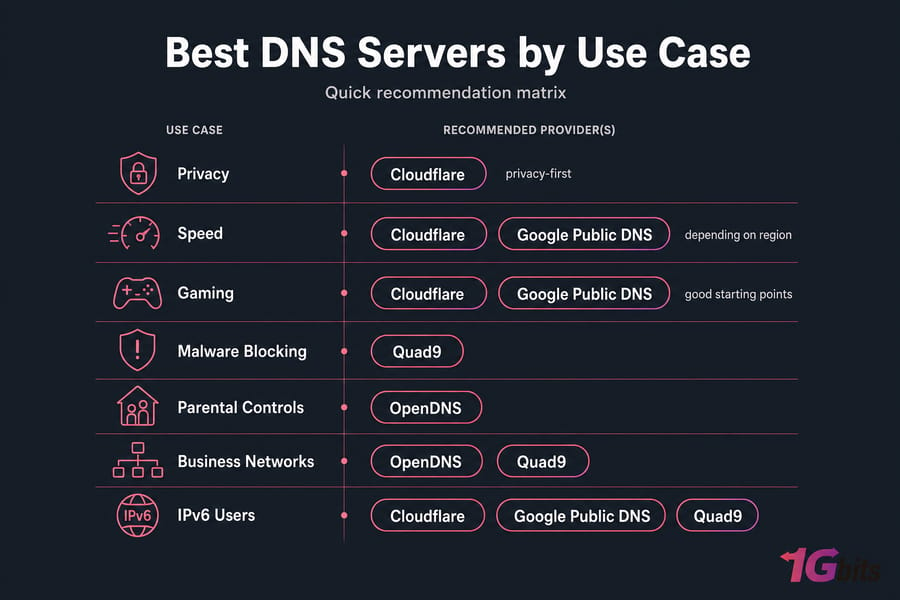
Best DNS for privacy
Cloudflare is the easiest recommendation here. It has broad encrypted DNS support and a privacy-first reputation. Quad9 is also a solid choice if you want privacy plus threat blocking.
Best DNS for speed
Usually Cloudflare or Google Public DNS. But test locally. The best DNS servers for gaming aren't always the same as the fastest DNS servers for everyday browsing.
Best DNS for gaming
Cloudflare or Google are good starting points because they're stable and often low-latency. Just keep expectations sane: DNS won't directly fix game server routing or reduce ping much on its own. For a deeper dive, see our guide on the best DNS servers for gaming.
Best DNS for malware protection
Quad9 wins here for most users. Its threat intelligence-based blocking is the main reason people switch to it.
Best DNS for parental controls
OpenDNS is still one of the better picks when you need family filtering and control over categories. For a home-wide setup, apply it at the router.
Best DNS for business networks
OpenDNS works well for policy-driven environments. Quad9 is also useful where security filtering matters more than user-level content categories.
Best DNS for IPv6 users
Cloudflare, Google, and Quad9 are the safest choices. If you're running mixed stacks, read up on IPv6 VPS planning too — IPv6 support stops being optional quickly.
📋 DNS Server Addresses for IPv4 and IPv6
This is the copy-and-paste section people actually need.
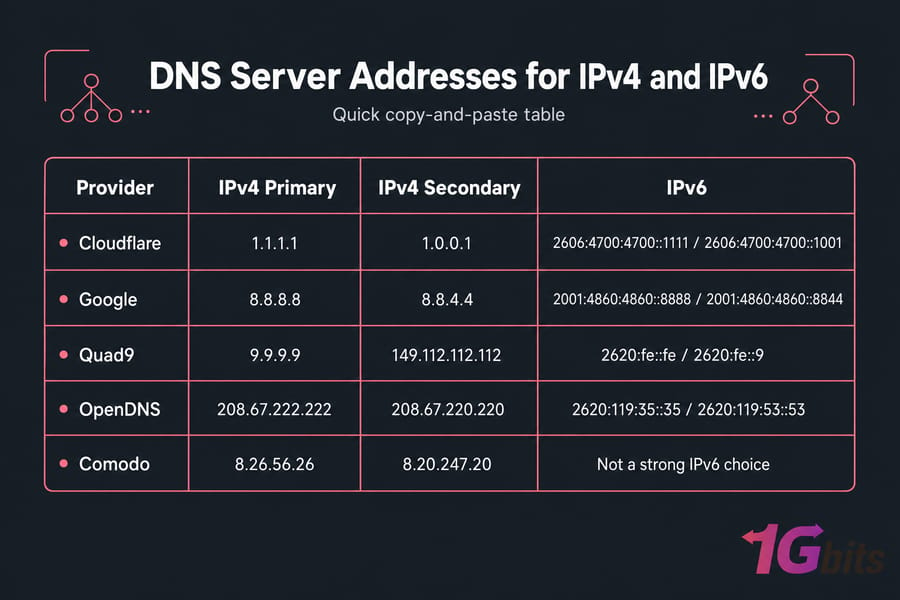
Quick copy-and-paste table
| Provider | Primary DNS | Secondary DNS |
| Cloudflare | 1.1.1.1 | 1.0.0.1 |
| 8.8.8.8 | 8.8.4.4 | |
| Quad9 | 9.9.9.9 | 149.112.112.112 |
| OpenDNS | 208.67.222.222 | 208.67.220.220 |
| Comodo | 8.26.56.26 | 8.20.247.20 |
DoH / DoT endpoints if available
Cloudflare, Google, and Quad9 all support encrypted DNS well. If your device, browser, or router supports custom DNS over HTTPS or DNS over TLS, use those rather than plain DNS when possible.
🧭 How to Choose the Right DNS Server
When to choose Cloudflare
Choose Cloudflare if you want a fast, modern, low-friction custom DNS setup with strong privacy positioning.
When to choose Google Public DNS
Choose Google if reliability and broad network reach matter more than filtering or branding around privacy.
When to choose Quad9
Choose Quad9 if malicious domain blocking is the deciding factor. Often recommended for less technical family members.
When to choose OpenDNS
Choose OpenDNS if you need content filtering and policy control across a home or small business network.
When to choose Comodo
Choose Comodo only if you specifically want a simple free DNS server with basic security filtering and you don't need the strongest IPv6 or encrypted DNS support.
⚙️ How to Change Your DNS Server
Use device-level changes for testing. Use router-level changes for whole-home coverage.
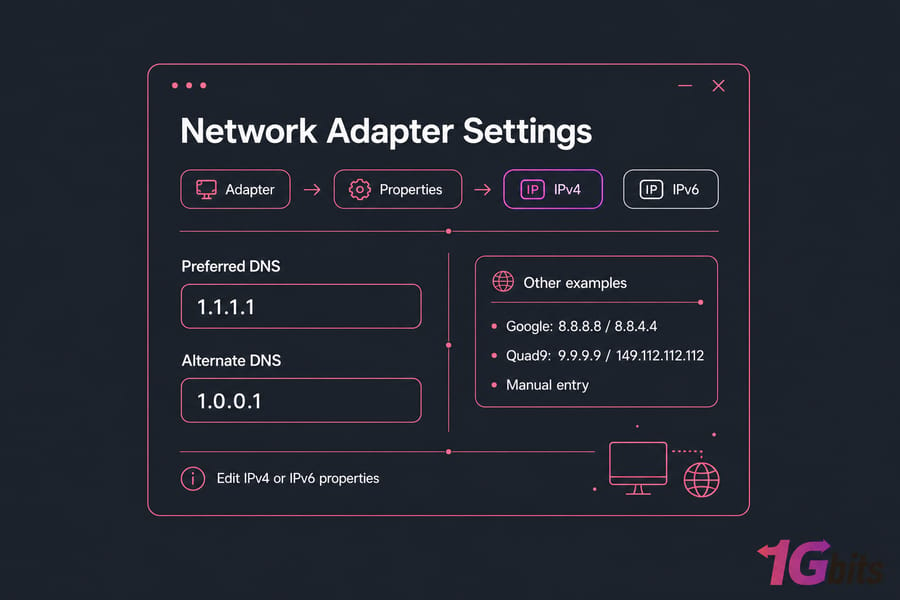
Windows
Open network adapter settings, edit the IPv4 or IPv6 properties, and enter your primary DNS and secondary DNS manually. For detailed walkthroughs, see How to change DNS on Windows.
macOS
Go to Network settings, select your active connection, then add DNS server addresses under the DNS tab.
Linux
This varies by distro and NetworkManager setup. Desktop users can often change it in GUI network settings. Server admins usually edit resolver settings or NetworkManager profiles. See How to change DNS on Linux for detailed instructions.
Android
Use Private DNS for hostname-based encrypted DNS where supported, or manually set DNS on the Wi-Fi network.
iPhone and iPad
Open Wi-Fi settings, tap the active network, configure DNS manually, and enter the resolver addresses.
Router-level setup
This is the best route for whole-home DNS filtering. Log into the router, find WAN or Internet DNS settings, and replace the automatic values. A lot of people also pair this with a dynamic DNS provider on home labs or remote-access setups.
🧪 How to Test Which DNS Server Is Fastest for You
Test from your actual device on your actual network. That's the only benchmark that counts.
Use nslookup or dig
Run repeated queries and compare response times. If you need a refresher, read What is Nslookup and What is the DIG command.
nslookup example.com 1.1.1.1
nslookup example.com 8.8.8.8
dig @9.9.9.9 example.com
Try DNS benchmark tools
A DNS benchmark can help compare query latency across several resolvers. Just don't treat one short run as gospel.
Test by location and device
A phone on mobile data, a laptop on home fiber, and a VM on a hosted node may all prefer different resolvers.
⚠️ Common DNS Problems After Switching and How to Fix Them
No internet after changing DNS
First, check for a typo. Then revert to automatic DNS and test again. If you're seeing common errors, these guides help: DNS server not responding and DNS_PROBE_FINISHED_NXDOMAIN.
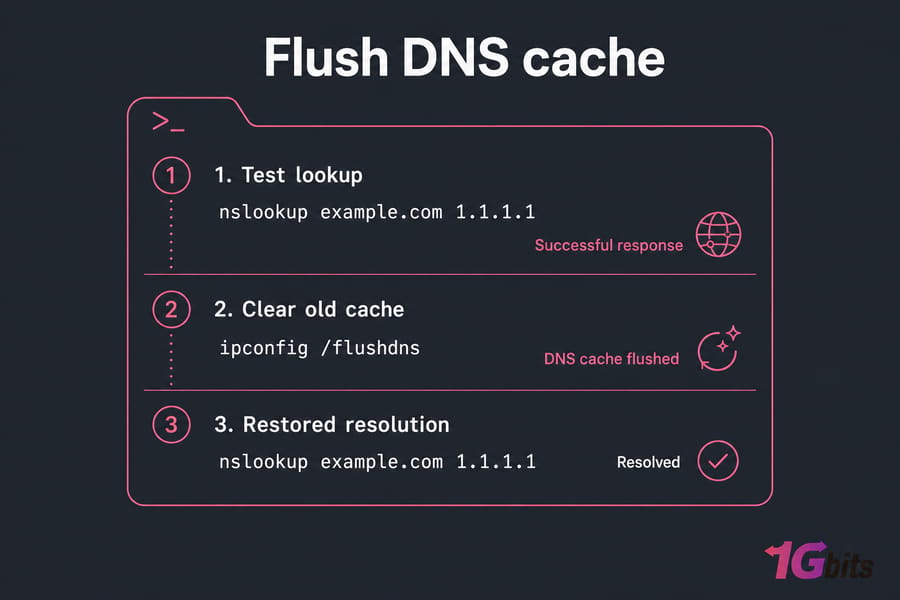
Flush DNS cache
Old cache entries can break things after a change. Here's How to flush DNS. On Windows, I usually start with ipconfig /flushdns.
Router or ISP override
Some routers push their own resolver settings, and some networks intercept DNS. Hotel Wi-Fi and captive portals are notorious for this. Connect first, pass the captive portal, then test again.
Switch back to automatic DNS
If the public resolver performs worse on your line, switch back. No shame in that. Public DNS vs ISP DNS is not a universal win.
⚠️ Common DNS Configuration Mistakes to Avoid
Deploying a custom lookup address requires careful attention to detail. Below are critical errors that administrators and general users often make when shifting away from default configurations:
- Neglecting Secondary Server Entry: Failing to input a secondary address leaves your system without a fallback path. If the primary node experiences maintenance, your name resolution fails completely, resulting in a false offline status.
- Hardcoding Addresses into Non-Static Environments: Forcing specific servers onto dynamic client laptops can conflict with corporate network rules. If you travel or use dynamic networks, it is recommended to configure via router setups rather than localized operating system files.
- Ignoring DNS Cache Build-up: When changing server options, old path records frequently persist inside local storage. This discrepancy often induces unexpected page resolution errors.
🔒 Are Free Public DNS Servers Safe?
Usually, yes — if you pick established providers and understand the tradeoffs. The safety question comes down to three things: who runs the resolver, what they log, and whether you use encrypted DNS transport.
Free public DNS servers can be better than ISP DNS for privacy or filtering, but not all secure DNS providers make the same promises. Read the privacy policy. Check whether they support DNS over HTTPS or DNS over TLS. And remember, DNS filtering is helpful, not bulletproof.
🔚 Wrapping It Up
The top 5 best DNS servers mentioned in this article are sure to solve the purpose for most individuals and businesses while being very easy to use and quite affordable. Up until a decade ago, the Internet was a simpler place. The arrival of the IPv6 protocol has made things complex and increased the burden on DNS servers.
Today, a DNS server must handle trillions of DNS lookup requests daily. The ISP's default DNS server might break down when handling such loads, which can eventually affect your Internet surfing speed. To improve Internet browsing speed or surfing experience, it would be wise to switch to a third-party DNS server. Whether you are provisioning enterprise clusters, setting up custom web servers, or securing home routers, selecting a top-tier alternative resolver ensures your digital navigation remains uninterrupted, responsive, and private. For readers exploring alternatives, you may also want a broader free DNS server roundup.

Leave A Comment