What is domain privacy?
Domain privacy (also known as domain privacy protection or WHOIS privacy) is a service that keeps your personal contact information hidden from the public WHOIS database.
When you register a domain name, ICANN the global organization that manages domain names—requires registrars to collect accurate ownership details such as your name, email address, phone number, and physical address. Without domain privacy protection, this information is publicly visible to anyone who performs a WHOIS lookup.
Domain privacy works by replacing your real contact details with anonymized or proxy information provided by your domain registrar. This way, your domain remains legally registered in your name, but your private data stays protected from spammers, marketers, scammers, and unwanted solicitations.
In simple terms, domain privacy protects your identity, not your website allowing you to own and manage a domain confidently without exposing your personal information to the entire internet.
What Does Domain Privacy Protect?
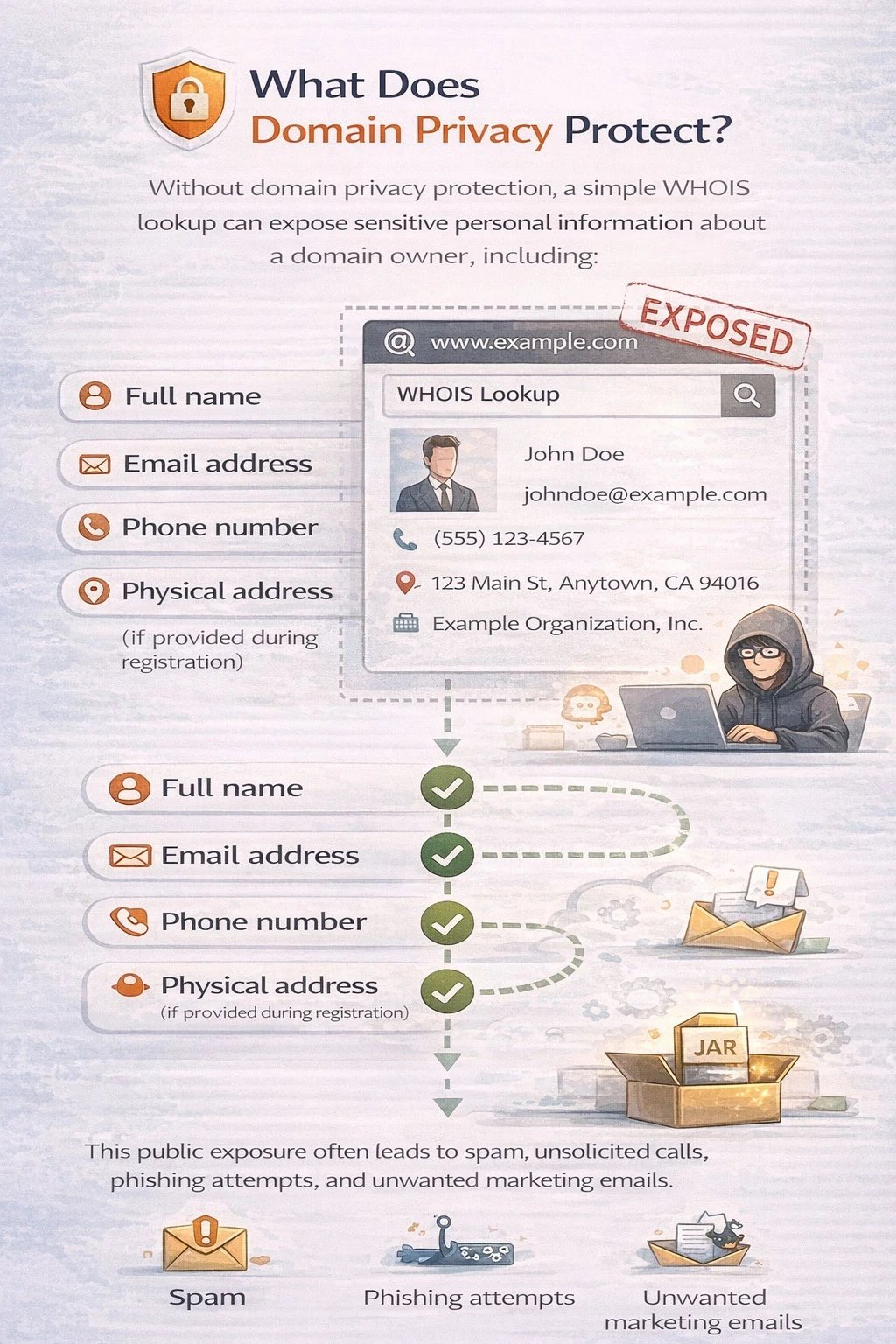
Without domain privacy protection, a simple WHOIS lookup can expose sensitive personal information about a domain owner, including:
-
Full name
-
Email address
-
Phone number
-
Physical address
-
Organization name (if provided during registration)
This public exposure often leads to spam, unsolicited calls, phishing attempts, and unwanted marketing emails.
What Domain Privacy Protects (Masks)
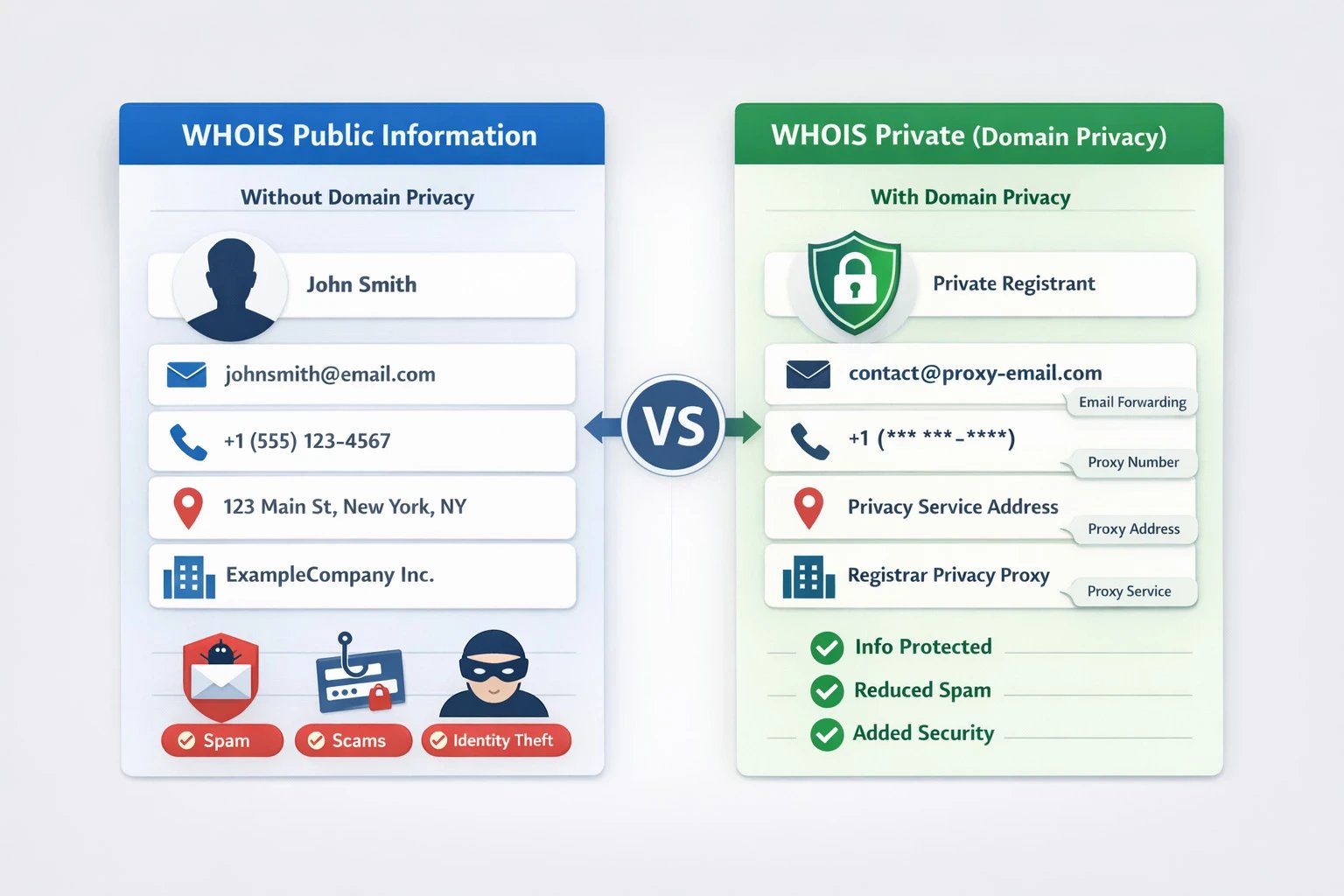
When domain privacy is enabled, your registrar replaces your real contact details with proxy or anonymized information:
-
Registrant name → replaced with the registrar or a privacy service name
-
Email address → replaced with an anonymized or forwarding email
-
Phone number → replaced with a proxy contact number
-
Physical address → replaced with the registrar’s address
Your domain is still legally registered to you, but your personal information stays private.
What Domain Privacy Does Not Hide
For transparency and internet accountability, certain technical and administrative details remain publicly visible:
-
Domain registration date
-
Domain expiration date
-
Registrar name
-
Nameservers
-
Domain status
This level of transparency is intentional. It helps maintain trust, security, and accountability across the internet while still protecting domain owners from unnecessary exposure.
What Is WHOIS and How a WHOIS Lookup Works?
The WHOIS database is a global, publicly accessible directory that stores registration information for domain names. Whenever a domain is registered, its details are recorded in this database and can be viewed using a WHOIS lookup tool.
A WHOIS lookup allows anyone individuals, businesses, or organizations—to see basic information about a domain, such as who registered it, when it was registered, and which registrar manages it. This system plays a key role in keeping the internet organized and trustworthy.
Why WHOIS Exists
WHOIS was created to support the healthy operation of the internet by ensuring:
-
Accountability for domain ownership so domains are traceable to a responsible party
-
Abuse reporting helping identify and report spam, malware, phishing, and other malicious activities
-
Legal and technical dispute resolution assisting in resolving ownership conflicts and technical issues
-
Internet governance transparency promoting openness and trust across the global internet ecosystem
In short, WHOIS helps balance transparency and responsibility, while services like domain privacy ensure that this openness doesn’t come at the cost of personal security.
WHOIS Lookup vs WHOIS Privacy vs WHOIS Redaction
|
Term |
Meaning |
|
WHOIS lookup |
Public search for domain ownership data |
|
WHOIS privacy |
Registrar masks owner data using proxy |
|
WHOIS redaction |
GDPR-based removal of certain data |
GDPR caused partial redaction, but domain privacy is still necessary, especially outside the EU or for email protection.
How Domain Privacy Protection Works (Step-by-Step)
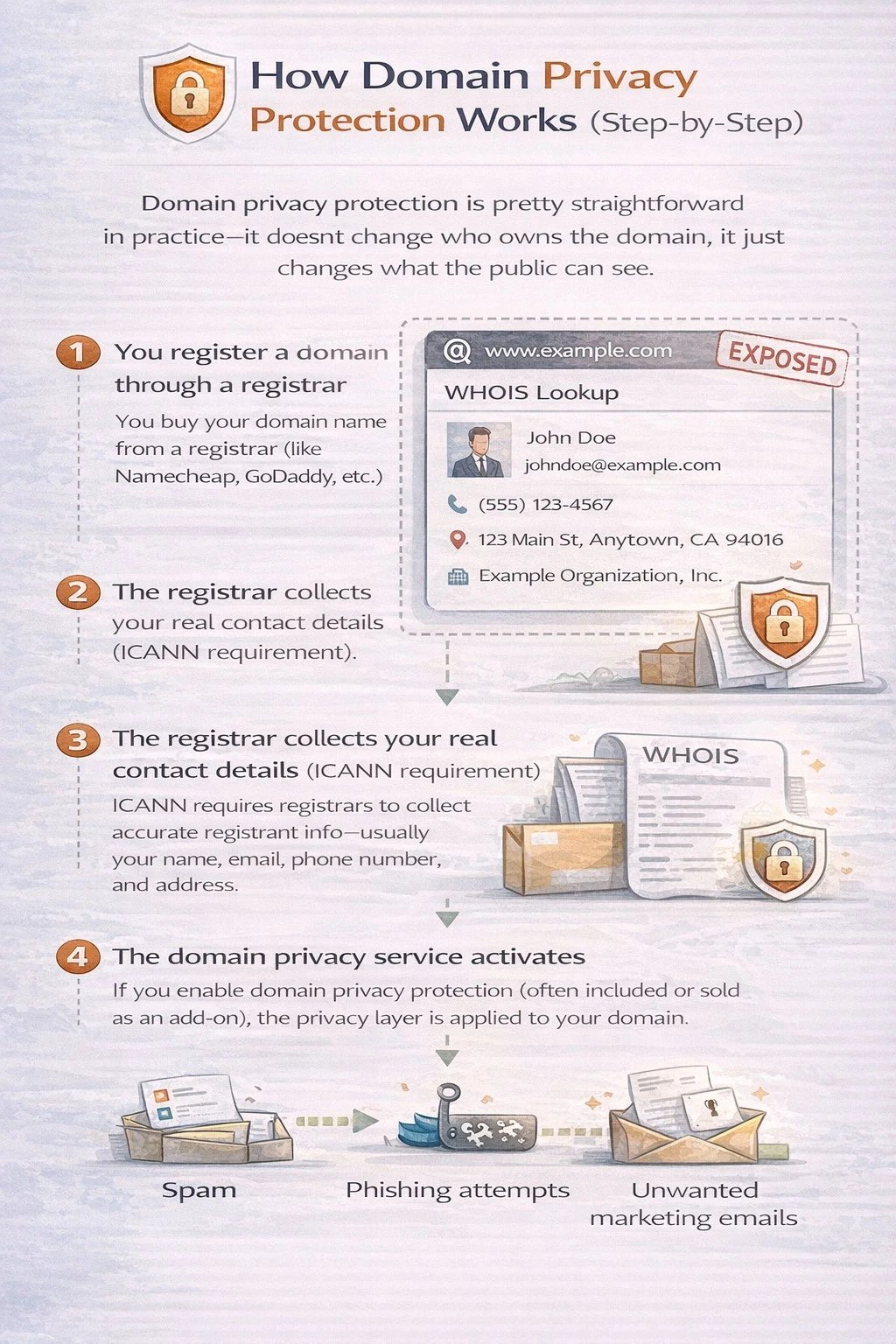
Domain privacy protection is pretty straightforward in practice it doesn’t change who owns the domain, it just changes what the public can see.
Here’s how it works:
-
You register a domain through a registrar
You buy your domain name from a registrar (like Namecheap, GoDaddy, etc.). -
The registrar collects your real contact details (ICANN requirement)
ICANN requires registrars to collect accurate registrant info usually your name, email, phone number, and address. -
The domain privacy service activates
If you enable domain privacy protection (often included or sold as an add-on), the privacy layer is applied to your domain. -
Public WHOIS fields get replaced with proxy details
Instead of showing your personal info, the WHOIS record displays the registrar’s details or a privacy service provider’s contact info. -
Emails sent to the WHOIS email address are forwarded to you
If someone sends a message to the anonymized WHOIS email, it typically forwards to your real email—so you can still be contacted without being exposed. -
Legal or abuse-related requests go through the registrar
Complaints (phishing, spam, trademark disputes, etc.) are routed through the registrar or privacy provider, who handles them according to policy and law.
ICANN Compliance (Important E-E-A-T Note)
Even with domain privacy enabled, registrars and privacy providers still operate under strict compliance rules:
-
Your registrar must still store your real identity internally
-
Ownership can be revealed under valid legal requests (court orders, law enforcement, etc.)
-
Abuse complaints can still reach the domain owner through forwarding and registrar processes
Domain privacy is not anonymity it’s controlled exposure.
It’s designed to protect your personal contact info from the public internet, while still keeping the domain system transparent and accountable.
What Is Full Domain Privacy and Protection?
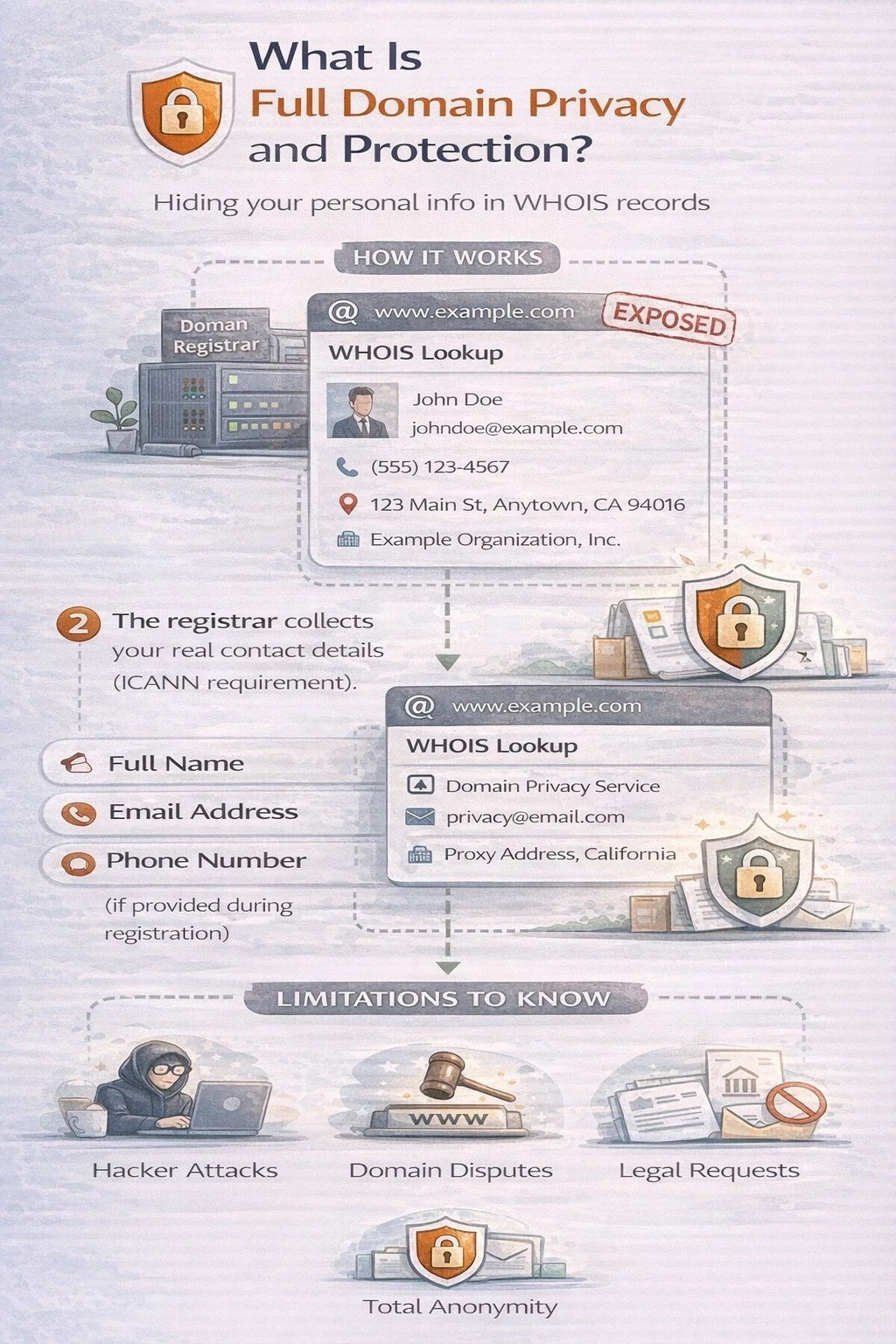
You’ll often see marketing terms like Full Domain Privacy and Protection, Premium WHOIS Protection, or Complete Domain Protection. These names sound powerful and reassuring, but they’re mostly branding terms used by domain registrars to describe the same basic feature: hiding your personal information from public WHOIS records.
What this usually means (not magic):
Despite the impressive names, full domain privacy and protection is mostly about hiding your personal information from the public WHOIS database. When you register a domain, details like your name, email address, phone number, and physical address are normally published and visible to anyone who looks them up.
With domain privacy enabled, the registrar replaces your real contact details with their own proxy or generic information. This helps reduce spam, scam emails, robocalls, and unwanted contact—but it doesn’t make your domain “invisible” or immune to attacks.
It’s also important to understand what this doesn’t do. Domain privacy doesn’t protect your website from hacking, prevent domain disputes, stop government or legal requests, or guarantee anonymity. If there’s a valid legal reason, registrars can still be required to reveal the real owner’s information.
So while the term sounds like an all-in-one security shield, it’s really a privacy convenience feature, not a comprehensive security solution.
|
Feature |
Basic Privacy |
“Full / Premium” |
|
WHOIS masking |
Yes |
Yes |
|
Email forwarding |
true |
Yes |
|
Spam filtering |
No |
Yes |
|
Auto-renew privacy |
No |
Yes |
|
Ownership alerts |
No |
Sometimes |
What Is Full Domain Privacy and Protection Renewal?
It simply means that the domain privacy service is renewed on a yearly basis—often as a separate charge from the domain registration itself. Even if your domain is renewed, the privacy feature may expire unless it’s also renewed.
There’s no ICANN-defined or industry-standard “full” level of privacy. These labels are just registrar-created packages that bundle WHOIS privacy with branding-friendly names, not special or enhanced protections beyond standard privacy masking.
Why Domain Privacy Matters (Real-World Risks)
Without domain privacy enabled, your registration details are publicly visible and can be easily scraped by bots and bad actors. Once that data is out there, it’s often reused, resold, and abused.
Common real-world risks include:
-
Spam floods sent to your personal email address
-
Phishing emails pretending to be your domain registrar or hosting provider
-
Identity scraping used in scams or social engineering attacks
-
Domain hijacking attempts targeting weak accounts
-
Aggressive and unwanted sales outreach
Real example:
Many domain owners receive fake “domain expiration” or “urgent renewal” emails within hours of registering a domain. These messages aren’t a coincidence—they’re generated using data pulled directly from public WHOIS records.
Is Domain Privacy Worth It?
Short answer: Usually, yes.
Long answer: It depends on who you are and how you use your domain.
When Domain Privacy Is Worth It
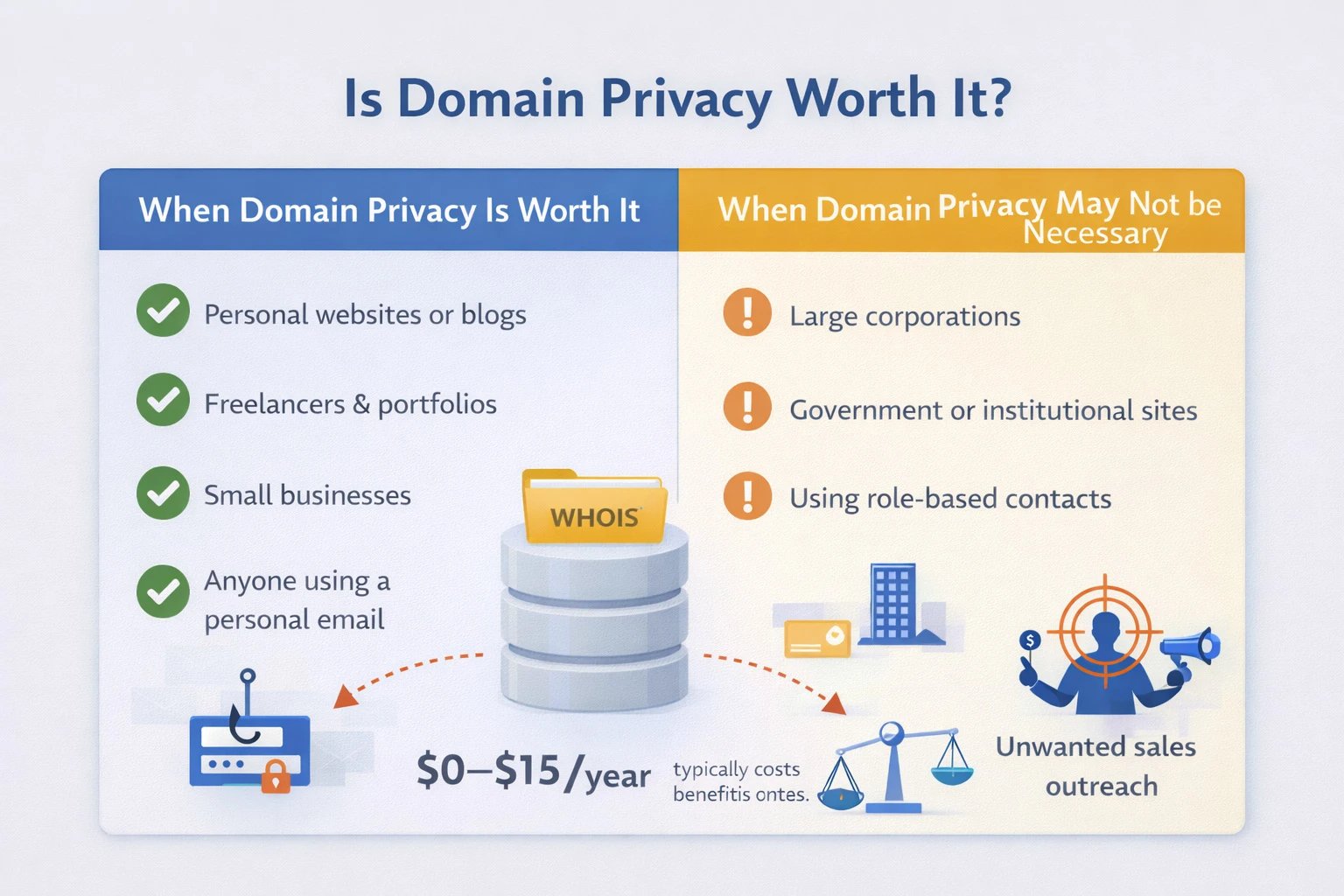
Domain privacy is especially useful if your domain is tied to you as an individual or a small organization.
It’s usually worth enabling if you run:
-
Personal websites or blogs
-
Freelance or portfolio sites
-
Small business websites
-
Non-profit organizations
-
Any domain registered with a personal email address
In these cases, domain privacy helps keep your real contact details out of public databases and reduces spam, scams, and unwanted outreach.
When Domain Privacy May Not Be Necessary
You might not need domain privacy if:
-
You’re a large corporation with a publicly listed legal entity
-
The domain belongs to a government or institutional organization
-
You already use role-based contact emails (like admin@, legal@) and public-facing addresses
Even then, some organizations still choose privacy for convenience and noise reduction.
Cost vs. Benefit
Domain privacy typically costs $0–$15 per year, depending on the registrar. In exchange, you avoid spam, phishing attempts, and the misuse of your personal data—making it a small cost for a surprisingly large peace of mind.
Bottom line:
If you’ve ever wondered “is domain privacy worth it?” or “do I need domain privacy?”, the answer for most individuals and small organizations is a clear yes.
Do I Need Domain Privacy? (Decision Guide)
|
Use Case |
Recommendation |
|
Personal blog |
Yes |
|
Portfolio site |
Yes |
|
Small business |
Yes |
|
Non-profit |
Yes |
|
Enterprise brand |
Optional |
|
High-risk region |
Strongly recommended |
If you value privacy in real life, you’ll value it online too.
Domain Privacy vs SSL (Common Confusion)
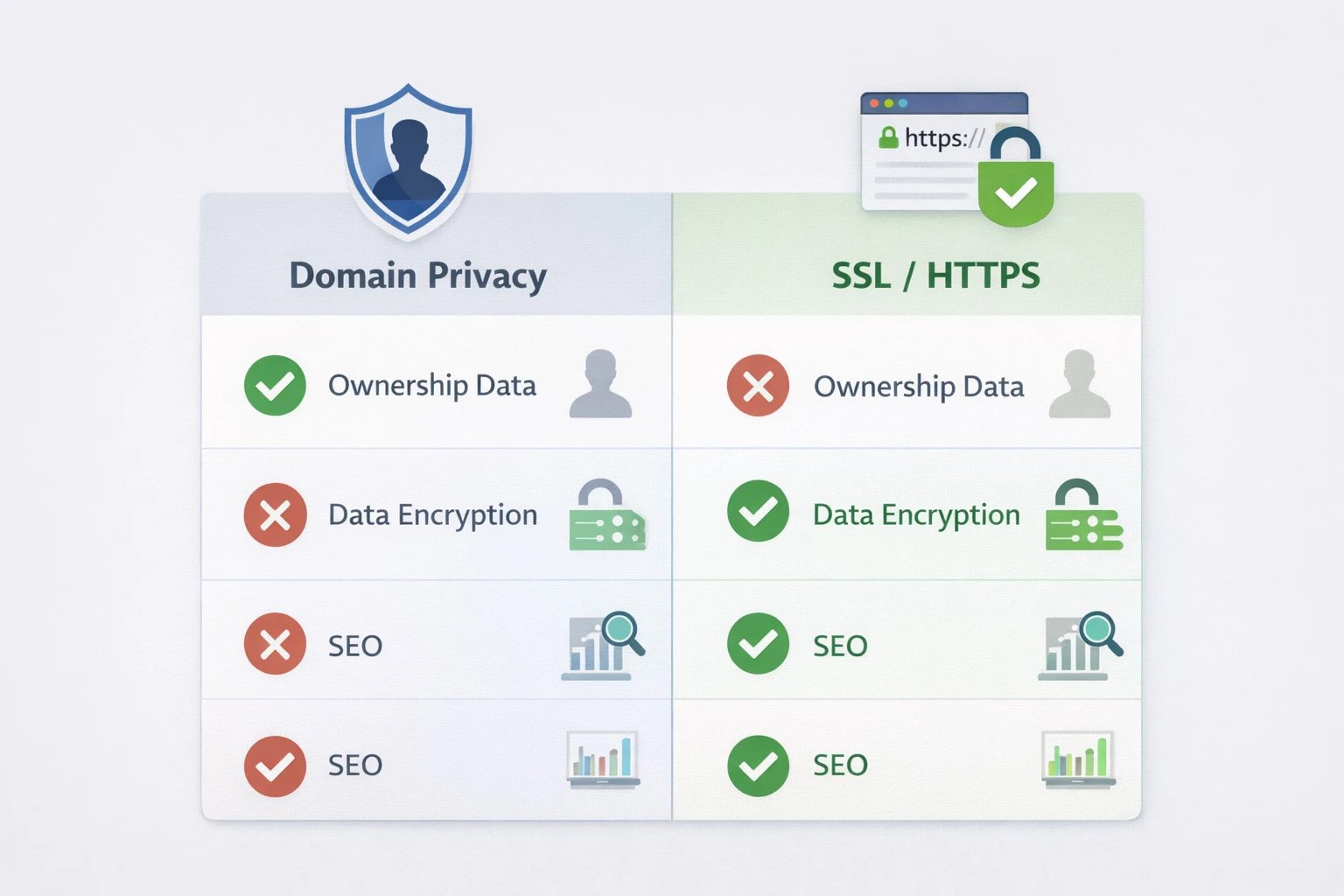
Many people ask: Is domain privacy the same as SSL?
Short answer: No they protect completely different things.
Domain privacy protects you, the domain owner. It hides your personal contact information from the public WHOIS database so your name, email, phone number, and address aren’t exposed to spammers or scammers.
SSL (HTTPS) protects your visitors. It encrypts the data exchanged between a user’s browser and your website, preventing eavesdropping, data theft, and tampering.
Think of it this way:
-
Domain privacy = who owns the domain (hidden)
-
SSL = how data travels to and from the website (encrypted)
They’re not substitutes for each other and using both is common and recommended for most websites.
|
Feature |
Domain Privacy |
SSL |
|
Protects identity |
Yes |
No |
|
Encrypts data |
No |
Yes |
|
Affects SEO |
Indirect |
Yes |
|
Visible to users |
No |
Yes (HTTPS) |
Is Domain Privacy Free?
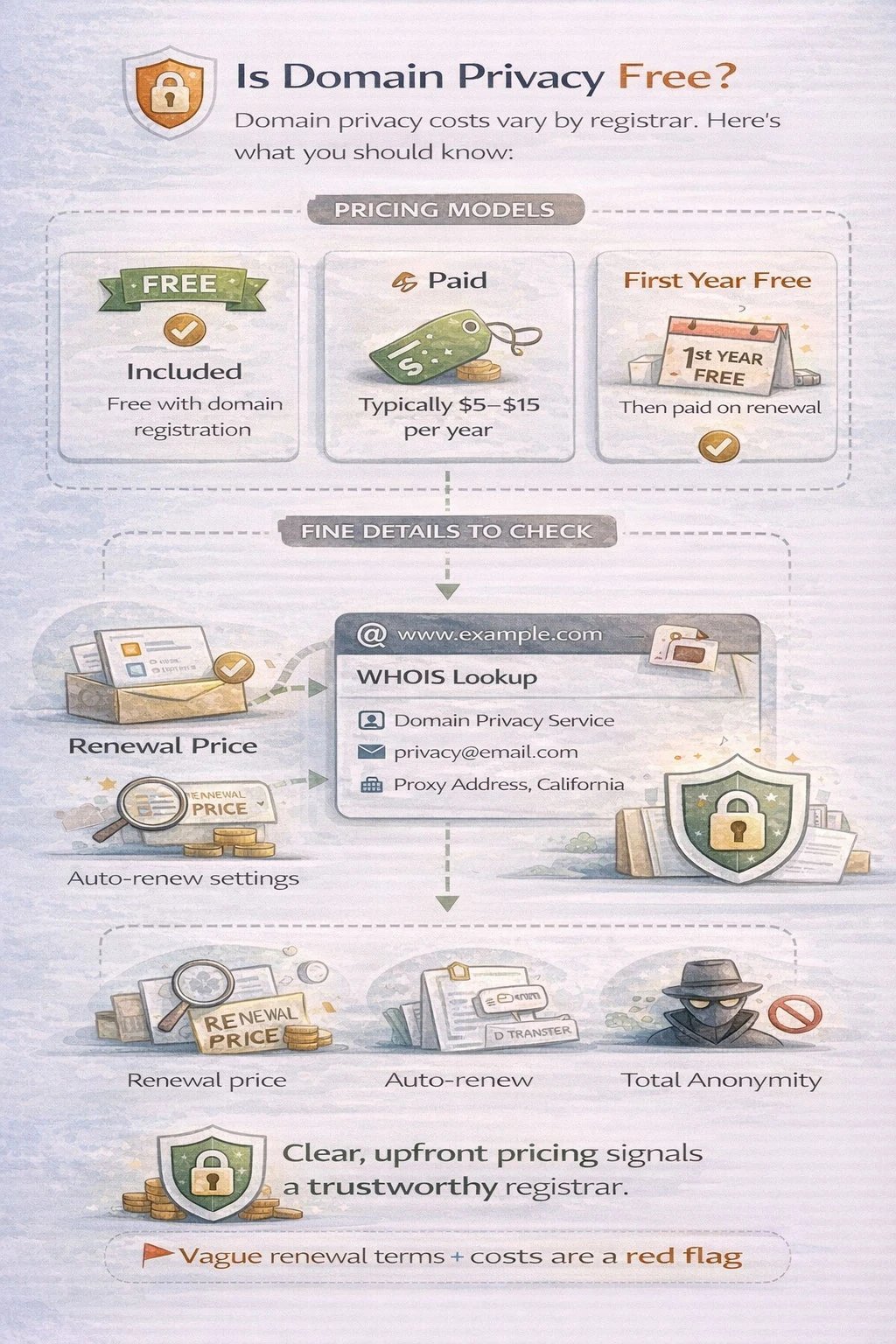
It depends on the domain registrar. Some include domain privacy at no extra cost, while others charge for it as an add-on service.
Common pricing models include:
-
Free included with the domain registration
-
Paid typically $5–$15 per year
-
Free for the first year, then paid on renewal
Always check the fine details:
-
The renewal price (this is where surprises often happen)
-
Whether domain privacy is set to auto-renew
-
What happens to privacy when you transfer the domain to another registrar
Clear, upfront pricing around domain privacy is a strong trust signal. If a registrar is vague about renewal costs or terms, that’s usually a red flag.
Domain Privacy, ICANN, and Legal Exceptions
Even when domain privacy is enabled, it isn’t absolute. In certain legally valid situations, a registrar may be required to disclose domain ownership information.
Common exceptions include:
-
Court orders
-
Requests from law enforcement agencies
-
Verified investigations involving abuse, fraud, or illegal activity
-
UDRP domain dispute proceedings
This system is intentional. It’s designed to balance:
-
User privacy, by default
-
Accountability, when domains are used for harm or abuse
-
Compliance, with ICANN policies and global internet governance rules
In other words, domain privacy protects legitimate users—not bad actors—and operates within established legal and regulatory frameworks.
How to Turn On Domain Privacy?
Enabling domain privacy is usually quick, simple, and fully reversible.
General steps:
-
Log in to your domain registrar account
-
Open your domain management or domain settings page
-
Look for “Domain Privacy” or “WHOIS Privacy”
-
Enable the service
-
Save your changes
In most cases, the update takes effect within minutes to a few hours, depending on the registrar and WHOIS update cycles.
If you don’t see the option, check whether privacy is included automatically or offered as a paid add-on.
Domain Privacy vs Domain Warranty (Clarification)
Many users confuse these two services, but they solve very different problems.
Domain privacy→ Protects your personal contact information by hiding it from public WHOIS records.
Domain warranty→ An optional protection service that may help cover issues like accidental domain loss, theft, or misconfiguration, depending on the registrar’s terms.
They are not the same, and one does not replace the other. Domain privacy focuses on data protection, while domain warranty focuses on domain recovery or risk mitigation.
Bottom line:
If you’re searching for “what is domain warranty and privacy”, remember—privacy hides your information, warranty helps safeguard the domain itself. Both are optional, and whether you need either depends on your risk tolerance and how critical the domain is to your business.
Common Myths About Domain Privacy
There’s a lot of confusion around what domain privacy does—and doesn’t—actually do. Let’s clear up the most common myths.
“It makes my site anonymous”→ No. Domain privacy only hides your ownership details from public WHOIS records. Your website, content, and activity are still fully visible.
“It protects me from hacking”→ No. Domain privacy doesn’t secure your server or website. Protection from hacking comes from hosting security, strong passwords, updates, and monitoring.
“Google dislikes private domains”→ False. Using domain privacy has no negative impact on SEO. Search engines do not penalize private WHOIS records.
“It’s illegal”→ Also false. Domain privacy is fully ICANN-compliant when offered by accredited registrars and widely used across the internet.
In short: Domain privacy is a legitimate, common feature that protects your contact data—not a secrecy tool or a security solution.
Conclusion: Should You Use Domain Privacy?
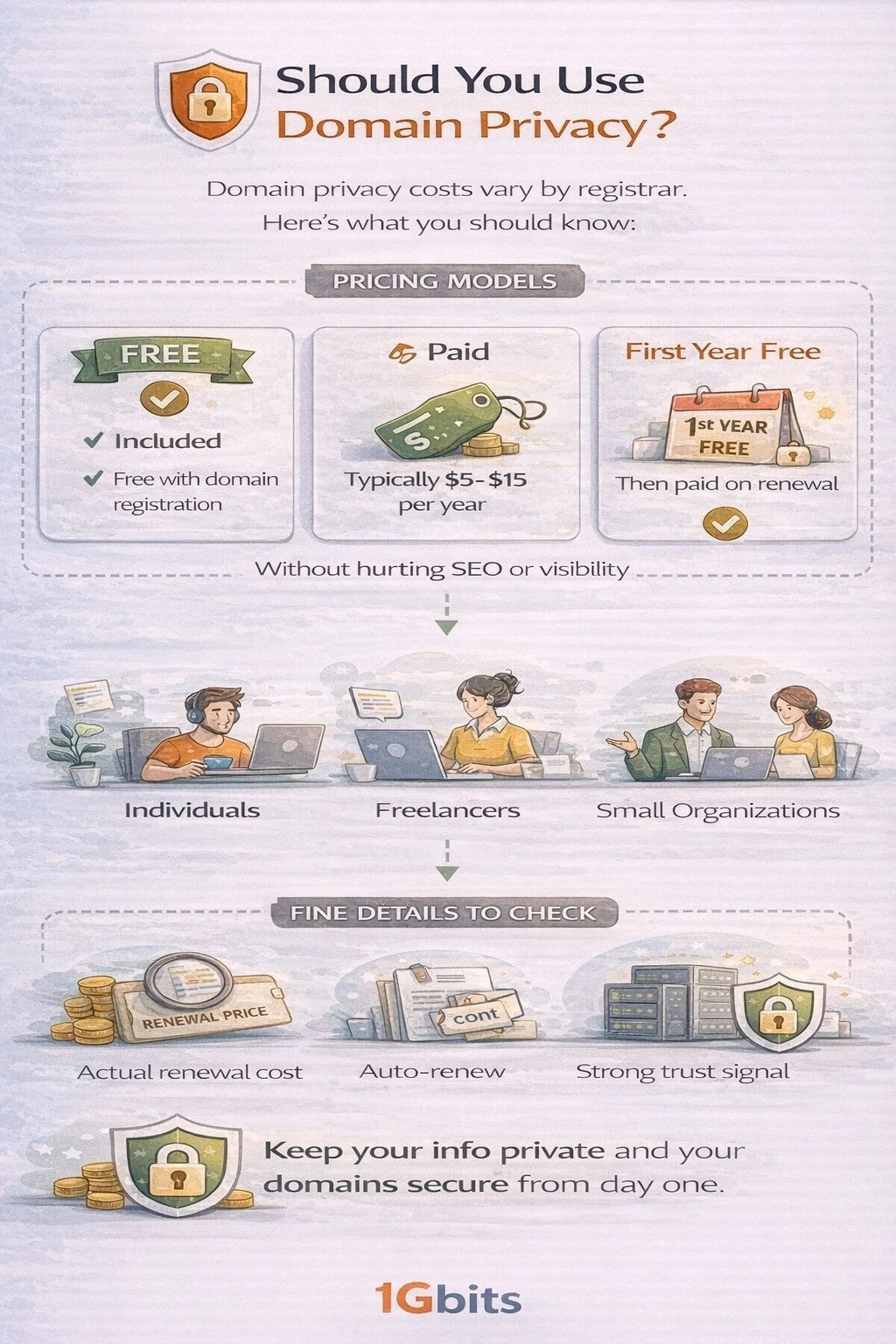
Domain privacy isn’t about secrecy it’s about control.
It helps prevent unnecessary exposure of your personal information, reduces spam and scam attempts, and aligns with modern expectations around online privacy. All of this comes without impacting SEO, website performance, or visibility.
For most individuals, freelancers, and small organizations, domain privacy is a simple, low-cost way to avoid problems before they start.
If you’re still getting familiar with how domains work, we recommend reading What Is a Domain Name to better understand how domain ownership, registration, and management fit together.
If privacy, performance, and peace of mind matter to you, choosing the right infrastructure makes a real difference. With 1Gbits, you get reliable hosting environments, instant deployment, global data centers, and 24/7 expert support—making it easier to manage your domains and services securely from day one.



![What Is Cold Data Storage? ❄️ [2026 Guide]](https://1gbits.com/cdn-cgi/image//https://s3.1gbits.com/blog/2026/02/what-is-cold-data-storage-750xAuto.webp "What Is Cold Data Storage? ❄️ [2026 Guide]")
![What Is Virtual Desktop Infrastructure? 🖥️ [VDI Explained]](https://1gbits.com/cdn-cgi/image//https://s3.1gbits.com/blog/2026/02/what-is-virtual-desktop-infrastructure-vdi-750xAuto.webp "What Is Virtual Desktop Infrastructure? 🖥️ [VDI Explained]")