
![Best CPU Benchmark Software: 🚀 Tested & Compared [2026]](https://1gbits.com/cdn-cgi/image/width=1200,quality=80,format=auto/https://s3.1gbits.com/blog/2021/06/cpu-benchmark-tools-online60-847xAuto.jpg "Best CPU Benchmark Software: 🚀 Tested & Compared [2026]")
If you want to benchmark your processor, don't just grab the first app you see and trust one number. CPU benchmark software can tell you a lot, but only if you pick the right tool and read the results correctly. This matters for gamers, PC builders, creators, Linux users, and server admins alike. Some tools are great for quick CPU performance tests, others are better for overclock stability, and a few handle CPU and GPU benchmarking together.
In this guide, we'll explain what CPU benchmark software is, how it works, and introduce you to the best CPU benchmark software available in 2026. Whether you want free CPU benchmark software, open source options, or Intel and AMD-specific tools, you'll find everything you need here.
What Is CPU Benchmark Software?
CPU benchmark software measures processor performance under a defined workload and returns benchmark results you can compare. Usually that means a benchmark score, but good tools also reveal clock behavior, CPU temperature, power draw, and sometimes signs of thermal throttling.
A CPU benchmark test evaluates:
- Single-core performance (important for gaming and lightly threaded apps)
- Multi-core performance (crucial for rendering, virtualization, and modern workloads)
- Thermal efficiency and stability
- Instructions per cycle (IPC) efficiency
There are two broad camps: synthetic benchmark tools such as Cinebench, Geekbench, and CPU-Z Bench, and real-world or workload simulation tests such as Blender Benchmark or compile-heavy Linux suites. One score alone rarely tells the full story.
Why Use CPU Benchmark Software?
There are several reasons why you may want to use a CPU benchmark tool:
- Upgrade decisions: Compare your current CPU with newer models.
- Performance troubleshooting: Identify if the CPU is causing system slowdowns.
- Overclocking verification: Ensure the processor is stable at new clock speeds.
- Gaming and rendering optimization: Measure how well your CPU handles games or video workloads.
- Value assessment: Compare benchmark scores against price to find the best fit for your budget.
If you're managing cloud hosting or dedicated server hosting, these tools are vital for hardware evaluation and choosing the right provider matters just as much. Before committing to a long-term plan, it's worth comparing the best dedicated server providers to ensure your processor meets workload demands.
| Tool | Best for | OS | Free/Paid | Single-core | Multi-core | Stress test | Temp monitoring | Beginner-friendly |
|---|---|---|---|---|---|---|---|---|
| Cinebench R23 | Rendering and quick CPU comparison | Windows, macOS | Free | Yes | Yes | No | No | Yes |
| Geekbench 6 | Cross-platform quick checks | Windows, macOS, Linux, Android, iOS | Free/Paid | Yes | Yes | No | No | Yes |
| PassMark PerformanceTest | Deep performance analysis | Windows | Paid/Trial | Yes | Yes | Limited | No | Yes |
| AIDA64 | Diagnostics and stability testing | Windows | Paid/Trial | Yes | Yes | Yes | Yes | Medium |
| Prime95 | Overclock stability | Windows, macOS, Linux | Free | No | No | Yes | No | No |
| CPU-Z Bench | Fast free processor benchmark | Windows | Free | Yes | Yes | No | No | Yes |
| Novabench | Quick health checks | Windows, macOS | Free/Paid | Yes | Yes | No | No | Yes |
| Phoronix Test Suite | Linux and server CPU benchmark | Linux, macOS, Windows | Free | Yes | Yes | Depends on test | No | No |
CPU Benchmark Metrics Explained
Single-Core Score
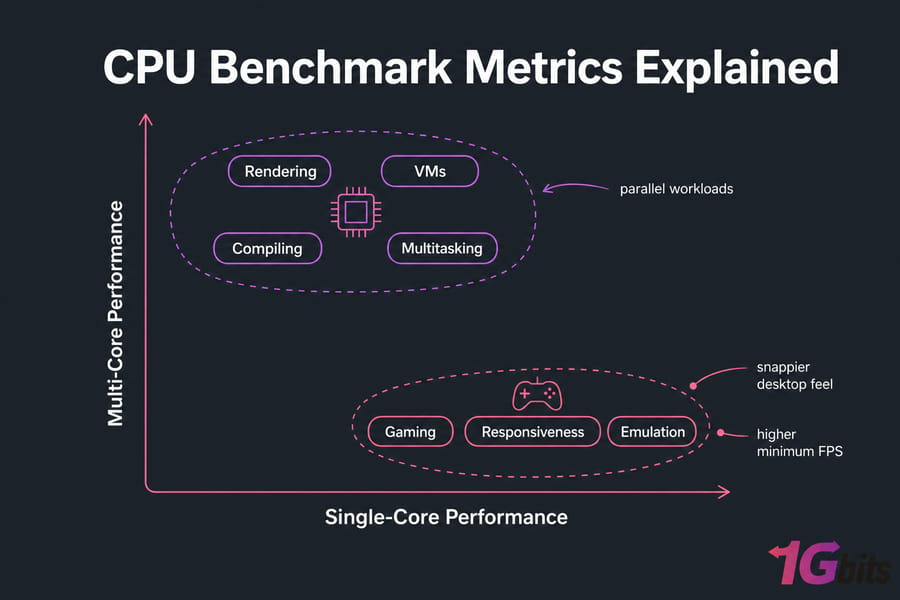
A single-core benchmark matters most for gaming, emulation, and lightly threaded apps. If two CPUs have similar core counts, the one with stronger single-threaded performance often feels snappier on the desktop and pushes higher minimum FPS.
Multi-Core Score
Multi-core benchmark results matter more for rendering, virtualization, compiling code, and heavy multitasking. If you run VMs or compare processors for workstation use, this number usually deserves more weight.
Clock Speed vs IPC
Clock speed alone can fool you. A 5.2GHz chip isn't automatically faster than a 4.8GHz one if the slower-clocked CPU does more work per cycle. That's IPC — instructions per clock. Real application performance comes from both.
Temperature, Power Draw, and Throttling
If the CPU hits thermal or power limits, scores drop. Laptops can lose 10% to 20% between the first and third pass because cooling couldn't keep up. Always monitor temperatures during testing — here's how to monitor CPU temperatures properly during a benchmark run.
Benchmark Score vs Real Application Performance
A good benchmark score is useful, but it's still a proxy. Cinebench may favor rendering behavior, while Geekbench is broader but shorter. A developer compiling kernels and a gamer chasing frame time consistency won't care about exactly the same numbers.
How Does a CPU Benchmark Test Work?
A typical CPU benchmark test includes multiple layers:
- Synthetic Tests: Artificial workloads like prime number calculations or compression loops.
- Real-World Simulations: Encoding a video, opening multiple browser tabs, or exporting 3D graphics.
- Scoring System: Each software uses a proprietary formula to generate performance scores. The higher the score, the better.
You can run a CPU benchmark at any time, but make sure your system is not under other heavy load conditions to get accurate results. If you're on Linux and want to verify your processor details before starting, these Linux commands to check CPU information will help you confirm specs before the test.
Best CPU Benchmark Software in 2026
Let's explore the top CPU benchmark software options currently available. We'll include free, paid, and open source CPU benchmark software, suitable for Windows, macOS, and Linux.
1. Cinebench R23
Best For: Creative professionals and general users
Platform: Windows, macOS
Price: Free
Cinebench by Maxon is one of the most popular CPU benchmarks for testing single-core and multi-core performance. It simulates rendering a 3D scene using the Cinema 4D engine. It's widely used in the industry and is perfect for comparing AMD and Intel CPUs.
✅ Highlights:
- Tests real-world workloads (3D rendering)
- Supports high core-count CPUs
- Simple one-click test
2. Geekbench 6
Best For: Cross-platform benchmarking
Platform: Windows, macOS, Linux, Android, iOS
Price: Free (basic), Paid (Pro)
Geekbench provides CPU and GPU benchmark software in one unified tool. It performs everyday tasks like web browsing, machine learning, and image processing.
✅ Highlights:
- Easy-to-read scores
- Good for mobile and desktop comparison
- Tests both single-core and multi-core
Is Geekbench free? Yes, a free version is available, but advanced features require a license.
3. PassMark PerformanceTest
Best For: Deep performance analysis
Platform: Windows
Price: Free trial, then paid
PassMark is an excellent CPU benchmark program that includes a large database of performance results from thousands of CPUs. Their CPU Mark is one of the most cited in reviews and forums.
✅ Highlights:
- Compare against global averages
- Detailed sub-scores for each component
- Exportable results for reports
4. AIDA64 Extreme
Best For: Enthusiasts and professionals
Platform: Windows
Price: Paid (free trial available)
AIDA64 offers extensive CPU benchmark tests, stress tests, and real-time monitoring tools. Useful for system builders and testers.
✅ Highlights:
- Memory and cache benchmarking
- Overclocking support
- Hardware diagnostics and reporting
5. Prime95
Best For: CPU stability, thermal testing, and overclocking reliability
Platform: Windows, macOS, Linux
Price: Free
Prime95 is one of the most widely recognized tools in the world of CPU stress testing, particularly popular among overclockers and hardware enthusiasts. Although it wasn't originally designed as a conventional CPU benchmark software, Prime95 has gained a strong reputation as a powerful way to test the stability of your processor under extreme conditions.
It's worth noting that while Prime95 doesn't give you a conventional benchmark score like Cinebench or Geekbench, it's one of the best tools to test the reliability of your system build. When used alongside monitoring tools like Open Hardware Monitor, it becomes an even more powerful combination for real-time temperature tracking during CPU benchmark tests.
6. CPU-Z + Bench
Best For: Detailed system profiling with basic benchmarking functionality
Platform: Windows
Price: Free
CPU-Z is a legendary utility that has long been a favorite among tech enthusiasts and system builders. Primarily designed to provide deep hardware insights — such as CPU architecture, cache levels, RAM speeds, and motherboard chipset — CPU-Z also includes a simple but effective built-in benchmark feature called Bench. It allows users to test single-thread and multi-thread CPU performance.
It's not as visually rich or comprehensive as some of the best CPU GPU benchmark software available, but it serves as a solid baseline, especially when comparing performance between two systems or CPUs from the same family. Plus, it's completely free and doesn't require installation — making it an excellent portable CPU benchmark tool for technicians and PC builders alike.
7. Novabench
Best For: Quick and balanced system benchmarking for everyday users
Platform: Windows, macOS
Price: Free
Novabench is an accessible and user-friendly CPU benchmark software that appeals to both casual users and IT professionals seeking fast insights into system performance. It provides a balanced test covering the CPU, GPU, memory, and disk speed — all within a short testing duration, often under two minutes.
While it lacks the extreme detail of tools like AIDA64 or 3DMark, Novabench excels in simplicity. Its lightweight design means it runs smoothly even on older machines, and it's frequently used for baseline performance testing before system upgrades or troubleshooting.
8. Phoronix Test Suite (Advanced Users)
Best For: Open-source benchmarking and automated performance testing on Linux
Platform: Linux, macOS, Windows
Price: Free & Open Source
Phoronix Test Suite stands out as one of the most advanced and versatile CPU benchmark tools available — especially for Linux enthusiasts and professionals. Developed by Phoronix Media, this open-source suite supports hundreds of tests that cover not just CPUs, but also GPUs, storage, memory, and system-level workloads. It can be customized to run specific CPU benchmark tests or comprehensive system diagnostics.
For tech-savvy users running Linux servers, this tool offers unparalleled insight and customization.
9. Open Hardware Monitor
Best For: Real-time monitoring during CPU benchmarking
Platform: Windows
Price: Free & Open Source
While Open Hardware Monitor is not a benchmarking tool on its own, it's an essential companion for any CPU benchmarking process. This open-source application provides detailed real-time insights into your hardware's health — including CPU temperatures, load, clock speeds, voltages, and even fan speeds. When running heavy CPU benchmark software like Prime95, Cinebench, or AIDA64, Open Hardware Monitor lets you observe how your system handles thermal stress and power consumption in real time.
10. UserBenchmark
Best For: Quick system-wide evaluation
Platform: Windows
Price: Free
UserBenchmark tests your CPU, GPU, SSD, HDD, and RAM all in one go. It's especially handy for gamers or general users who want a simple overview. However, it has faced controversy over methodology bias, so it's best used alongside other tools rather than as your only source.
Intel and AMD CPU Benchmark Software
Many tools work for both, but some are optimized for Intel or AMD processors:
- Intel Extreme Tuning Utility (XTU): Offers performance tuning and stress testing for Intel CPUs.
- Ryzen Master: AMD's official app to overclock and monitor Ryzen CPUs.
GPU and CPU Benchmark Software Free: One Tool, Two Jobs
For gamers and designers, the best CPU GPU benchmark software includes Geekbench, AIDA64, and 3DMark (which focuses on GPU but also tests CPU physics processing). These help identify the system's bottleneck — CPU or GPU.
Synthetic vs Real-World Benchmarks
When Synthetic Scores Are Useful
Synthetic benchmark tools are great for fast, repeatable CPU comparison. They're ideal when you want to benchmark your processor after a BIOS tweak, compare CPU benchmark scores online, or spot a performance regression.
When Real-World Tests Matter More
If your actual workload is Blender, encoding, game engines, or server-side builds, real-world tests matter more. Blender Benchmark, PCMark, SPEC CPU, Sysbench, and Phoronix Test Suite can tell a more honest story than one short synthetic run.
How to Compare CPU Benchmark Results Correctly
Run each test 2 to 3 times and average the results. Compare the same benchmark version, same power mode, and similar ambient temperature. That sounds tedious, honestly, but it prevents bad conclusions.
Scores vary because of RAM speed, BIOS defaults, motherboard power limits, laptop cooling, background apps, and Windows power plans. And yes, thermal throttling absolutely affects benchmark scores. Don't compare a thin laptop against a desktop tower and assume the chip alone explains the gap.
How to Run a CPU Benchmark
Running a benchmark is simple:
- Choose a benchmark tool (like Cinebench or Geekbench)
- Close other applications for accurate results
- Run the test (choose single-core or multi-core mode)
- Review the score and compare it online
Repeat the test under different conditions (e.g., after overclocking) for comparisons.
Common Benchmarking Mistakes to Avoid
Running Tests with Background Apps Open
Browsers, launchers, updates, RGB software — all of it can skew results.
Comparing Scores Across Different Tool Versions
A Geekbench 5 result is not the same thing as a Geekbench 6 result. Same goes for other benchmark databases.
Ignoring Cooling and Thermal Throttling
Bad cooling makes a healthy CPU look weak. Check temps, fan curves, and paste condition.
Using One Benchmark Only
This is probably the most common mistake. Use at least one synthetic benchmark, one monitoring tool, and one workload-relevant test. Also, don't overlook other components — how much RAM you actually need and storage speed both affect benchmark consistency more than most people expect.
CPU Stress Testing vs CPU Benchmarking
Benchmarking gives you a performance snapshot and a score. Stress testing checks stability, heat, and endurance over time. Monitoring tools track temperatures, clocks, voltages, and power draw. Three different jobs.
Prime95 is mostly a CPU stress test. Cinebench and Geekbench are benchmark tools. Open Hardware Monitor is a companion utility, not a benchmark itself. That distinction matters because stress tests can run hotter than normal apps and hotter than many benchmarks.
Is CPU Benchmark Safe?
Yes, benchmarking is safe if:
- You use trusted software (like the ones listed above)
- You avoid stress tests on failing or overheating systems
- You ensure proper cooling during intensive testing
Free vs Paid CPU Benchmark Software
Free tools can do a lot: Cinebench for rendering-style CPU comparison, CPU-Z for quick single-core and multi-core numbers, Prime95 for stability, Open Hardware Monitor for temps, and Novabench for a simple health check. For many home users, that's enough.
Paid tools like AIDA64 and PassMark are worth it when you need broader diagnostics, exportable reports, more test depth, or regular validation work.
CPU Benchmark with Price Consideration
When choosing hardware or VPS hosting, it's smart to compare CPU benchmark with price to find value-for-money. Websites like PassMark's CPU List or Geekbench Browser allow you to filter by performance, see current market prices, and identify budget or premium-tier processors. If you're weighing hosting options, dedicated server with Bitcoin payment flexibility can also factor into your cost equation alongside raw benchmark scores.
How to Choose the Right CPU Benchmark Tool
For Gaming
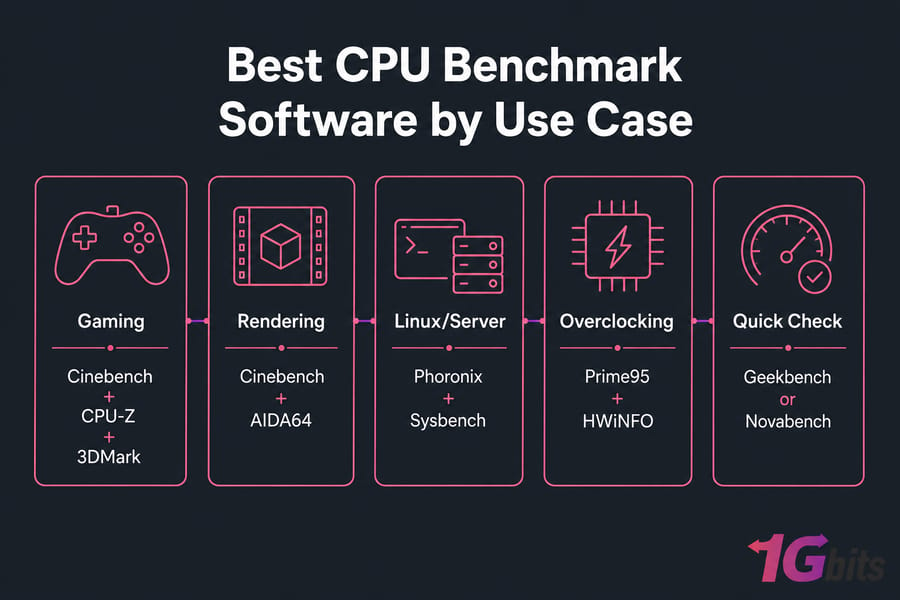
Prioritize single-core benchmark data and game-adjacent tests. Shortlist Cinebench, CPU-Z, and 3DMark — and pair this with your best gaming CPU research before making upgrade decisions.
For Overclocking and Stability Testing
Use Prime95 or OCCT for stress, not just scoring. Then monitor thermals and clocks carefully.
For Content Creation and Rendering
Cinebench and AIDA64 are strong choices. Blender Benchmark is also worth your time if rendering is your real workload.
For Server and Linux Performance Testing
Phoronix Test Suite, Sysbench, and stress-ng are better fits than flashy desktop tools. If you're evaluating infrastructure on a budget, a cheap dedicated server paired with the right benchmarks can still deliver solid performance data before committing to a long-term plan.
For Quick Health Checks
Geekbench or Novabench is fine when you just want a quick answer. Not perfect, but fast.
Recommended CPU Benchmark Tools for Windows, macOS, and Linux
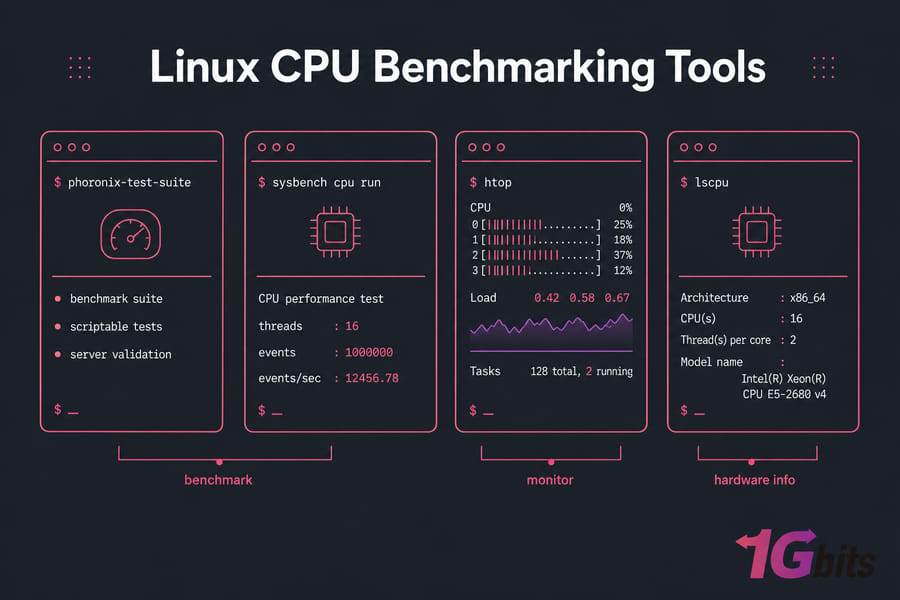
For Windows, the best mix is Cinebench, Geekbench, AIDA64, PassMark, CPU-Z, HWiNFO, and OCCT. On macOS, Geekbench and Cinebench are the easiest starting points, with Prime95 available for heavier stability work. For Linux, Phoronix Test Suite leads, followed by Sysbench, stress-ng, top, htop, and lscpu for monitoring and validation.
Are Online CPU Benchmarks Reliable?
Browser-based tests are fine for rough comparisons, not final decisions. They're affected by browser overhead, tabs, extensions, OS scheduling, and power settings. If you want reliable benchmark results, use installed software from official sources instead of an online CPU benchmark test alone.
CPU Benchmark Software Free Download
Most tools are available for free download from official websites:
- Cinebench: Maxon.net
- Geekbench: Geekbench.com
- UserBenchmark: Userbenchmark.com
Avoid third-party download sites to prevent malware risks. Download benchmark tools only from official pages — Maxon for Cinebench, Primate Labs for Geekbench, UL for 3DMark, PassMark, FinalWire for AIDA64, CPUID for CPU-Z, and the Phoronix site for Phoronix Test Suite.
Final Verdict: Which CPU Benchmark Tool Should You Use?
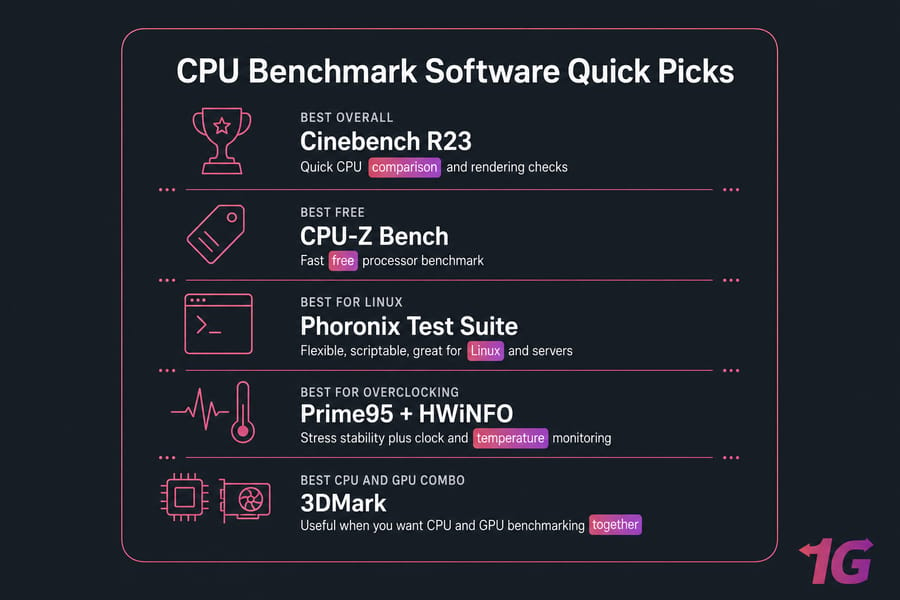
If you want one best overall CPU benchmark software pick, use Cinebench R23. For the best free quick test, go with CPU-Z Bench or Geekbench. For Linux and server CPU performance, use Phoronix Test Suite. For overclock stability, choose Prime95 plus HWiNFO or HWMonitor. And if you want CPU and GPU coverage together, 3DMark is the easy recommendation.
From casual users to professional system builders, everyone can benefit from CPU benchmark software. Whether you want free options, GPU and CPU combo testing, or Linux-based tools, you now have a complete toolkit to evaluate and compare processor performance. Still not sure? Start with Cinebench or Geekbench for a simple yet powerful test — and remember to compare your results online. If you're testing server hardware, buy dedicated server hosting from 1Gbits and ensure your processor meets the demands of your workload before deployment.
Need broader hardware context after benchmarking? Check our guides on best server CPUs, processor cooling, and storage tradeoffs like SSD vs HDD.

Leave A Comment