
Choosing the best Docker course in 2026 isn’t just about content — it’s about saving time, avoiding outdated tutorials, and learning skills you can actually use in real-world projects.
In this guide, you’ll find the best Docker courses (free and paid), carefully selected based on hands-on labs, course quality, real user reviews, and up-to-date DevOps practices.
Quick Picks — Best Docker Courses Right Now
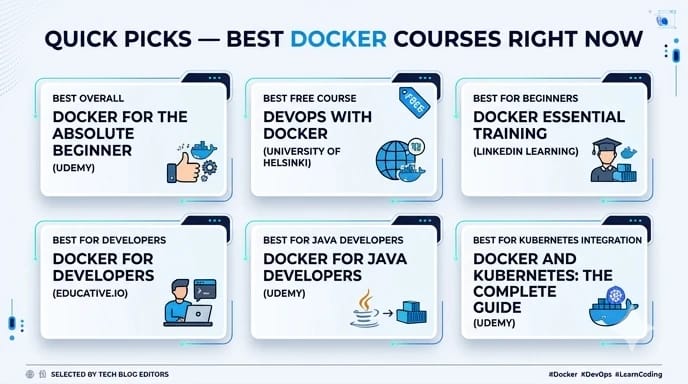
If you don’t have time to go through the full list, here are the best Docker courses right now based on different needs:
- Best Overall: Docker for the Absolute Beginner — Hands-On — DevOps (Udemy)
- Best Free Course: DevOps with Docker (University of Helsinki)
- Best for Beginners: Docker Essential Training (LinkedIn Learning)
- Best for Developers: Docker for Developers (Educative.io)
- Best for Java Developers: Docker for Java Developers (Udemy)
- Best for Kubernetes Integration: Docker and Kubernetes: The Complete Guide (Udemy)
These picks are based on course depth, hands-on experience, instructor quality, and overall learning value.
What is the Best Docker Course?
The best Docker course depends on your goals. For beginners, "Docker for the Absolute Beginner" is the best starting point. For free learning, the University of Helsinki course is the top choice. Developers should consider Educative.io, while advanced users can choose Kubernetes-focused courses.
How I Chose These Docker Courses
With so many Docker courses available online, choosing the right ones can be overwhelming. To make this list genuinely useful, I followed a structured evaluation process focused on quality, practical value, and real-world relevance.
Instead of simply listing popular courses, I carefully compared them based on consistent criteria to ensure that each recommendation helps you build real Docker skills—not just theoretical knowledge.
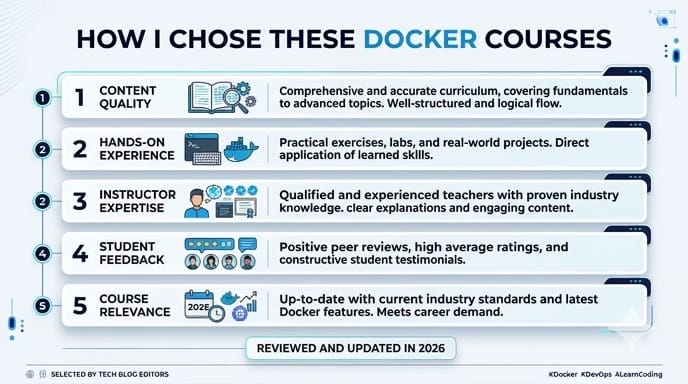
Evaluation Criteria
Each course was assessed using a set of core criteria designed to reflect both learning effectiveness and real-world applicability.
Content quality was a primary factor, including how well the course covers Docker fundamentals, containerization concepts, and more advanced topics like networking or orchestration.
Hands-on experience was equally important. Courses that include labs, exercises, or guided projects were prioritized because Docker is best learned through practice.
I also evaluated instructor expertise, focusing on real-world DevOps or cloud experience, as well as teaching clarity and structure.
Finally, student feedback such as ratings, reviews, and course popularity was considered to validate overall learner satisfaction.
Sources and Research Process
To build this list, I reviewed courses from leading platforms such as Udemy, Pluralsight, LinkedIn Learning, Educative, and university-backed programs.
I analyzed official course pages, syllabi, preview lessons, and student reviews to understand the depth and quality of each course. This helped identify not only what each course promises, but also how well it delivers on those promises in practice.
Whenever possible, I compared multiple courses side-by-side to determine which ones offer the best learning experience for specific use cases, such as beginners, developers, or DevOps professionals.
Last Updated and Accuracy
This list was last reviewed and updated in 2026 to reflect the most current course content, platform updates, and industry trends.
Because Docker and DevOps tools evolve rapidly, I focused on courses that are actively maintained or still relevant in modern development workflows. Outdated or poorly maintained courses were excluded, even if they were once popular.
Testing and Practical Value
Practical learning was a major priority in this selection. Docker is a hands-on technology, so courses that allow learners to actively build, run, and manage containers were ranked higher.
I gave preference to courses that include real-world scenarios, interactive environments, or step-by-step labs. These elements help bridge the gap between theory and actual implementation.
Courses that focus only on lectures without practical exercises were considered less effective, especially for beginners who need guided, hands-on experience to build confidence.
This approach ensures that the courses listed here are not only informative, but also genuinely useful for developing real Docker skills.
| Content Quality | Coverage of Docker basics, Dockerfiles, networking, and advanced topics |
| Hands-on Learning | Labs, exercises, guided projects, or interactive environments |
| Instructor Expertise | Real-world DevOps, cloud, or containerization experience |
| Student Feedback | Ratings, reviews, and learner satisfaction |
| Course Relevance | Current content aligned with modern Docker workflows |
What is Docker?
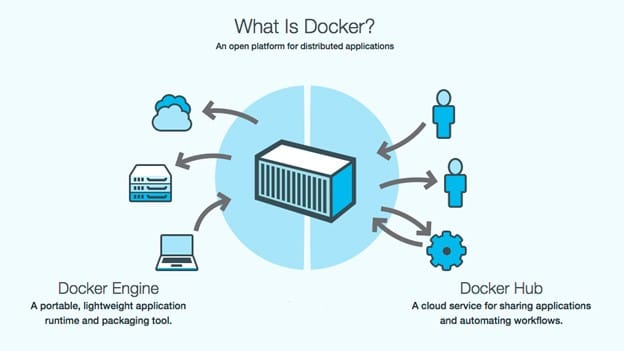
Docker often hailed as a transformative technology in modern software development, is essentially a platform designed to simplify the process of building, managing, and deploying applications within containers. But what exactly are containers, and how does Docker fit into this landscape?
Imagine containers as self-sufficient packages that encapsulate everything an application needs to run smoothly: code, runtime, system tools, libraries, and settings—all neatly bundled together. Docker, among the best Docker tutorial sources available, acts as an orchestrator, making the creation and management of these containers a breeze.
To better understand how Docker works in practice, it’s important to first understand what a Docker container is and how it packages applications into isolated environments.
Picture it as a versatile toolkit, offering the best Docker tools to construct these containers. It allows developers to package their applications in a consistent environment, irrespective of the underlying infrastructure. These containers, portable and scalable, can seamlessly move between development, testing, and production environments.
Think of the best Docker tutorial for beginners as a gateway into this world of containerization. It simplifies the complexities of deployment and dependency management, empowering developers to focus on crafting efficient, innovative applications. With Docker, gone are the days of "it works on my machine" scenarios, as these containers ensure consistency across various systems.
The magic of Docker lies in its ability to streamline workflows, enhance collaboration, and expedite the deployment process. Within the realm of the best Docker tutorial sources, one can delve into the intricacies of Docker-tutorial intricacies, from a quick Docker tutorial for rapid immersion to a comprehensive Docker tutorial 101 for a foundational understanding.
In essence, Docker revolutionizes software development by providing a standardized, efficient method to package, distribute, and run applications—making it an indispensable tool in the arsenal of every modern developer. In addition, Docker relies on reusable building blocks called Docker images, which define how containers are created and executed.
To know how to install docker on Ubuntu, you can read the article How to install docker on Ubuntu.. If you're comparing containerization with traditional virtualization, this guide on VM vs Docker explains the key differences clearly.
Docker vs Kubernetes
Understanding Docker vs Kubernetes is essential when working with containerized applications. Here’s a simplified breakdown:
- Docker: A platform used to create, package, and run applications in containers. It focuses on containerization and simplifies deployment.
- Kubernetes: An orchestration tool that manages containers at scale, handling deployment, scaling, and system reliability.
- Key Difference: Docker creates and runs containers, while Kubernetes manages them across multiple systems.
- Relationship: These tools are complementary—Docker is often used within Kubernetes.
- Use Case: Docker is ideal for development, while Kubernetes is best for large-scale production environments.
If you want a deeper technical comparison, check out this detailed guide on Docker vs Kubernetes, which explains their roles in modern DevOps workflows.
| Primary Role | Containerization platform | Container orchestration platform |
| Main Purpose | Build, package, and run containers | Manage, scale, and automate container deployments |
| Best For | Developers and small-to-medium deployments | Large-scale production environments |
| Complexity | Lower | Higher |
| Learning Curve | Beginner-friendly | Intermediate to advanced |
| Use Together? | Yes, often used as part of the container workflow | Yes, often manages Docker-based workloads |
Choosing the Right Docker Course
When choosing a Docker course, there are several important factors to consider:
- Content quality: The course should cover Docker fundamentals, Dockerfiles, and real-world use cases.
- Instructor expertise: Courses taught by experienced professionals usually provide better practical insights.
- Hands-on experience: Look for courses with labs, exercises, or projects.
- Community and support: Access to discussion forums can help solve problems faster.
- Updates and relevance: Choose courses that reflect the latest Docker features and practices.
- Reviews and ratings: Learner feedback helps evaluate course quality.
Course Comparison Table
To help you quickly compare the best Docker courses, here’s a side-by-side summary of key details like level, duration, pricing, and hands-on availability:
| Course | Provider | Level | Duration | Price | Labs | Certificate | Rating |
| Docker for the Absolute Beginner | Udemy | Beginner | ~6 hours | Paid | ✔️ Yes | ✔️ Yes | ⭐ 4.7 |
| Getting Started with Docker | Pluralsight | Beginner | ~4 hours | Paid (subscription) | ✔️ Yes | ✔️ Yes | ⭐ 4.5 |
| Docker Essential Training | LinkedIn Learning | Beginner | ~3 hours | Paid | ✔️ Yes | ✔️ Yes | ⭐ 4.6 |
| Docker for Developers | Educative.io | Intermediate | ~5 hours | Paid | ✔️ Interactive | ✔️ Yes | ⭐ 4.6 |
| Docker and Kubernetes: The Complete Guide | Udemy | Intermediate–Advanced | ~20+ hours | Paid | ✔️ Yes | ✔️ Yes | ⭐ 4.7 |
| DevOps with Docker | University of Helsinki | Beginner–Intermediate | Self-paced | Free | ✔️ Yes | ❌ No | ⭐ 4.8 |
| Docker for Java Developers | Udemy | Intermediate | ~8 hours | Paid | ✔️ Yes | ✔️ Yes | ⭐ 4.5 |
Prerequisites — What You Should Know Before Learning Docker
Before starting to learn Docker, having some basic knowledge can make the process much easier:
- Basic Linux knowledge: Understanding file systems and basic commands helps you grasp Docker faster.
- Command line familiarity: Docker is mostly used via CLI, so comfort with terminal commands is important.
- Basic programming experience: Helps you understand applications, dependencies, and environments.
- Understanding environments: Knowing development vs production environments makes Docker easier to understand.
You don’t need all of these to start, but having basic Linux and CLI knowledge will make learning much smoother. If you're new and need help setting things up, you can follow this step-by-step guide on how to install Docker before starting your learning journey.
If you're using a specific operating system, you can follow dedicated guides like installing Docker on Windows or installing Docker on macOS.
Free vs Paid Docker Courses — Which One Should You Choose?
When learning Docker, one of the most common questions is whether to choose a free course or invest in a paid one. The right choice depends on your goals, experience level, and how quickly you want to progress.
Both free and paid courses have their advantages, and understanding the differences can help you make the best decision.
Here’s a quick summary:
- Free courses: Best for beginners and quick introductions
- Paid courses: Better for structured and in-depth learning
- Hands-on labs: Usually more extensive in paid courses
- Support and updates: More reliable in premium platforms
If you're just getting started, a free course is a good first step. For deeper learning or career growth, a paid course is usually the better option.
| Cost | No upfront cost | Requires payment or subscription |
| Best For | Beginners and casual learners | Serious learners and career-focused users |
| Depth | Usually basic to intermediate | Usually more structured and comprehensive |
| Hands-on Labs | Sometimes included | More commonly included |
| Certificates | Occasionally available | Often available |
| Support | Limited | Better support and community access |
1. Docker for the Absolute Beginner — Hands-On — DevOps (Udemy)
"Docker for the Absolute Beginner — Hands-On — DevOps" on Udemy is one of the most popular entry-level courses for learning Docker from scratch. It’s designed specifically for beginners and focuses on building a strong foundation through simple explanations and practical exercises.
Key features of this course include:
- Beginner-friendly explanations that simplify core Docker concepts
- Coverage of essential topics such as containers, Dockerfiles, and container management
- Hands-on labs and practical exercises to reinforce learning
- A structured learning path from fundamentals to more advanced use cases
- Clear instruction with real-world examples to improve understanding
- Strong ratings and positive feedback from learners
This course stands out as a top choice for beginners who want a clear, practical introduction to Docker and containerization without unnecessary complexity.
To learn more, visit Docker for the Absolute Beginner — Hands-On — DevOps (Udemy).
2. Getting Started with Docker (Pluralsight)
"Getting Started with Docker" on Pluralsight is a well-structured course that introduces the fundamentals of Docker and containerization. It is designed for developers and IT professionals who want both conceptual understanding and practical skills for working with containers.
Key features of this course include:
- A balanced mix of theoretical concepts and hands-on learning
- Coverage of container fundamentals, Docker tools, and core workflows
- Practical experience with managing containers and working with images
- Introduction to container orchestration concepts and deployment strategies
- Insights from experienced instructors, including collaborative learning formats
- Focus on real-world use cases such as application packaging and deployment
This course is a solid choice for learners who want to understand not just how Docker works, but also why it is used in modern development and DevOps environments.
To learn more, visit Getting Started with Docker (Pluralsight).
3. Docker Essential Training: Installation and Configuration (LinkedIn Learning)
"Docker Essential Training: Installation and Configuration" on LinkedIn Learning is a practical course focused on setting up Docker across different environments. It’s especially useful for beginners who want a clear, step-by-step guide to installing and configuring Docker on various platforms.
Key features of this course include:
- Step-by-step guidance for installing Docker on macOS, Windows, Linux, and cloud environments
- Hands-on setup and configuration exercises for real-world readiness
- Clear instruction from an experienced software engineer
- Introduction to running Docker in cloud platforms such as AWS
- Flexible, self-paced learning through the LinkedIn Learning platform
- Strong focus on building a solid foundation before moving to advanced topics
This course is a great starting point if your main goal is to get Docker up and running correctly and understand how to configure it across different systems.
To learn more, visit Docker Essential Training: Installation and Configuration (LinkedIn Learning).
4. Docker for Developers (Educative.io)
"Docker for Developers" on Educative.io is a focused course designed specifically for developers who want to integrate Docker into their development workflow. It emphasizes practical use cases and shows how Docker can simplify building, testing, and deploying applications.
Key features of this course include:
- A developer-focused approach to using Docker in real-world projects
- Practical guidance on managing dependencies and avoiding environment conflicts
- Techniques for packaging and deploying applications using containers
- Insights into scaling applications efficiently with Docker
- Interactive, browser-based learning environment for hands-on experience
- Real-world examples showing how Docker is used in modern software development
This course is ideal for developers who want to move beyond basic Docker knowledge and start using it effectively in their day-to-day development process.
To learn more, visit Docker for Developers (Educative.io).
5. Docker Crash Course for Busy DevOps and Developers (Udemy)
"Docker Crash Course for Busy DevOps and Developers" on Udemy is designed for learners who want to understand Docker quickly without going through long, in-depth courses. It focuses on the most important concepts and practical skills needed to start using Docker in real projects.
Key features of this course include:
- Fast-paced learning focused on core Docker concepts
- Hands-on exercises that help you apply what you learn immediately
- Coverage of essential topics for building and deploying containerized applications
- Time-efficient structure, ideal for busy developers and DevOps professionals
- Practical insights into using Docker in modern development workflows
- Guidance from experienced instructors with real-world examples
This course is a great option if you want to learn Docker fundamentals quickly and start using it in your workflow without spending weeks on training.
To learn more, visit Docker Crash Course for Busy DevOps and Developers (Udemy).
6. Learning Docker (LinkedIn Learning)
.jpg "Learning Docker course on LinkedIn Learning")
"Learning Docker" on LinkedIn Learning is a beginner-friendly course that introduces the core concepts of Docker, including containers, Dockerfiles, and their real-world applications. It’s led by an experienced instructor and focuses on helping learners build a solid foundation.
For a deeper understanding of container technologies, you can also explore the differences between Docker and LXC, which helps clarify how Docker compares to other containerization tools.
Key features of this course include:
- Clear introduction to Docker fundamentals such as containers and images
- Practical examples that demonstrate real-world Docker usage
- Structured learning path suitable for beginners
- Flexible, self-paced learning through the LinkedIn Learning platform
- Introduction to related tools like Docker Compose for multi-container applications
- Coverage of Docker use cases across different environments, including Windows
To work with multi-container applications, you can follow this guide on how to install Docker Compose.
This course is a strong option for beginners who want a clear and structured introduction to Docker along with practical examples.
To learn more, visit Learning Docker (LinkedIn Learning).
7. Docker Deep Dive (Pluralsight)
"Docker Deep Dive" on Pluralsight is a comprehensive course that covers both the fundamentals and deeper aspects of Docker and containerization. It serves as a strong starting point for learners who want to build a solid understanding before moving on to advanced tools like Kubernetes.
For those exploring container runtimes, it's helpful to understand how Docker compares to other technologies. You can read this detailed guide on Docker vs Containerd to better understand their differences and use cases.
Key features of this course include:
- Strong foundation in Docker concepts and containerization principles
- Practical insights into real-world Docker usage and workflows
- Introduction to scaling applications and managing containerized environments
- Coverage of Docker setup, management, and day-to-day usage
- A clear pathway toward advanced topics like Kubernetes and orchestration
- Guidance on building scalable and production-ready solutions
As you continue learning, you may also want to explore alternative tools such as Docker vs Podman or orchestration options like Docker Swarm.
This course is a solid choice for learners who want both foundational knowledge and a pathway toward more advanced container technologies.
To learn more, visit Docker Deep Dive (Pluralsight).
8. Docker in Depth (Cloud Academy)
"Docker in Depth" by Cloud Academy is a comprehensive learning path that takes you from basic Docker concepts to advanced deployment scenarios. It’s designed for learners who want a structured and progressive approach to mastering Docker in real-world environments.
For those exploring alternative container tools, you can also review this comparison of Docker vs Podman to understand how different container technologies compare in terms of performance and security.
Key features of this course include:
- A structured learning path from basic container usage to cluster deployments
- Coverage of single-container and multi-container application setups
- Hands-on exercises that reinforce real-world Docker usage
- Practical guidance on deploying applications in different environments
- Focus on real-world scenarios and professional use cases
- Strong progression toward advanced container and deployment concepts
This course is ideal for learners who want a deeper understanding of Docker and how to use it effectively in production and cloud-based environments.
To learn more, visit Docker in Depth (Cloud Academy).
9. Docker for Java Developers
"Docker for Java Developers" is a specialized course designed to help Java developers integrate Docker into their development workflow. It focuses on containerizing Java applications and improving deployment, debugging, and performance in containerized environments.
For developers who want to expand beyond Docker and explore orchestration, understanding the differences between Docker vs Kubernetes can provide valuable insights into scaling and managing containerized applications.
Key features of this course include:
- Java-focused approach to containerizing applications using Docker
- Coverage of Docker fundamentals tailored to Java development workflows
- Hands-on guidance for packaging and running Java applications in containers
- Techniques for debugging Java applications inside Docker environments
- Best practices for optimizing performance and resource usage
- Practical insights into deploying Java applications in modern DevOps setups
This course is ideal for Java developers who want to leverage Docker to simplify development, improve consistency, and streamline deployment processes.
To learn more, visit Docker for Java Developers.
10. Docker and Kubernetes: The Complete Guide (Udemy)
"Docker and Kubernetes: The Complete Guide" on Udemy is a comprehensive course designed for developers and DevOps professionals who want to go beyond Docker basics and learn how to deploy and manage applications at scale using Kubernetes.
Key features of this course include:
- In-depth coverage of both Docker and Kubernetes from beginner to advanced levels
- Hands-on projects that demonstrate real-world application deployment
- Step-by-step guidance on building, testing, and deploying containerized applications
- Focus on modern DevOps workflows and production-ready environments
- Practical scenarios for managing containers at scale using Kubernetes
- Strong emphasis on real-world use cases and industry-relevant tools
This course is an excellent choice for learners who want to move from basic Docker usage to mastering container orchestration and deploying scalable applications in production environments.
To learn more, visit Docker and Kubernetes: The Complete Guide (Udemy).
11. Docker & Kubernetes: The Practical Guide (Udemy)
"Docker & Kubernetes: The Practical Guide" on Udemy is a hands-on course focused on helping learners understand and apply both Docker and Kubernetes in real-world scenarios. It is designed for those who prefer practical learning over purely theoretical explanations.
Key features of this course include:
- Strong emphasis on hands-on practice and real-world implementation
- Step-by-step learning from Docker basics to advanced Kubernetes concepts
- Clear explanations supported by diagrams and practical examples
- Focus on core features and workflows used in modern DevOps environments
- Guidance on deploying and managing applications using Kubernetes
- Practical approach to building efficient and scalable infrastructure
This course is a great choice for learners who want to build practical skills and confidently work with Docker and Kubernetes in real-world development and DevOps environments.
To learn more, visit Docker & Kubernetes: The Practical Guide (Udemy).
12. Docker Mastery: with Kubernetes + Swarm from a Docker Captain
"Docker Mastery: with Kubernetes + Swarm from a Docker Captain" is a highly regarded course led by an experienced Docker Captain. It provides deep, practical training on Docker along with orchestration tools like Kubernetes and Docker Swarm.
Key features of this course include:
- Expert-led instruction from an experienced Docker Captain
- Comprehensive coverage of Docker, Kubernetes, and Docker Swarm
- Hands-on labs and real-world exercises to reinforce learning
- Practical guidance on using official Docker and Kubernetes tools
- Access to community support and discussion groups for problem-solving
- Clear focus on real-world DevOps workflows and deployment scenarios
This course is an excellent choice for learners who want an in-depth, practical understanding of Docker and container orchestration tools used in modern DevOps environments.
To learn more, visit Docker Mastery: with Kubernetes + Swarm from a Docker Captain.
13. DevOps Tutorial: Complete Beginners Training — 5 in 1 Bundle
"DevOps Tutorial: Complete Beginners Training — 5 in 1 Bundle" is a comprehensive course designed to introduce beginners to core DevOps concepts and tools, including Docker. It provides a broad overview of modern development workflows and how different DevOps components work together.
Key features of this course include:
- Beginner-friendly introduction to DevOps principles and workflows
- Coverage of multiple tools in one course, including Docker and CI/CD concepts
- Hands-on exercises to reinforce practical understanding
- Step-by-step guidance on containerization and Docker fundamentals
- Introduction to automation, monitoring, and deployment practices
- Flexible learning structure suitable for self-paced study
- Cost-effective bundle covering multiple DevOps topics in one place
This course is a good starting point for beginners who want to explore Docker alongside other essential DevOps tools and gain a broader understanding of modern software delivery processes.
To learn more, visit DevOps Tutorial: Complete Beginners Training — 5 in 1 Bundle.
14. The Docker for DevOps Course: From Development to Production
"The Docker for DevOps Course: From Development to Production" focuses on using Docker to streamline the development and deployment of web applications. It is designed to help learners understand how Docker fits into modern DevOps workflows from start to finish.
Key features of this course include:
- End-to-end coverage of building, testing, and deploying applications with Docker
- Practical approach to automating deployment workflows
- Hands-on examples and real-world scenarios for application deployment
- Introduction to containerization concepts, Dockerfiles, and container management
- Integration of Docker into CI/CD pipelines for modern DevOps practices
- Focus on development workflows and production-ready environments
- Beginner-friendly structure with gradual progression
This course is a strong option for learners who want to understand how Docker is used across the full development lifecycle, from local development to production deployment.
To learn more, visit The Docker for DevOps Course: From Development to Production.
15. Best Free University-Level Course for Beginners (University of Helsinki)
.png "University-level Docker course for beginners")
The University of Helsinki’s “DevOps with Docker” course is one of the best free, university-level programs for learning Docker and containerization. It offers a structured and in-depth introduction to Docker with a strong focus on practical learning.
Key features of this course include:
- Comprehensive coverage of Docker, containers, Docker Compose, and web services
- Hands-on exercises that reinforce real-world container usage
- Self-paced structure, allowing flexible learning for beginners
- Instruction from experienced university-level educators
- Exposure to related topics such as reverse proxies and databases
- Completely free access, making it accessible to all learners
- High-quality academic content with practical relevance
This course is an excellent choice for beginners who want a deeper, structured learning experience without paying for a course.
To learn more, visit Best Free University-Level Course for Beginners (University of Helsinki).
16. Best Lab-Based Course for Beginners with Free Certificate (IBM)
IBM’s Docker course is a beginner-friendly program that focuses on hands-on learning through interactive labs and guided exercises. It is ideal for learners who prefer learning by doing and want to build practical Docker skills from the start.
Key features of this course include:
- Interactive labs that allow you to practice Docker commands in real environments
- Clear video demonstrations explaining core Docker concepts
- Self-paced learning with flexible progress and no strict deadlines
- Free digital certificate upon course completion
- Coverage of essential topics such as containers, images, and registries
- Practical exercises that simulate real-world Docker usage
- Strong focus on building job-ready Docker skills
This course is a great option for beginners who want hands-on experience and a recognized certificate to support their learning journey.
To learn more, visit Best Lab-Based Course for Beginners with Free Certificate (IBM).
17. Hands-On Docker for Java Developers
"Hands-On Docker for Java Developers" is a specialized course designed for Java developers who want to use Docker effectively in their application development and deployment workflows. It focuses on practical implementation and real-world use cases within the Java ecosystem.
Key features of this course include:
- Hands-on approach to building, running, and deploying Java applications with Docker
- Real-world use cases that demonstrate Docker in practical Java development scenarios
- Focused guidance on integrating Docker into Java-based workflows
- Clear explanation of how containerization benefits Java applications
- Practical exercises that reinforce learning through direct implementation
- Strong focus on applying Docker in real development environments
This course is ideal for Java developers who want to move beyond theory and gain practical experience using Docker in real-world projects.
To learn more, visit Hands-On Docker for Java Developers.
How Long Will It Take to Learn Docker?
The time it takes to learn Docker depends on your background, learning pace, and how deeply you want to go. For most learners, Docker basics can be picked up in a few days, while mastering it for real-world use can take several weeks.
Below is a realistic learning timeline to help you understand what to expect and how to plan your learning journey.Beginner Level (1–3 Days)
If you're completely new to Docker, you can learn the core concepts in just a few days with focused study.
At this stage, you’ll understand what containers are, how Docker works, and how to run basic commands like pulling images, starting containers, and using Docker CLI.
Beginner-friendly courses and quick tutorials are usually enough to get you started and comfortable with the fundamentals.
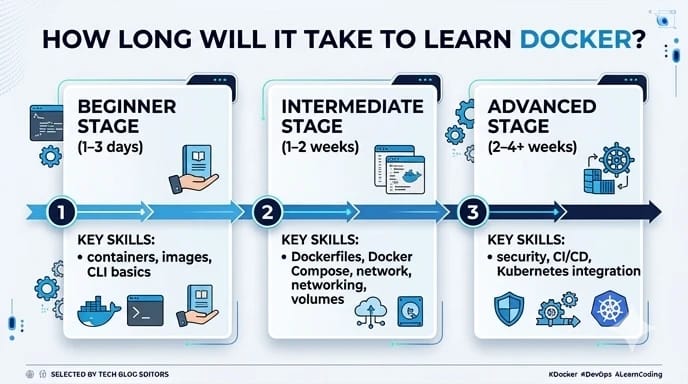
Intermediate Level (1–2 Weeks)
Once you move beyond the basics, the learning curve becomes more practical and hands-on.
During this phase, you'll learn how to write Dockerfiles, build custom images, manage multi-container applications using Docker Compose, and handle networking and volumes.
This is where real learning happens, especially if you follow courses that include labs and real-world examples.
Advanced Level (2–4+ Weeks)
To use Docker professionally, you'll need a deeper understanding of how it fits into modern DevOps workflows.
This includes topics like container optimization, security best practices, CI/CD integration, and working with orchestration tools like Kubernetes.
At this level, hands-on experience and real project work become essential to truly master Docker.
Fast-Track vs Deep Learning
If your goal is to quickly start using Docker, you can become functional in under a week by focusing on core commands and workflows.
However, if you want to use Docker in production environments or as part of a DevOps role, expect to spend several weeks building real-world experience and understanding best practices.
Recommended Learning Path
To learn Docker efficiently, it's best to follow a structured path:
- Step 1: Learn Docker basics (images, containers, CLI)
- Step 2: Practice with Dockerfiles and build your own images
- Step 3: Use Docker Compose for multi-container apps
- Step 4: Work on real projects and deployment scenarios
- Step 5: Explore advanced topics like Kubernetes and CI/CD integration
Following this roadmap will help you move from beginner to confident Docker user much faster and more effectively.
| Beginner | 1–3 days | Containers, images, basic Docker commands |
| Intermediate | 1–2 weeks | Dockerfiles, Docker Compose, volumes, networking |
| Advanced | 2–4+ weeks | Security, optimization, CI/CD, Kubernetes integration |
Career Opportunities After Learning Docker
Learning Docker can open the door to a wide range of career opportunities in modern software development and DevOps. As containerization has become a standard practice in the industry, Docker skills are now in high demand across many technical roles.
Whether you're a beginner or an experienced developer, understanding Docker can significantly improve your employability and technical skill set.
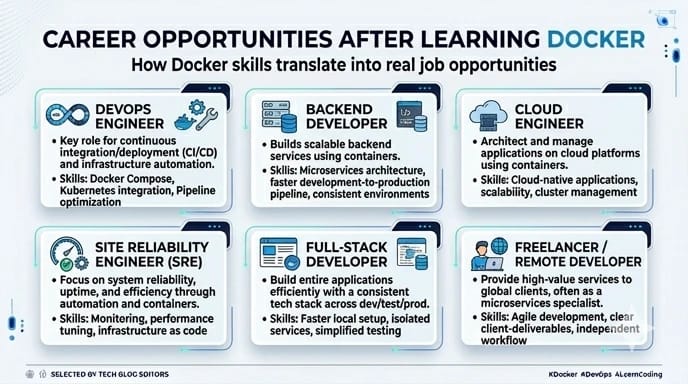
DevOps Engineer
Docker is a core tool in DevOps workflows, making it an essential skill for DevOps engineers.
In this role, you'll use Docker to build, deploy, and manage containerized applications, often alongside tools like Kubernetes, CI/CD pipelines, and cloud platforms.
Many companies expect DevOps professionals to have hands-on experience with Docker in real production environments.
Backend Developer
Backend developers use Docker to create consistent development and deployment environments.
By containerizing applications, developers can ensure their code runs reliably across different systems, reducing bugs and environment-related issues.
Docker is especially useful when working with microservices architectures and APIs.
Cloud Engineer
Cloud platforms like AWS, Azure, and Google Cloud heavily rely on containerization technologies.
As a cloud engineer, you'll often deploy and manage Docker containers in scalable environments, using services like Kubernetes or container registries.
Docker knowledge is often considered a foundational skill for cloud-related roles.
For production deployments, many developers use cloud-based environments such as Docker VPS hosting to run and scale containerized applications efficiently.
Site Reliability Engineer (SRE)
SREs focus on maintaining system reliability and performance, and Docker plays a key role in achieving this.
Containers help standardize deployments and simplify scaling, making it easier to manage complex distributed systems.
Understanding Docker can help SREs troubleshoot issues faster and maintain stable infrastructure.
Full-Stack Developer
Full-stack developers benefit from Docker by simplifying both frontend and backend environment setup.
It allows teams to run entire applications locally using containers, improving collaboration and reducing setup time.
Docker is especially valuable in team environments where consistency across machines is critical.
Freelancing and Remote Opportunities
Docker skills are also valuable for freelancers and remote developers.
Many clients prefer developers who can deliver containerized applications that are easy to deploy and scale. This makes Docker a strong addition to your freelance skill set.
It also enables smoother collaboration in remote teams by ensuring consistent environments across different systems.
How Docker Impacts Your Career Growth
Adding Docker to your skill set can significantly increase your value in the job market.
It demonstrates that you understand modern development practices, including containerization, scalability, and deployment automation.
In many cases, Docker is not just a standalone skill—it acts as a gateway to more advanced technologies like Kubernetes, cloud-native development, and DevOps engineering.
| DevOps Engineer | Builds, deploys, and manages containerized applications |
| Backend Developer | Creates consistent development and deployment environments |
| Cloud Engineer | Deploys and manages containers in cloud environments |
| Site Reliability Engineer | Improves consistency, scaling, and reliability of systems |
| Full-Stack Developer | Runs complete application stacks in containers |
| Freelancer | Delivers portable and easy-to-deploy applications |
Course Updates & Currency
Docker and DevOps technologies evolve quickly, and course quality can change over time as platforms update content, instructors revise materials, or new tools emerge.
To ensure this list remains accurate and valuable, it is regularly reviewed and updated based on the latest available information.
How Often This List Is Updated
This course list is reviewed periodically to reflect new releases, major updates, and changes in course quality or relevance.
Courses that become outdated, no longer maintained, or fall behind current industry practices are removed or replaced with better alternatives.
At the same time, newly published or highly rated courses are evaluated and added when they meet the criteria outlined in this guide.
Last Checked and Verified
All courses and information in this article were last reviewed and verified in 2026.
This includes checking course content, platform availability, pricing models, and overall relevance to current Docker and DevOps workflows.
How Course Relevance Is Maintained
Priority is given to courses that are actively maintained, frequently updated, or still aligned with modern containerization practices.
Courses that reflect current tools such as Docker Compose, container networking, and Kubernetes integration are ranked higher than outdated or purely theoretical content.
This ensures that the recommendations remain practical and useful for real-world applications—not just historical reference.
Why This Matters for Learners
Choosing an up-to-date course is essential when learning Docker, as outdated content can lead to confusion or learning obsolete practices.
By keeping this list current, you can confidently choose a course that reflects how Docker is actually used in today’s development and DevOps environments.
Further Reading — Books & Official Documentation
While online courses are one of the best ways to learn Docker, combining them with high-quality books and official documentation can significantly deepen your understanding.
These resources provide more detailed explanations, advanced concepts, and long-term reference material that you can revisit as your skills grow.
Best Docker Books
Books are ideal for building a strong conceptual foundation and exploring Docker in depth.
Popular Docker books often cover topics such as container architecture, networking, security, and best practices in a structured and comprehensive way.
They are especially useful if you prefer a more systematic learning approach or want to go beyond quick tutorials and videos.
Some widely recommended Docker books include beginner-friendly guides as well as advanced resources for DevOps professionals.
Official Docker Documentation
The official Docker documentation is one of the most accurate and up-to-date sources of information.
It includes detailed guides on installation, configuration, container management, networking, and orchestration tools like Docker Compose.
Although it can be technical for beginners, it becomes an essential reference as you gain more experience and start working on real projects.
Why Combine Courses with Reading?
Courses are great for guided learning, but books and documentation help reinforce and expand that knowledge.
By combining both, you can move from simply following tutorials to truly understanding how Docker works and how to apply it in different scenarios.
This approach is especially useful if you're aiming for professional roles in DevOps, cloud engineering, or backend development.
Recommended Learning Strategy
A practical approach is to start with a structured course, then use books and documentation as a reference while practicing.
For example, you can follow a course to learn the basics, then refer to the official documentation when working on projects or troubleshooting issues.
This combination helps you learn faster, retain knowledge better, and build real-world Docker expertise.
Useful Docker Resources
To accelerate your Docker learning journey, it’s important to go beyond courses and use practical resources like cheat sheets, command references, and hands-on projects.
These resources can help you practice faster, troubleshoot issues, and build real-world skills more effectively.
To get started faster, you can explore this practical guide to Docker basic commands, which covers the most important commands every beginner should know.
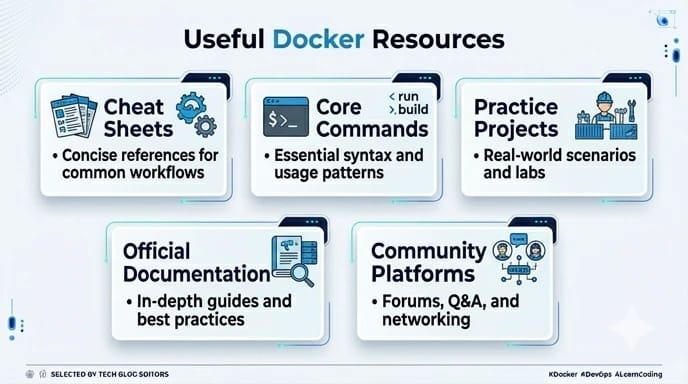
Docker Cheat Sheets
Cheat sheets are one of the fastest ways to remember essential Docker commands and workflows.
They provide a quick reference for commonly used commands like running containers, managing images, and working with volumes and networks.
Keeping a Docker cheat sheet handy can save time and help reinforce what you learn from courses.
Essential Docker Commands
Mastering Docker commands is key to becoming confident with container management.
Focus on core commands such as docker run, docker build, docker ps, docker images, and docker-compose up.
Practicing these commands regularly will help you understand how Docker works under the hood and improve your efficiency.
Hands-on Practice Projects
The best way to learn Docker is by building real projects.
Start with simple tasks like containerizing a basic web application, then move on to more advanced projects such as multi-container setups using Docker Compose.
For example, you can build a full-stack app with a frontend, backend, and database running in separate containers.
For example, you can try deploying a real project by following this tutorial on installing WordPress with Docker on a VPS.
Official Documentation
Docker’s official documentation is one of the most reliable and up-to-date learning resources available.
It provides detailed explanations, examples, and best practices for everything from installation to advanced configurations.
While it may feel technical at first, it becomes an invaluable reference as your skills grow.
Online Communities and Forums
Learning Docker becomes much easier when you’re part of a community.
Platforms like Stack Overflow, GitHub, and DevOps forums can help you troubleshoot issues, learn from others, and stay updated with best practices.
Engaging with the community also exposes you to real-world problems and solutions.
Conclusion
The best Docker course isn’t necessarily the most expensive or the longest — it’s the one that helps you build real, hands-on skills.
If you're a beginner, start simple and focus on practice. If you're a developer or DevOps engineer, choose courses that include real-world deployments and Kubernetes integration.
Docker remains a core skill in modern development, and with the right course and consistent practice, you can go from beginner to production-ready much faster than you think.

Leave A Comment