

Popular, contemporary, and loaded with features, MySQL is an open-source and free relational database management system. Need the version right now? Open a terminal and run this:
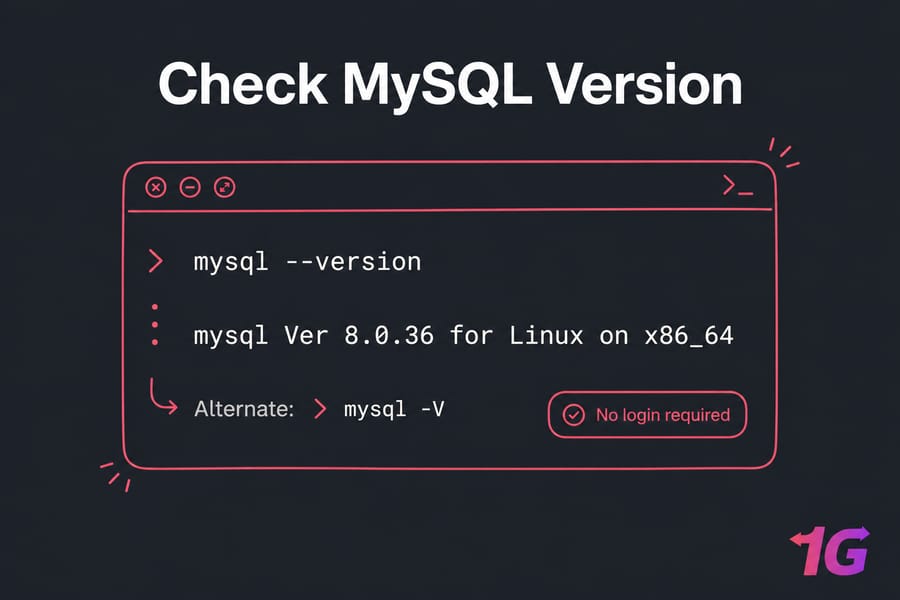
mysql --version
mysql -V
Already logged into the database? Run this instead:
SELECT VERSION();And if you live in a GUI, the version is sitting in plain sight — phpMyAdmin shows it on the dashboard, MySQL Workbench shows it under Server Status, and XAMPP shows it in the control panel logs. That's the whole answer. The rest of this article covers the edge cases, the platform differences, and the reasons the two methods above sometimes disagree with each other. To ensure your applications run with maximum efficiency and stability, choosing the right server for SQL database infrastructure is a fundamental step for any growing project.
🔍 Why Is Knowing Your MySQL Version Necessary?
It's essential to know the version of MySQL you're using because there can be major variations between them. Your system will have new features and becomes more capable with a newer version of MySQL. I've lost hours to this exact problem: an app throws a cryptic SQL syntax error, and the culprit turns out to be a server running 5.7 when the code assumed 8.0.
Compatibility with Applications and Plugins
WordPress plugins, Laravel migrations, ORMs, backup tools — they all publish minimum version requirements. MySQL 8.0 introduced window functions, CTEs, and a different default authentication plugin (caching_sha2_password), which breaks older clients outright. Since some components might not function with your system, knowing your MySQL version number might be crucial in identifying potential problems when interacting with third-party tools and plugins.
Security Patches and Bug Fixes
Old versions accumulate known CVEs. MySQL 5.7 hit end of life in October 2023, meaning no more security fixes from Oracle. Running it in production today is a gamble. Inaccurate reporting, duplicate data, and security breaches are just a few mistakes that can occur with outdated databases. While you're auditing, take a moment to secure MySQL databases and remove anonymous users — both take five minutes.
Feature Differences Between MySQL Versions
Roles, atomic DDL, JSON improvements, and a rewritten optimizer all landed in 8.0. If a tutorial's SQL just won't run, check your version before you blame the tutorial. To fulfil your organisation's needs and ensure you're using the most recent software and technology, it's imperative to upgrade your database software. Installing the most recent MySQL version also reduces the risk of your system failing. If you are managing your own infrastructure, opting for a Linux dedicated server can provide the control and resources necessary to maintain and update your database environment effectively.
🛠️ How to Check MySQL Version from the Command Line
This is the fastest route, assuming you have shell access and the MySQL client installed.
💻 Using mysql --version or mysql -V
mysql --versionSample output:
mysql Ver 8.0.36 for Linux on x86_64 (MySQL Community Server - GPL)No login required. No password. It just reads the binary. One catch, and it's a big one — this reports the client version, not the server version. On your laptop they're usually the same. On a remote box they often aren't.
⚙️ Using mysqladmin version
mysqladmin -u root -p versionThis one actually talks to the server, so you get real server details: version string, uptime, threads, open tables. It needs credentials.
📊 Using STATUS; inside the MySQL Client
Log in with mysql -u root -p, then type STATUS; (or just \s). You'll get both versions side by side — client version at the top, server version a few lines down. Handy when you suspect a mismatch.
📝 How to Check MySQL Version with an SQL Query
If all you have is a database connection — a hosting panel, a remote GUI, an app console — the SQL query to check MySQL version is your friend.
Run SELECT VERSION();
SELECT VERSION();+-----------+
| VERSION() |
+-----------+
| 8.0.36 |
+-----------+This is the MySQL version query people search for. It always returns the server version, wherever you run it from.
Run SHOW VARIABLES LIKE 'version%';
SHOW VARIABLES LIKE 'version%';More detail here: version, version_comment, version_compile_os, and version_compile_machine. This is how you spot MariaDB masquerading as MySQL — the comment field gives it away. If you're weighing engines, our breakdown of MySQL vs MariaDB is worth a read before you commit.
Understand Client Version vs Server Version
Say it with me: the client is the program you type into, the server is the daemon storing your data. Two separate pieces of software with independent version numbers. A 5.7 client can connect to an 8.0 server (with caveats), which is exactly why mysql --version and SELECT VERSION(); can print different numbers on the same machine.
🪟 How to Check MySQL Version on Windows
Using Command Prompt
mysql --version
where mysql
If mysql isn't on your PATH, navigate to the bin folder manually — usually C:\Program Files\MySQL\MySQL Server 8.0\bin — then run the command from there.
Using PowerShell
mysql --version
Get-Command mysql
If mysql Is Not Recognized
The error "mysql is not recognized as an internal or external command" almost never means MySQL is missing. It means Windows doesn't know where the binary lives. Add the bin directory to your system PATH, restart the terminal, try again.
🐧 How to Check MySQL Version on Linux or Ubuntu
Using Terminal
mysql --version
mysqld --version
mysqld --version is the underrated one — it reports the server binary's version without needing a login.
Checking the Installed Package Version
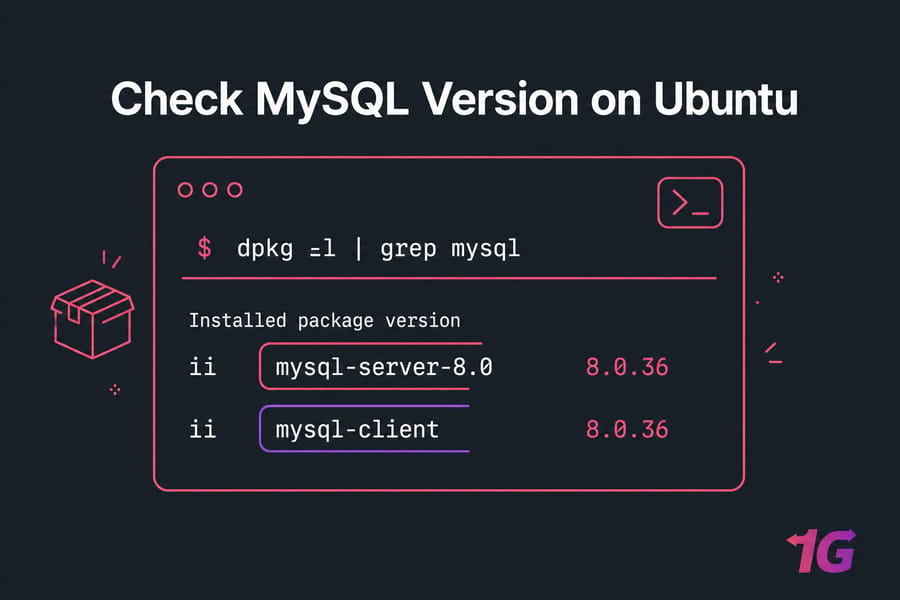
dpkg -l | grep mysql          # Debian / Ubuntu
rpm -qa | grep mysql          # CentOS / RHEL
yum list installed | grep mysql
dnf list installed | grep mysql
Setting up a fresh box? Here's how to install MySQL on Ubuntu or install MySQL on CentOS.
Checking Whether MySQL Is Installed
which mysql
systemctl status mysql
service mysql status
🍎 How to Check MySQL Version on macOS
Using Terminal
which mysql
mysql --version
Checking Homebrew Installations
brew list | grep mysql
brew info mysql
Homebrew installs to /opt/homebrew/bin on Apple Silicon and /usr/local/bin on Intel. If which mysql returns nothing, that's your PATH again.
🌐 How to Check MySQL Version in phpMyAdmin
Checking the current MySQL version via phpMyAdmin might be a good alternative if you feel that running commands from the command line is not your cup of tea. phpMyAdmin offers a practical, user-friendly interface for managing databases.
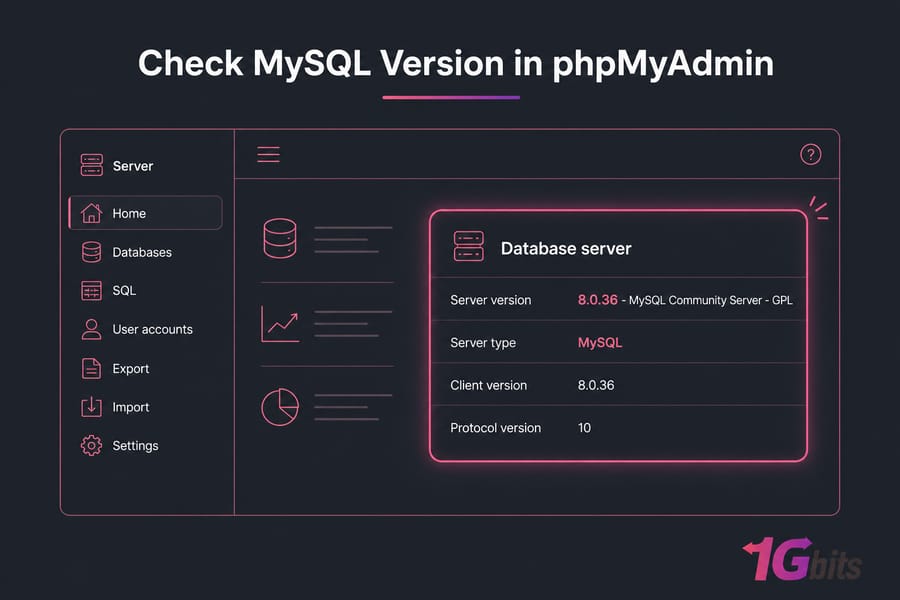
- Log into phpMyAdmin (via cPanel, localhost, or your hosting panel).
- Click the server name in the left sidebar to reach the home screen.
- Look at the Database server panel on the right.
- Read the Server version line — for example
8.0.36 - MySQL Community Server - GPL.
That same panel lists the client version separately, plus the protocol version. No SQL needed. For those looking for streamlined management, utilizing a cPanel VPS can significantly simplify the process of accessing phpMyAdmin and monitoring your database server stats.
📊 Determine MySQL Version Using dbForge Studio for MySQL
One of the greatest tools for database management, maintenance, and development is dbForge Studio for MySQL. While using the dbForge MySQL GUI tool, you may quickly check the version of MySQL that is currently running. There are two methods for doing this:
- While modifying connection settings, you first receive information about the MySQL server version. Enter connection parameters in the Database Connection Properties window, then click Test Connection.
- After connecting, you can check your MySQL version by right-clicking the connection name inside Database Explorer and choosing Properties.
🖥️ How to Check MySQL Version in Workbench
- Open Workbench and connect to your instance.
- In the Navigator pane, switch to the Administration tab.
- Click Server Status.
- The version appears next to Server Version, alongside host, port, and uptime.
Faster alternative: open a query tab and run SELECT VERSION();. Two seconds, same result.
📦 How to Check MySQL Version in XAMPP
- Launch the XAMPP Control Panel and start the MySQL module.
- Read the log window — the startup line prints the version.
- Or click Shell and run
mysql --version. - Or open
http://localhost/phpmyadminand read the Database server panel.
Here's the gotcha that trips up nearly everyone: modern XAMPP ships MariaDB, not MySQL, even though the control panel still says "MySQL." So SELECT VERSION(); might return something like 10.4.32-MariaDB. That's normal. If you are learning development and need a controlled environment, you might consider setting up a Linux VPS to host your own projects rather than relying solely on local stacks like XAMPP.
🔍 How to Check If MySQL Is Installed
On Windows
Run where mysql in CMD, or check Services (services.msc) for an entry named MySQL80. You can also look for the install directory under Program Files.
On Linux and Ubuntu
Run which mysql, then systemctl status mysql. The package manager checks above confirm it independently.
On macOS
Run which mysql and brew list | grep mysql. Also check System Settings for a MySQL preference pane if you used the Oracle installer.
Once it's confirmed installed, the next step is usually to create a MySQL user instead of running everything as root.
📊 Comparison of Methods
| Method | Works Without Login? | Shows Server Version? | Best For |
mysql --version |
Yes | No (client only) | Fastest local check |
mysqld --version |
Yes | Yes | Server binary on Linux |
mysqladmin version |
No | Yes | Server details plus uptime |
SELECT VERSION(); |
No | Yes | Remote servers, any client |
SHOW VARIABLES LIKE 'version%'; |
No | Yes | Full detail, MariaDB detection |
| phpMyAdmin / Workbench | No | Yes | GUI users, shared hosting |
⚠️ Common Problems When Checking MySQL Version
mysql Command Not Found
PATH problem, nine times out of ten. Locate the binary (where mysql on Windows, find / -name mysql -type f 2>/dev/null on Linux) and add its directory to PATH.
Access Denied When Connecting
Wrong credentials, or the user lacks privileges. On many Ubuntu installs, root uses socket authentication — try sudo mysql with no password.
Different Tools Show Different Versions
Multiple installations. XAMPP's bundled MariaDB, a Homebrew MySQL, and a Docker container can all coexist happily on one machine. Inside Docker, run docker exec -it mysql-container mysql --version to check that specific instance.
🚀 How to Find the Most Recent Version of MySQL
What is the most recent version of MySQL? I won't hardcode a version number here — it'd be stale in a month. Check the official MySQL release notes and the MySQL downloads page instead. Oracle now splits releases into LTS tracks (stable, long support windows) and Innovation tracks (new features, shorter lifecycle). For production, pick LTS. Always skim the release notes for breaking changes before upgrading.
💡 Pro Tips for Database Management
- Always perform a full database backup before initiating any version upgrade.
- Monitor your server resource usage regularly to ensure the MySQL version isn't causing performance bottlenecks.
- Use staging environments to test compatibility before updating your production database.
🏁 Conclusion
Millions of businesses and professionals utilize the incredibly well-liked open-source RDMS MySQL. Knowing which version of MySQL you're running while using it to manage databases is crucial. Quick local check? mysql --version. Remote or managed server where you only have a database connection? SELECT VERSION();. GUI person? phpMyAdmin's home screen or Workbench's Server Status panel. XAMPP user? Check the control panel log, and don't panic when it says MariaDB.
When the numbers disagree, remember it's client versus server — that single distinction explains most of the confusion around this task. Happily, both Linux and Windows make it easy to determine the version of MySQL. For a deeper understanding of the differences between MySQL and its alternative, MariaDB, check out our detailed comparison in the article "MySQL vs MariaDB." Curious about the naming? See our explainer on SQL vs MySQL.

Leave A Comment