

Running your own Ethereum node is one of the most powerful ways to participate in the blockchain ecosystem. Whether you’re a developer testing smart contracts, a validator securing the network, or a business seeking full data transparency, hosting an Ethereum node gives you direct control over blockchain access:without relying on third-party services.
However, the challenge lies in infrastructure. Running a node at home introduces bandwidth limits, hardware costs, noise, heat, downtime, and security risks. That’s why most professionals today rely on a VPS for Ethereum node: a virtual private server optimized for 24/7 uptime, high bandwidth, fast SSD storage, and scalable performance.
In this guide, we’ll explore:
-
What an Ethereum node is and why you should run one
-
Different node types:full node, archive node, validator node:and their VPS requirements
-
A comparison table of essential VPS specs for Ethereum
-
The Best VPS for blockchain nodes in 2026
-
How to choose between Ethereum full node VPS providers and VPS for running Ethereum archive node setups
-
Internal setup tips, security practices, and more
Before diving into setup, let’s quickly compare the baseline hardware requirements.
VPS Hardware Requirements for Ethereum Nodes (Comparison Table)
To help you choose the right Ethereum node hosting VPS configuration, here’s a practical breakdown of the minimum and recommended resources depending on node type.
|
Node Type |
Recommended CPU |
RAM Requirement |
Storage Type & Capacity |
Bandwidth |
Ideal VPS Option |
|
Full Node |
4+ vCPU |
8–16 GB |
1 TB NVMe SSD |
Unlimited / 1 Gbps |
Ethereum full node VPS providers such as 1Gbits |
|
Archive Node |
8+ vCPU |
32–64 GB |
2–6 TB NVMe SSD |
High-speed 10 Gbps |
VPS for running Ethereum archive node |
|
Validator Node (Staking) |
4 vCPU |
16 GB |
1 TB SSD |
High-Uptime Network |
Dedicated VPS for Ethereum node with redundancy |
Want an in-depth breakdown? Read Optimizing Your Crypto Operations With Ethereum VPS on 1Gbits to learn how professionals fine-tune node hosting for peak results.
What Is an Ethereum Node and Why Run One?
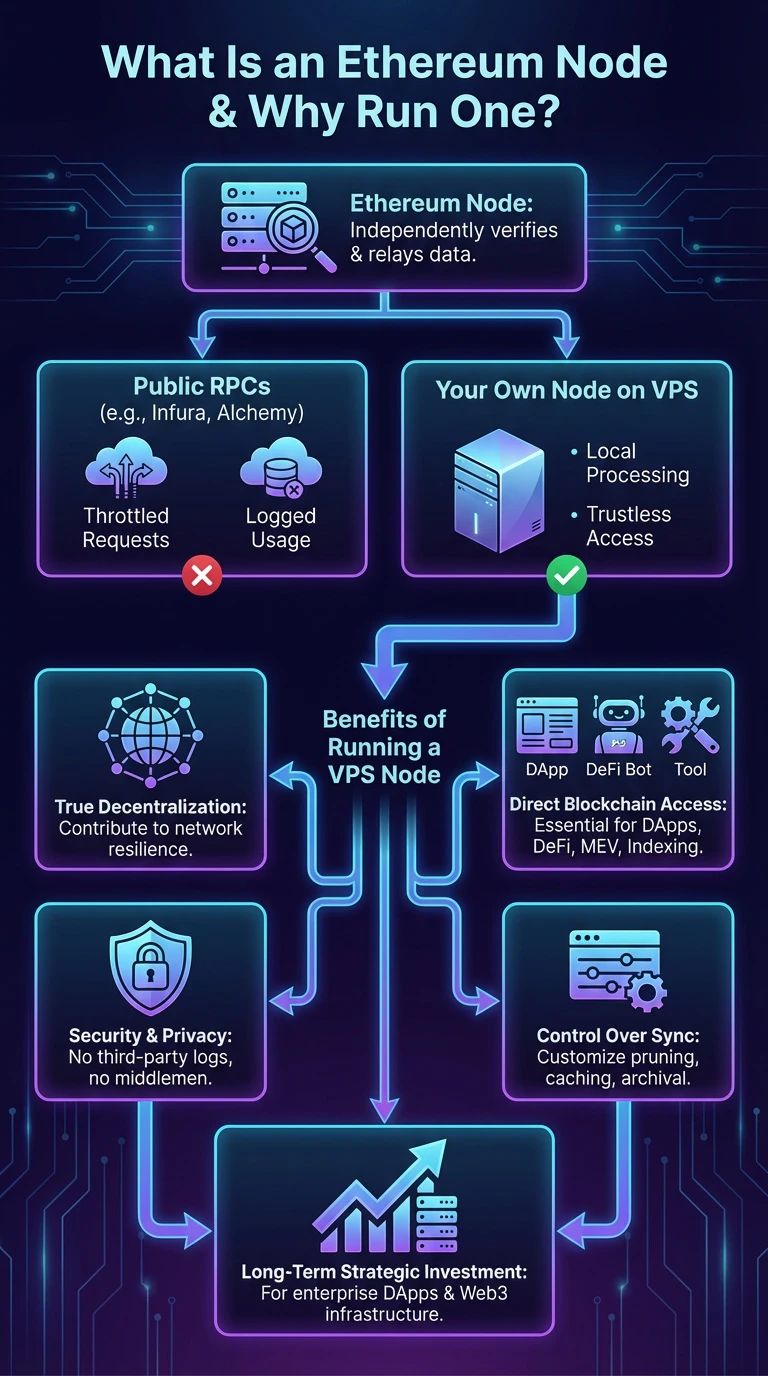
An Ethereum node is a server that independently verifies and relays blockchain data. Instead of relying on public RPC providers like Infura or Alchemy; which may throttle requests or log your usage; you process transactions locally and access the network trustlessly.
Running a VPS for Ethereum node provides:
- True decentralization: You contribute to network resilience.
- Direct blockchain access: Essential for DApps, DeFi bots, MEV tools, and indexing services.
- Security & privacy: No third-party logs, no middlemen.
- Control over sync settings: Customize pruning, caching, or archival preferences.
If you're running an enterprise-level DApp or simply experimenting with Web3 infrastructure, owning your node on a high-performance Ethereum node hosting VPS is a long-term strategic investment.
Types of Ethereum Nodes and Their VPS Requirements
Not all Ethereum nodes are the same; and your VPS selection must align with your goal. There are three major types to consider:
1. Full Node: For Developers & DApp Operators
A full node downloads the current state of the blockchain and validates transactions. It does not retain historical state (older smart contract storage values), which makes it lighter than archive nodes.
-
Ideal for: Smart contract testing, wallet infrastructure, DeFi integrations
-
VPS Requirements: 4 vCPU, 8-16 GB RAM, 1 TB SSD
-
Best Hosted On: Ethereum full node VPS providers like 1Gbits
Looking to deploy one now? Check out our ethereum vps hosting plans designed specifically for full-node users.
2. Archive Node: For Data Analytics & Indexing Services
Archive nodes store every historical blockchain state, making them crucial for:
-
Block explorers
-
Data researchers
-
Analytics dashboards (e.g., Dune, Nansen clones)
-
Institutional-grade monitoring
However, they require large amounts of storage and strong CPUs. That’s why choosing the right VPS for running Ethereum archive node is critical.
-
VPS Requirements: 8+ vCPU, 32–64 GB RAM, 3–6 TB NVMe SSD, 10 Gbps bandwidth
-
Suitable For: Enterprise-grade infrastructure, chain indexing
3. Validator Node (Staking): For Passive Income Operators
Ethereum 2.0 introduced staking, allowing users to earn rewards by validating blocks.
-
Requires 32 ETH deposit to activate a validator
-
Must be online 24/7, or you risk penalties (slashing)
-
VPS Requirements: 4 vCPU, 16 GB RAM, SSD storage, ultra-high uptime
Tip: If you plan to stake, choose a redundant Ethereum node hosting VPS that supports backup failover.
Top VPS Providers for Running an Ethereum Node in 2026
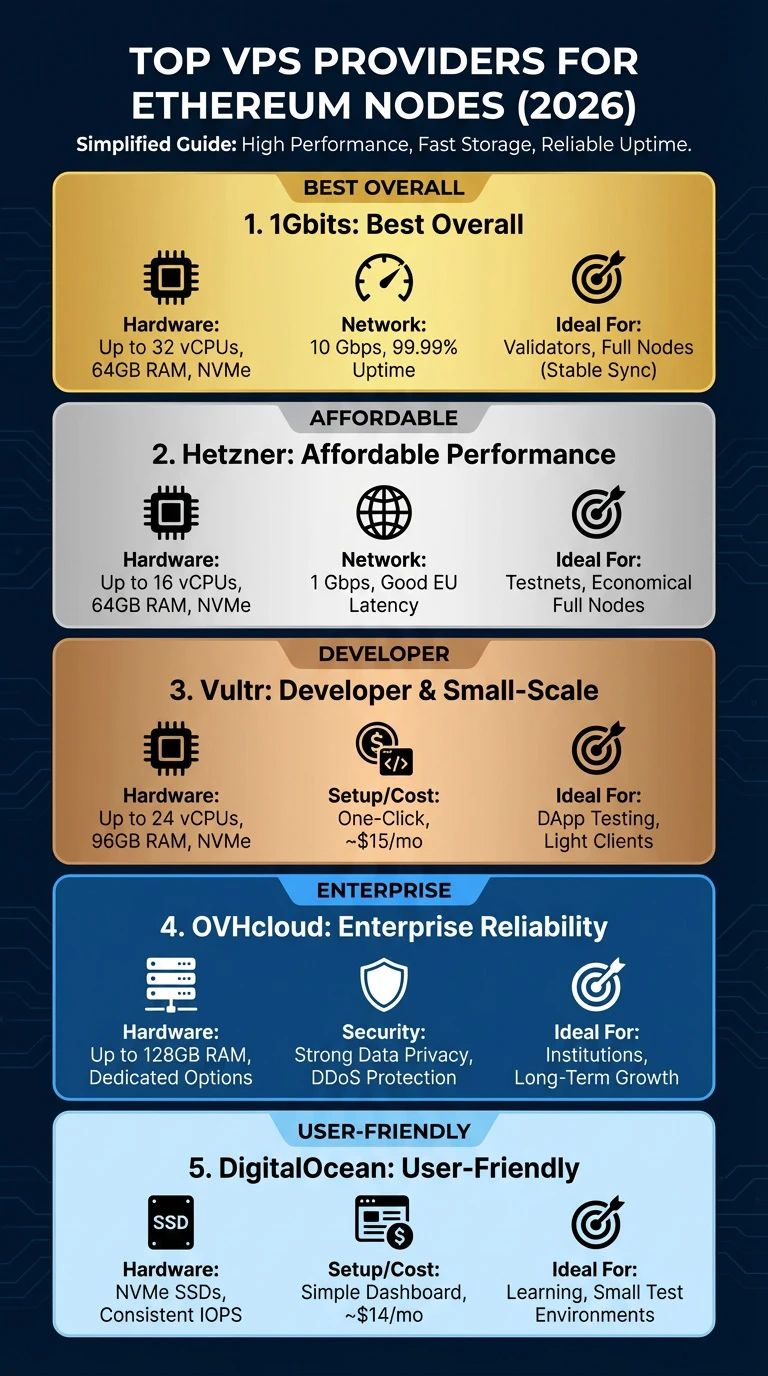
Choosing the right VPS for Ethereum node hosting is one of the most important decisions before deploying your infrastructure. Ethereum nodes are resource-intensive: they demand high CPU performance, large and fast SSD storage, excellent network bandwidth, and continuous uptime. Not all VPS providers meet these blockchain-specific requirements. Below is a detailed look at the best VPS for blockchain nodes in 2026 evaluated for technical specs, performance consistency, scalability, and cost-efficiency.
1. 1Gbits – The Best Overall Ethereum VPS Provider
1Gbits stands out as one of the few VPS providers purpose-built for blockchain workloads. Its Ethereum VPS plans are optimized for full nodes, archive nodes, and validators, offering unparalleled reliability and speed.
Key Highlights:
-
Hardware Specs: Up to 32 vCPUs, 64 GB RAM, and NVMe SSDs with read/write speeds exceeding 3000 MB/s.
-
Network: 1–10 Gbps unmetered bandwidth with 99.99% uptime SLA.
-
Security: Enterprise-grade firewalls, DDoS protection, and dedicated IPv4/IPv6 addresses.
-
Ease of Setup: Ready-to-deploy Ethereum VPS images with preinstalled dependencies.
-
Support: 24/7 technical assistance and blockchain-specific guidance.
For anyone running a validator or archive node, 1Gbits’ infrastructure ensures stability during long synchronization periods. Its VPS for running Ethereum archive node plans are built for high disk I/O operations, avoiding the slowdowns that often occur on traditional cloud platforms.
You can learn more about their blockchain-focused infrastructure in Optimizing Your Crypto Operations With Ethereum VPS.
2. Hetzner – High Performance at an Affordable Cost
Hetzner is a popular choice among developers who need a balance of cost and computing power. It provides strong CPU performance and NVMe storage, making it suitable for Ethereum full node VPS providers who prioritize efficiency over customization.
Key Highlights:
-
Up to 16 vCPUs and 64 GB RAM.
-
NVMe SSDs for faster state synchronization.
-
Reliable 1 Gbps connection with strong uptime.
-
Data centers located in Germany and Finland — good latency for European users.
Hetzner’s main limitation lies in its restrictive terms for crypto-related workloads, so always verify compliance before deploying blockchain operations. However, for testnets or full node operations, it remains one of the most economical VPS for Ethereum node setups available.
3. Vultr – Ideal for Developers and Small-Scale Nodes
Vultr combines simplicity and flexibility, offering an intuitive control panel and global data centers. Its NVMe-powered instances provide stable performance for running light clients or Ethereum full node VPS providers.
Key Highlights:
-
Quick deployment with one-click startup scripts.
-
24 global data centers ensuring low latency across regions.
-
Up to 24 vCPUs and 96 GB RAM.
-
Pricing starts around $15/month, making it cost-effective for experimentation.
Vultr is excellent for developers testing DApps or running secondary nodes, though heavy-duty archive node hosting may require higher-tier instances.
4. OVHcloud – Enterprise Reliability and Strong Data Protection
OVHcloud is a trusted European hosting provider offering robust infrastructure and a strong commitment to data privacy. Its dedicated and VPS solutions are ideal for Ethereum node hosting VPS setups that demand long-term stability.
Key Highlights:
-
Powerful VPS and dedicated options with NVMe drives and up to 128 GB RAM.
-
SLA-backed 99.9% uptime guarantee.
-
Advanced DDoS protection and security monitoring.
-
Affordable bandwidth scaling for high-throughput networks.
OVHcloud excels in compliance and data resilience, making it a preferred choice for enterprise or institutional Ethereum validators. The provider’s flexible scaling options also make it suitable for long-term blockchain growth.
5. DigitalOcean – User-Friendly and Developer-Oriented
DigitalOcean offers one of the easiest deployment processes among cloud VPS providers. It’s ideal for developers running Ethereum full nodes or testing environments due to its simplicity and consistent network performance.
Key Highlights:
-
Simple dashboard and one-click app setup.
-
Global presence with reliable 1 Gbps connections.
-
NVMe SSDs with consistent IOPS.
-
Pricing starts around $14/month.
While DigitalOcean is not specifically optimized for blockchain workloads, it remains a great entry point for those learning node management or setting up smaller Ethereum test environments.
Comparison Table: VPS for Ethereum Node Hosting
|
Provider |
Max CPU / RAM |
Storage Type |
Bandwidth |
Uptime |
Best For |
|
1Gbits |
32 vCPUs / 64 GB |
NVMe SSD |
1–10 Gbps |
99.99% |
Full, Archive, Validator Nodes |
|
Hetzner |
16 vCPUs / 64 GB |
NVMe SSD |
1 Gbps |
99.9% |
Full Nodes, Testnets |
|
Vultr |
24 vCPUs / 96 GB |
NVMe SSD |
1 Gbps |
99.99% |
DApp Development, Light Nodes |
|
OVHcloud |
32 vCPUs / 128 GB |
SSD |
1 Gbps |
99.9% |
Enterprise Validators |
|
DigitalOcean |
16 vCPUs / 64 GB |
SSD |
1 Gbps |
99.99% |
Developers, Testnets |
Comparing VPS Specs for Ethereum Nodes: Choosing the Right Tier
Now that you understand node types, let’s map VPS configurations to real-world usage scenarios.
|
User Type |
Recommended Node Type |
Ideal VPS Specification |
Suggested Hosting Tier |
|
Beginner / Developer |
Full Node |
4 vCPU / 8 GB RAM / 1 TB SSD |
Entry-Tier Ethereum full node VPS providers |
|
DApp Backend Operator |
Full or Light Archive |
8 vCPU / 16 GB RAM / 2 TB SSD |
Mid-Tier Performance VPS |
|
Data Analysts / Block Explorer |
Archive Node |
16 vCPU / 32-64 GB RAM / 4+ TB NVMe |
High-Tier VPS for running Ethereum archive node |
|
ETH Staker / Validator |
Beacon + Execution Client |
4 vCPU / 16 GB RAM / High-Availability VPS |
Redundant Uptime Hosting |
How to Set Up an Ethereum Node on a VPS: Step-by-Step Guide
Running an Ethereum node on a VPS for Ethereum node may seem technical at first, but the process becomes simple when broken into clear steps. Start by choosing a reliable VPS provider optimized for blockchain workloads, such as 1Gbits, which offers the right balance of CPU, RAM, bandwidth, and storage for Ethereum nodes.
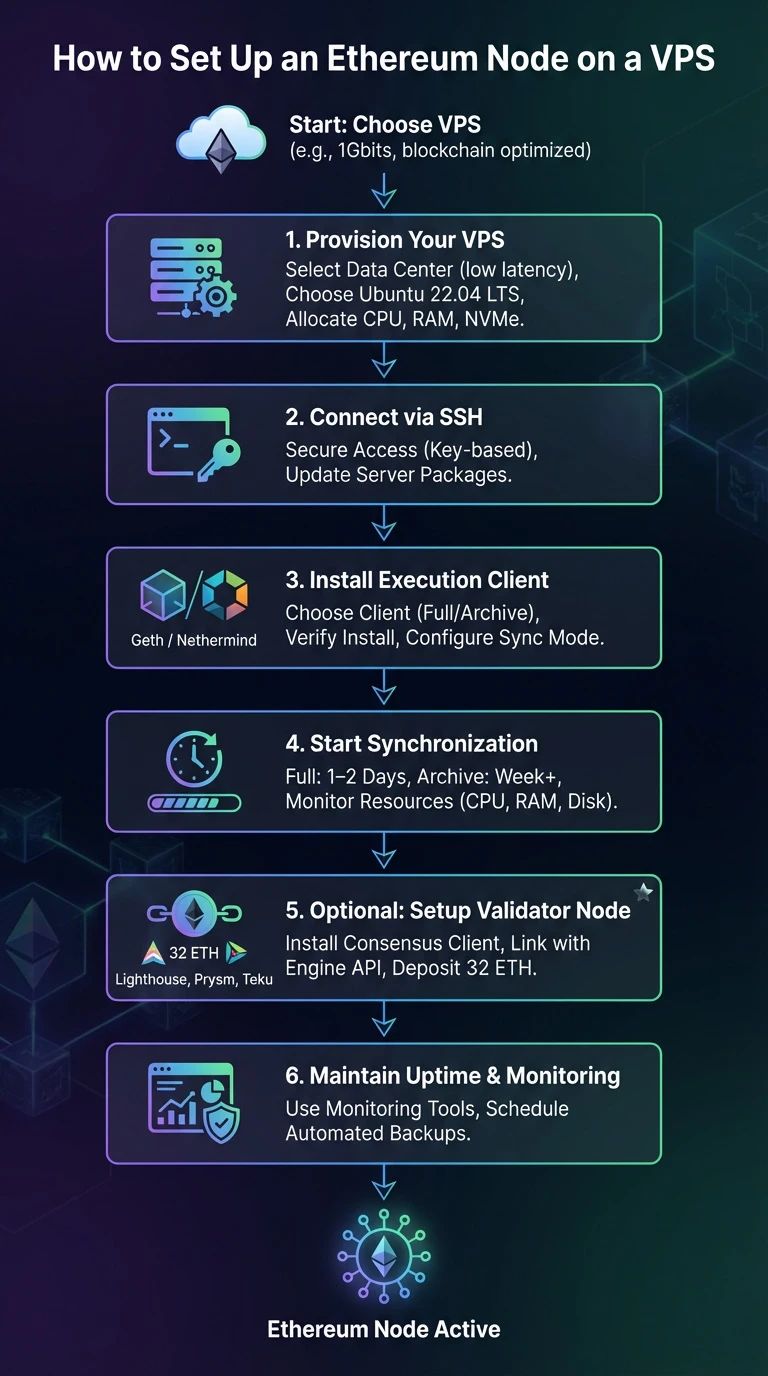
1. Provision Your VPS
- Select a data center close to your location for lower latency.
- Choose an operating system image, preferably Ubuntu 22.04 LTS for long-term support.
- Allocate sufficient CPU, RAM, and NVMe storage depending on node type.
2. Connect via SSH
- Use SSH with key-based authentication for secure access.
- Update the server packages immediately to prevent dependency conflicts.
3. Install Ethereum Execution Client
- Choose between Geth and Nethermind. Geth is widely used for full nodes, while Nethermind provides better performance for archive nodes.
- Follow official installation instructions and verify the installation.
- Configure sync mode: fast/snap sync for full nodes, no pruning for archive nodes.
4. Start Synchronization
- Full nodes typically sync within 1–2 days; archive nodes may take a week or more.
- Monitor CPU, RAM, disk I/O, and bandwidth usage to ensure smooth progress.
5. Optional: Setup Validator Node
- Install a consensus client such as Lighthouse, Prysm, or Teku after execution layer sync.
- Link execution and consensus clients using authenticated Engine API keys.
- Deposit 32 ETH to activate validator responsibilities.
6. Maintain Uptime and Monitoring
- Use monitoring tools for CPU, memory, disk, and network usage.
- Schedule automated backups and snapshots to protect data
Selecting one of the best VPS for blockchain nodes ensures reliable synchronization without interruptions, which is especially critical for archive nodes and validator operations.
Troubleshooting Sync and Storage Issues
Ethereum nodes may experience sync delays, storage limits, or connectivity issues. Understanding common causes helps keep your VPS for running Ethereum archive node operational.
-
Disk Bottlenecks: Slow block imports usually indicate insufficient disk performance. Consider upgrading to NVMe storage or higher IOPS plans.
-
Disk Space Shortages: Archive nodes grow rapidly. Monitor disk usage and expand storage before running out of space.
-
Network Instability: Dropped connections or low peer counts may result from firewall restrictions or provider network throttling. Verify peer connections and adjust node settings.
-
Database Corruption: In rare cases, the blockchain database can become corrupted. Stop the client, back up the corrupted files, and resync using a snapshot or full sync.
Using a VPS with guaranteed uptime and predictable performance minimizes most of these issues and ensures your Ethereum node runs smoothly.
Conclusion
Running an Ethereum node requires a blend of computing power, uptime reliability, and network stability. While many VPS providers can host blockchain workloads, only a few are optimized for Ethereum’s resource-intensive operations.
To summarize:
-
For best overall performance and stability, go with 1Gbits Ethereum VPS — it’s engineered for blockchain synchronization, validator uptime, and long-term scalability.
-
For budget setups, Hetzner or Vultr are solid alternatives for testnets or learning environments.
-
For enterprise-grade reliability, OVHcloud remains a trusted name with high-availability guarantees.
Before launching your node, assess your goals whether it’s for validation, development, or monitoring. Then choose a VPS plan that aligns with your hardware and uptime needs.
If you’re ready to start, explore Ethereum VPS and deploy your node within minutes using their blockchain-optimized infrastructure.

Leave A Comment